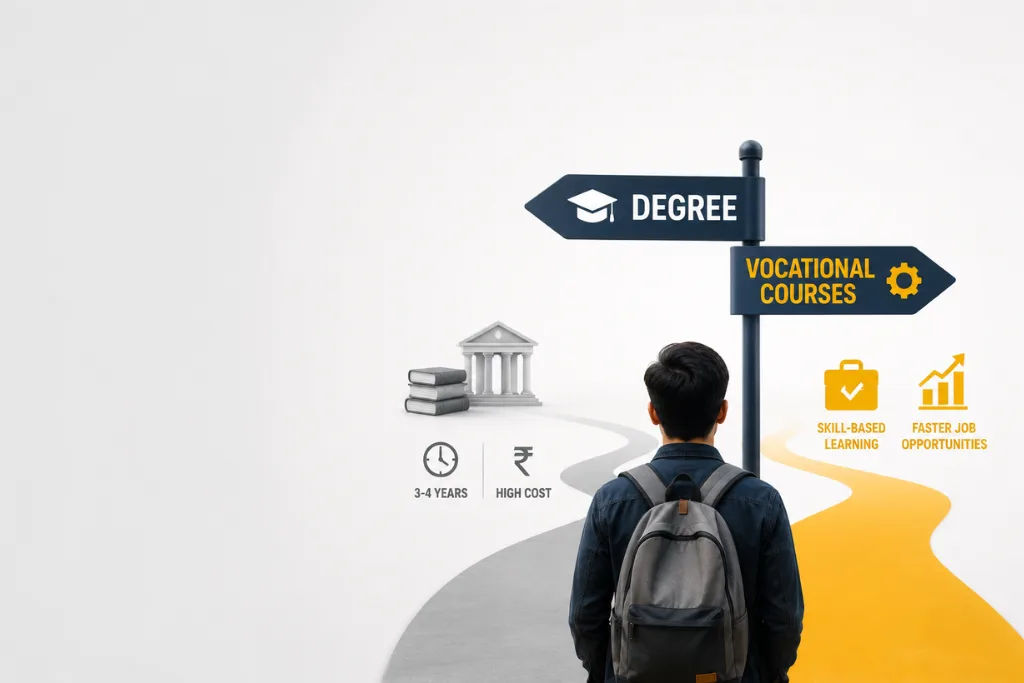
More Indian students are skipping 3-year degrees and picking 6-month skill courses instead. It’s not a trend driven by low ambition. It’s driven by math, job market reality, and a growing awareness that a degree no longer guarantees what it once did. This piece breaks down the 5 real reasons behind the shift and what it means if you’re deciding right now.
Why Indian students are choosing vocational courses — and it’s not a backup plan anymore
For years, the script was simple. Study hard. Get into a good college. Get a degree. Get a job.
That script is breaking down. And why Indian students are choosing vocational courses over traditional degrees has become a real question,because the answer says something uncomfortable about how the old path is failing a lot of people.
This is a vocational courses vs degree India conversation that’s moved from dinner-table whispers to actual enrollment numbers. Here’s what’s actually driving it.
1. Degrees stopped guaranteeing jobs — and students noticed
The numbers are hard to ignore. According to the Mercer-Mettl India Graduate Skill Index 2025, only 42.6% of Indian graduates are employable. That means more than half of the students who spent 3 to 5 years and lakhs of rupees on a degree are still not ready for the workforce by the industry’s own measure.
In the vocational courses vs degree India debate, this is the single biggest driver. When a 3-year BCom or BA produces a graduate who can’t find a job, and a 6-month digital marketing or hardware technician course produces one who can students pay attention.
The degree still carries social weight. But social weight doesn’t pay rent.
2. Skill-based education India is finally getting government backing
This shift isn’t just student sentiment. Policy is moving in the same direction.
NEP 2020 set a target of exposing at least 50% of students to vocational education by 2025. As of December 2025, vocational training is already being delivered in 25,000 schools across India, covering 35 lakh students. The vocational education India 2026 rollout under NEP includes subjects like AI, data analytics, mechatronics, and IoT starting from Grade 6.
Skill-based education India is no longer a fringe policy experiment. It’s the stated direction of the national education system. When the government backs something this visibly, it removes a lot of the stigma that previously stopped students from considering it.
3. The real reason why Indian students are choosing vocational courses: time and money
A B.Tech costs anywhere between ₹4 lakh and ₹15 lakh and takes 4 years. A vocational diploma in the same field say, embedded systems or cloud computing costs a fraction of that and takes 1 to 2 years.
That math matters enormously for students from Tier 2 and Tier 3 cities. For a family in Patna or Coimbatore, a 4-year degree with uncertain job prospects at the end is a serious financial gamble. A shorter, job-focused course with a clearer employment path is a rational choice not a consolation prize.
Why Indian students are choosing vocational courses is, in large part, a story about economic pragmatism. And the skill-based education India push is finally aligning with what students were already calculating on their own.
This also connects to something deeper about career anxiety. Read more on that in why fear of failure keeps us from growing a lot of students stick to degrees out of fear of what people will think, not because the degree is actually the better choice.
4. The job market started rewarding skills over certificates
Recruiters — especially at startups and mid-size companies — have quietly moved on from caring whether you have a degree. What they want to see is a portfolio, a certification, and proof you can do the thing.
A graphic designer with a Canva Pro certification and 50 real projects beats a fine arts graduate with no portfolio, every time. A full-stack developer who completed a credible bootcamp and built 3 apps beats a BCA graduate who’s never deployed anything.
This is the vocational courses vs degree India reality that LinkedIn profiles are starting to reflect. Skills sections now matter more than education sections for a lot of roles.
And here’s the uncomfortable part: AI is accelerating this. Someone using AI is going to take your job before AI does and that person is more likely to be the fast learner with practical skills than the graduate with theoretical knowledge and no tools experience.
5. Vocational education India 2026: the stigma is fading
This one is slower to shift, but it’s shifting.
For a long time, vocational education was seen as what you chose when you couldn’t get into college. That perception kept millions of capable students away from paths that would have served them better.
That’s changing partly because of government messaging, partly because vocational education India 2026 is producing visible outcomes, and partly because a generation of parents is watching their engineering or arts graduates struggle while their neighbour’s kid with a hotel management diploma got placed in 6 months.
If you’re a student researching the best vocational courses after 12th India, you’re in a very different information environment than students were 10 years ago. The options are better, the certifications are more recognised, and the employers are more open.
The question isn’t whether vocational training is a “lesser” path anymore. The question is whether the specific course you’re considering has good placement outcomes and industry recognition.
What this actually means if you’re deciding right now
The framing of “degree vs vocational course” is a bit too clean. A lot of students benefit from combining both starting with a skill-based course to get employed quickly, then continuing education part-time.
But if you’re weighing a 4-year degree with uncertain outcomes against a focused vocational program with clear job pathways, the calculus has changed. The degree isn’t automatically the safer bet anymore. That’s the real story behind why Indian students are choosing vocational courses in growing numbers and it’s one the education system is only beginning to catch up with.
For more on how the education and thinking landscape is shifting in India, this piece on whether we’re losing the ability to think in the AI era is worth a read.
The best vocational courses after 12th India vary by field and city. But the trend is clear: practical skills, faster timelines, and real industry outcomes are winning over the prestige of a degree that no longer guarantees much.