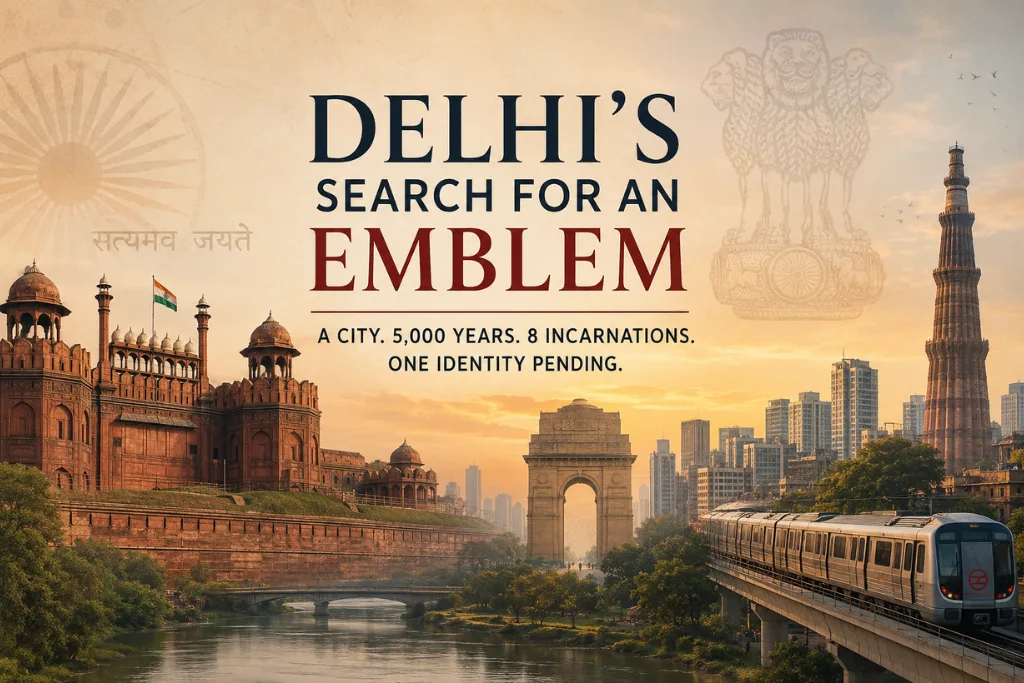
Delhi’s emblem has a strange history. India’s capital city has had more rulers than most countries. Delhi has been the seat of the Mughals, the Delhi Sultanate, the British Raj, and now the Republic of India. Empires rose and fell here. Monuments were built, torn down, and built again on the same ground. The city has been reconstructed at least 8 times over 5,000 years.
And yet, until very recently, there was no official Delhi’s emblem.
No symbol. No seal. No Delhi’s identity that said: this is Delhi, and this is what it stands for.
Chandigarh, a city built from scratch in 1952, had one from day one. Chandigarh designed its identity before the concrete dried. Delhi, one of the oldest continuously inhabited cities on earth, borrowed the national emblem and called it a day.
What is the Delhi’s emblem?
If you’ve seen an official letter from the Delhi government, you’ve seen 4 lions standing back to back on a circular base. That’s the National Emblem of India, adapted from the Lion Capital of Ashoka: a 2,300-year-old sandstone sculpture that sat atop a pillar in Sarnath, Uttar Pradesh.
India adopted it on January 26, 1950, the day the Republic was declared. The 4 lions represent courage, pride, strength, and confidence. Below them, in Devanagari script, are the words Satyameva Jayate: Truth Alone Triumphs, from the Mundaka Upanishad.
It’s a powerful symbol. It belongs to the nation.
The emblem of Delhi was never really Delhi’s own. The city just never got around to making one.
“Unlike most Indian states, Delhi has not had an official logo until now.” (CM Rekha Gupta, 2024)
Why a city of 8 incarnations had no Delhi identity of its own

Delhi’s problem is, ironically, its richness. The city has been so many things to so many people that settling on one image feels almost impossible.
Historians count at least 8 cities built on this ground, each layered over the last. The legendary Indraprastha from the Mahabharata, believed to have stood near present-day Purana Qila, is the oldest. Then came Lal Kot, founded by the Tomara Rajputs in the 8th century. The Delhi Sultanate built theirs. The Mughals built theirs. Shah Jahan built Shahjahanabad in 1648, what we now call Old Delhi, with the Red Fort at its heart. The British built New Delhi, commissioned in 1911 and designed by Edwin Lutyens, to project imperial permanence.
Every ruler chose a different symbol. A different aesthetic. A different city, essentially, on the same soil.
So what do you pick for the Delhi’s emblem? The Red Fort? The Qutub Minar? India Gate? The Yamuna? Each image carries a different empire’s fingerprints. Pick the Red Fort and you’re nodding to the Mughals. Pick India Gate and you’re echoing the British. The city has no single founding story the way Chandigarh does: no single architect, no single moment of creation.
The National Emblem of India: a 2,300-year-old symbol Delhi borrowed

The National Emblem of India that Delhi has used all these years has its own remarkable story.
Emperor Ashoka erected the original pillar at Sarnath around 250 BCE, at the very spot where the Buddha gave his first sermon. The 4 lions, carved from a single block of yellow sandstone, face the 4 cardinal directions. Around the base sit an elephant, a horse, a bull, and a lion, separated by Dharma Chakras. Each animal, scholars believe, represents a stage in the Buddha’s life.
The pillar lay buried for centuries. British archaeologist Friedrich Oscar Oertel excavated it in 1905. It now sits in the Sarnath Museum in Varanasi, preserved at precisely 20-24 degrees Celsius and 45-55% humidity, under round-the-clock police guard.
When India’s founders needed a national emblem in 1947, art schools across the country were asked to submit designs. Nothing worked. It was a civil servant, Badruddin Tyabji, and his wife Surayya, who proposed the Lion Capital. Surayya drew the graphic version herself. The printing press at Viceregal Lodge made the first impressions. Everyone loved it.
It became India’s emblem on Republic Day, 1950. The Heritage Lab has a detailed account of how the Lion Capital became India’s national symbol.
And Delhi, as the seat of the national government, simply kept using it. For 75 years.
Delhi’s official logo: the search for a new identity
In 2024, CM Rekha Gupta’s government launched a Delhi official logo design competition on the MyGov portal. Over 1,800 entries came in from across the country. An expert committee, chaired by the Secretary of the General Administration Department, was set up to shortlist the designs.
The plan was to unveil the Delhi official logo on November 1, 2024, Delhi Foundation Day. It got postponed. Cabinet ministers were away for Bihar elections. Then it got postponed again.
As of early 2026, Delhi’s official logo is still pending final approval.
That delay is almost poetic. A city with 5,000 years of history, still figuring out which 5,000 years to put on the letterhead.
What the emblem of Delhi needs to say
This is the harder question. A logo is just a design. But what it represents is a choice about Delhi identity, and for this city, that choice is genuinely complex.
Compare it to Chandigarh. Le Corbusier designed the Open Hand in 1948, before the city even existed. The symbol came first, then the city grew into it. The Open Hand said: we are new, we are open, we don’t carry the weight of what came before. It was a clean philosophical statement for a city born from trauma, built to look forward.
Delhi can’t do that. Delhi is the weight of what came before. Every street has a layer of history under it. The city’s identity is precisely its complexity, its contradictions, its refusal to be just one thing.
A good Delhi’s emblem probably needs to hold that tension. The ancient and the new. The Yamuna and the metro. The Red Fort and the startup offices in Gurugram’s orbit. Whatever design finally lands, it has a harder job than the Open Hand did.
The Open Hand just had to say: we begin here.
The Delhi’s emblem, whenever it finally arrives, has to say: we never really stopped.
For more on Indian cities, heritage, and culture, visit SmartMag Blogs