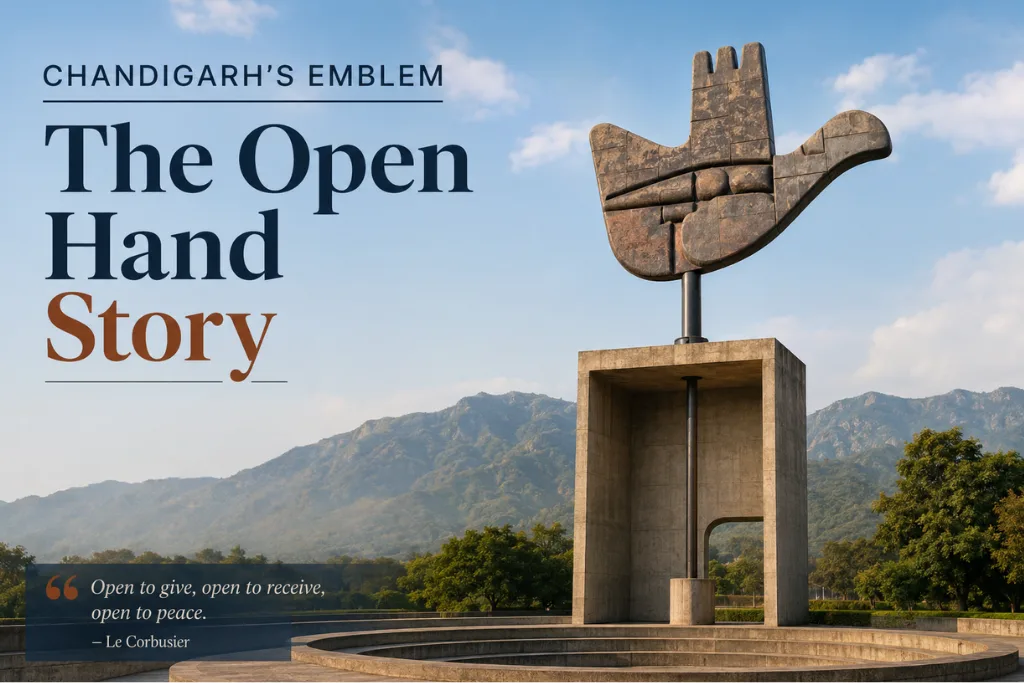
The Open Hand Monument is a 26-metre, 50-tonne rotating steel sculpture in Chandigarh’s Capitol Complex, designed by architect Le Corbusier as the official emblem of the city. Shaped like an open palm and mounted on a wind-driven pivot, it symbolises what Corbusier called “the hand to give and the hand to take” — generosity and openness, cast in metal.
Most visitors photograph it and move on. Few know it started as a private obsession three years before the architect ever set foot in the city — a recurring sketch he made obsessively, scrawled once with three words in French: La Fin d’un Monde. The End of a World.
That man was Le Corbusier. This is the story of how his sketch became a nation’s symbol.
Why Chandigarh needed a symbol at all
In 1947, Partition split Punjab in two. Lahore the province’s old capital, a city of mosques and gardens and 2,000 years of history went to Pakistan. The new Indian Punjab was suddenly without a capital. And Jawaharlal Nehru, India’s first Prime Minister, was not interested in a provisional fix.
He wanted something that had never existed before. A city built from scratch. A city that would be, in his words, “unfettered by the traditions of the past, a symbol of the nation’s faith in the future.” He told the architects: be experimental. Don’t let tradition get in the way.
American architects Albert Mayer and Matthew Nowicki got the commission first. Nowicki died in a plane crash in 1950. The project passed to Le Corbusier a Swiss-French architect who was nearly 70, who had never built an entire city, and who saw in Chandigarh a chance to finally test ideas he’d been developing on paper for decades.
“It hits you on the head and makes you think.” Jawaharlal Nehru on Chandigarh, 1959
The man behind the hand
Charles-Édouard Jeanneret he took the name Le Corbusier from a pseudonym was born in Switzerland in 1887. By the time Nehru called him, he was one of the most influential architects alive. He believed buildings should be machines for living. He believed cities should breathe. He believed concrete, used right, could be beautiful.
He wasn’t an easy person. Complicated politics, complicated ego. But in Chandigarh, he found something rare: a client who gave him real freedom.
He focused on the Capitol Complex the governmental head of the city. The Secretariat, the High Court, the Palace of Assembly. Grand buildings in raw concrete, sitting against the Shivalik foothills. His cousin Pierre Jeanneret handled day-to-day construction, living in Chandigarh for over a decade while Le Corbusier flew in for a few months each year.
Where the idea of the Open Hand came from
Le Corbusier first sketched the Open Hand Monument in 1948 before he ever saw Chandigarh. He’d been thinking about the image for years, rooted in his broader philosophy: architecture wasn’t just about buildings, it was about expressing the human condition.
The open palm, in his thinking, held 2 meanings at once. It was “the hand to give and the hand to take.” Generosity and receptivity. An open hand doesn’t grab. It doesn’t point. It holds things and offers them back.
He presented the idea to Nehru during his first visit to India in 1951. Nehru liked it reportedly considered it for the Non-Aligned Movement. But Le Corbusier had a specific vision: the hand placed at the Capitol Complex, facing the Himalayas, rotating with the wind. A weather vane that carried a philosophy.
“Open to give, open to receive, open to peace.” Le Corbusier on the Open Hand
He sketched the concept for the 75th anniversary of Nehru’s birth in 1964. In that sketch, the hand would shine in 4 colours: yellow, red, green, and white. Vitality. Life. Peace. Above the drawing, he wrote La Fin d’un Monde the end of empire, the end of old hierarchies, and the beginning of something else.
The logic of a spinning emblem
Most civic symbols are static. A coat of arms. A lion. A pair of wheat sheaves. The Chandigarh’s emblem moves.
That’s not incidental it’s the whole point. The hand is mounted on a pivot and turns like a weathervane, always facing into the wind. The direction changes; the hand’s openness doesn’t. Ideas come from different directions. The city receives them all.
The physical structure is industrial in its honesty: sheet metal, a steel column, a pivot mechanism. No ornamentation. A functional object that happens to mean something. Very Corbusier.
Below it, he designed what he called a “contemplation hollow” a sunken amphitheater, 5 metres below ground level, where citizens could gather to talk about public affairs. Far from officials. Just people, the hand above them, and the mountains beyond.
| Detail | Fact |
|---|---|
| Designed by | Le Corbusier (Charles-Édouard Jeanneret) |
| Height | 26 metres (85 feet) |
| Weight | ~50 tonnes |
| Material | Industrial-grade metal sheets on a steel pivot |
| Location | Capitol Complex, Sector 1, Chandigarh |
| Concept year | 1948 (first sketch); 1964 (formal submission) |
| Physical build | Completed 1972, after Le Corbusier’s death in 1965 |
| UNESCO status | World Heritage Site (Capitol Complex), 2016 |
| Meaning | The hand to give and the hand to take; peace and unity of mankind |
| Official role | Emblem of the Government of Chandigarh |
From dream to emblem
Le Corbusier died in 1965, before the physical monument was erected. The structure was finally built in 1972, seven years after his death. By then, the Open Hand Monument Chandigarh had already become synonymous with the city appearing on government seals, building facades, and city signage across Punjab.
In 2016, the Capitol Complex received UNESCO World Heritage designation, part of a global nomination covering 17 Le Corbusier buildings across 7 countries on 3 continents. The Open Hand was specifically cited as highly representative of Corbusier’s architectural philosophy.
Today it’s on every official document the Chandigarh Administration issues. Children in the city grow up with it. Most couldn’t tell you exactly what it means. That’s probably fine. Symbols work even when you can’t articulate them.
Why it still matters
Chandigarh was built as India’s argument that modernity and identity weren’t opposites. That a country emerging from colonialism could design its own future. The Open Hand was Le Corbusier’s argument inside that argument: the future should be open-palmed, not clenched.
The context in 1952 was specific. A partition that had just displaced millions. A country sorting out what it was. A city full of refugees trying to rebuild. An open hand, in that moment, carried real weight.
Most cities get crests with lions on them. Chandigarh got a 50-tonne sculpture that spins with the wind, designed by one of history’s greatest architects as the summary of his entire philosophy. Not bad, Chandigarh.
Visiting the Open Hand Monument
The monument stands in Sector 1 of the Capitol Complex, Chandigarh, and is open to visitors 10 AM–5 PM on weekdays. It’s part of the UNESCO-listed Capitol Complex, so entry to the surrounding grounds may require prior permission or ID, check with the Chandigarh Tourism office before visiting, since access rules around government buildings can change.
In short: the Open Hand is a 50-tonne, 26-metre rotating sculpture designed by Le Corbusier, built in 1972, and now the official Chandigarh’s emblem, a working symbol of openness sketched by one man decades before it ever stood.
For more articles on Indian culture, cities, and heritage, visit SmartMag Blogs.