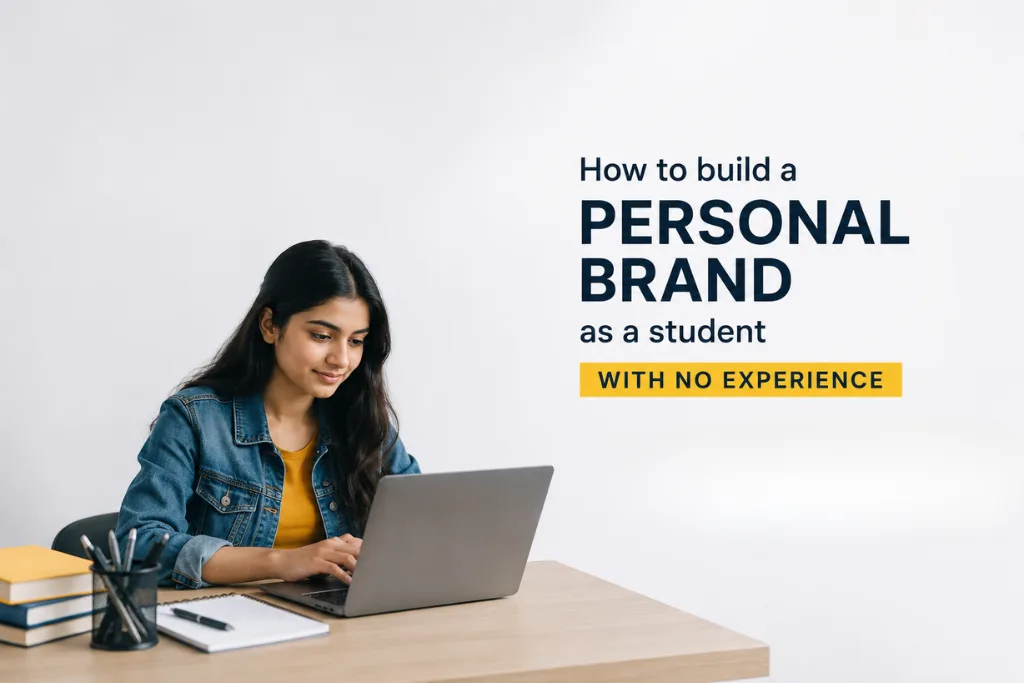
Most students think personal branding is something you do after you’ve achieved things. Building a personal brand for students is actually how you get the opportunities that lead to achievements.
A personal brand is just a clear, consistent signal about who you are and what you’re good at. You don’t need experience to start. You need a direction and a platform. 80% of recruiters consider personal branding important when evaluating candidates, and 70% of employers say it matters more than a resume. If you’re waiting until you “have something to show,” you’re already behind the people who started early.
Here’s how to build it from zero.
How to build a personal brand as a student: 5 steps that actually work
Step 1: Pick one thing to be known for (the first rule of how to build a personal brand as a student)
The biggest mistake students make is trying to be everything at once. Marketing student who also codes, plays guitar, and is passionate about sustainability. That’s not a brand. That’s a bio.
How to build a personal brand as a student starts with picking one thing you want to be known for, at least for now. It doesn’t have to be your final answer. It just needs to be specific enough that when someone lands on your LinkedIn profile, they immediately understand what you do.
Fill in this sentence: “I’m a [year] [course] student interested in [specific field]. I share content on / work on [specific topic].”
That one sentence becomes your north star for everything else.
Step 2: Choose one platform: student personal branding tips start here
You don’t need to be everywhere. You need to be consistent somewhere.
For most students in India, LinkedIn is the right call. Recruiters are there. Alumni are there. The content bar is lower than people think, and a post that gets 12 likes on Instagram might reach 3,000 people on LinkedIn because of how the algorithm works.
If you’re in a creative field like design, writing, or photography, Instagram or a portfolio site makes more sense. If you’re in tech, GitHub is a personal brand in itself. Consistent commits, public projects, a clean README on each repo. That tells a hiring manager more than any cover letter.
The student personal branding tips that actually stick all point to the same thing: pick one platform, commit to it for 60 days, then decide if you want to expand.
This pairs directly with our LinkedIn tips for freshers in India if LinkedIn is where you’re starting.
Step 3: Use your projects as content: online presence for students
“I don’t have anything to post” is the most common reason students give for not starting. It’s almost never true.
College projects count. Internship learnings count. A book that changed how you think about your field counts. A problem you noticed in your industry and how you’d approach solving it counts.
Online presence for students gets built from work you’re already doing, just made visible. A 2nd-year finance student who posts a weekly breakdown of a company’s quarterly results is building a brand. A design student who shares their Figma process, including what didn’t work, is building a brand. How to build a personal brand as a student without experience is really just this: document the learning, not the achievement.
Three content types that work well at this stage:
Learning in public. “I spent 3 hours trying to understand DCF valuation. Here’s what finally made it click.” That post helps other students and signals to recruiters that you think carefully about your field.
Project breakdowns. Finished an assignment or internship project? Write 150 words on what you built, what tools you used, and what you’d do differently. That’s a post.
Takes on industry news. Something happened in your field this week. You have a view on it. 3 sentences is enough.
Step 4: Show up consistently: more online presence for students tips
The students who build strong brands aren’t the ones who post the best content. They’re the ones who show up regularly over a long period.
One post a week for a year beats five posts in one week then silence. Recruiters and connections notice activity patterns. A profile with 50 posts spread across 12 months reads as genuinely engaged. A profile with 8 posts all from the same week reads as someone who tried once and stopped.
These are the student personal branding tips that separate people who get results from people who don’t. Consistency is the whole game at this stage.
Most students don’t do this because starting feels uncomfortable. Putting your thinking out there before you feel qualified is genuinely hard. That’s fear of failure doing exactly what it always does, keeping you invisible right when visibility matters most.
Post the imperfect thing. Nobody expects a 2nd-year student to have it all figured out.
Step 5: Start before you need it: personal branding for freshers India
Here’s the part most students miss. Personal branding for freshers India works best when you start before you’re actively job hunting, not during.
When you begin applying, you want your LinkedIn to already have 6 months of consistent activity. Your GitHub already has projects with commits. Your name already comes up when someone searches for you. That’s what personal branding for freshers India looks like when it’s actually working.
75% of candidates research a company’s social media before applying. Recruiters do the same thing in reverse. They look you up before they call you in. A sparse, inactive profile doesn’t just fail to impress. It actively creates doubt.
The personal brand for students who get hired early isn’t built overnight. It’s built in the 6 to 12 months before anyone is asking. Someone using AI is going to take your job before AI does. The person who gets that job isn’t necessarily more talented. They’re more visible.
Start now. Not when you feel ready.
The one thing to do today
Open LinkedIn. Rewrite your headline using the format from step 1. That’s it for today.
Tomorrow, write one post about something you learned this week. 100 words is enough.
That’s how a personal brand for students gets built. One small action at a time. No big launch. No strategy deck. Just showing up, consistently, before everyone else does.
For more on the skills that hold up as things keep changing, this piece on skills that will become more valuable as AI advances is worth reading alongside this one.
More on careers and building yourself at Smartmag.in