You wake up. Check Gmail. Navigate to work on Google Maps. Open Chrome, search something, land on a Google result. Sign into a site using “Sign in with Google.” Watch YouTube at lunch. Edit a file in Docs. By evening, your photos auto-backed up to Google Photos without you asking.
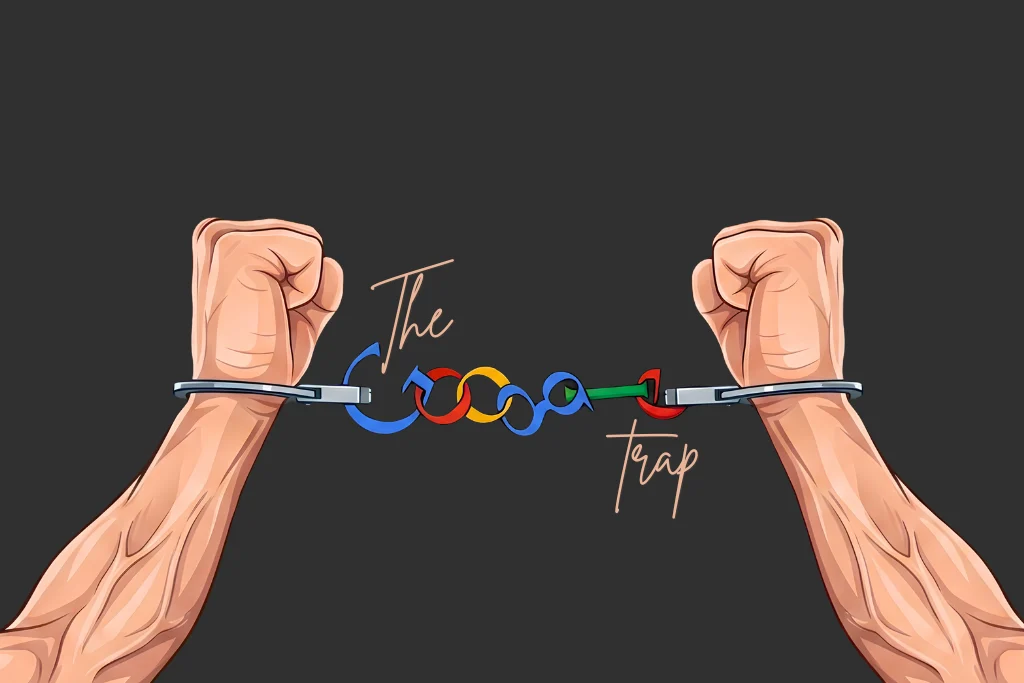
You didn’t make a single deliberate choice. You just lived a completely ordinary day inside one company’s infrastructure. That’s the Google trap.
What is the Google trap?
The Google trap is the slow process by which billions of people hand over their digital lives to one company. Not through force, but through 20 years of products that were genuinely better and always free.
As of April 2026, Google holds 90.02% of the global search market (Statista). Chrome runs on 4.16 billion devices. Android powers roughly 3 billion phones. Gmail has over 1.8 billion users. These aren’t just products. They are, for most people, what the internet actually is.
May 2026 fact
Alphabet’s full-year 2025 revenue crossed $400 billion for the first time, confirmed in Q4 2025 earnings. CEO Sundar Pichai called it “a tremendous quarter.” Google Search alone generated $224.53 billion in FY2025. Almost none of it came from charging users directly.
How the trap was built
Gmail launched in 2004 with 1GB of storage. Competitors were offering 2MB. You didn’t choose Gmail to lock yourself in. You chose it because it was obviously better.
Same logic, product by product. Maps replaced GPS devices. Chrome replaced Firefox for most people. Android put Google on 3 billion phones. Google Photos offered unlimited free storage for years. Each product was a real improvement. Each one also expanded the territory you’d have to abandon if you ever left.
The most aggressive move was controlling defaults. Getting Google to rank you matters, but Google also paid billions just to be the first thing you see, before you ever search anything.
Antitrust — verified May 2026
In August 2024, U.S. federal judge Amit Mehta ruled Google illegally monopolized the search market. The key evidence: Google paid Apple $20 billion in a single year, representing 36% of Safari’s search ad revenue, just to stay the default on iPhones. Google filed an appeal on May 22, 2026, arguing it won “fair and square.” The case is now with the U.S. Court of Appeals for the D.C. Circuit.
The 5 doors of the Google trap
1. Free products that beat every alternative
You can’t compete with $0. Google Photos gave unlimited storage for years. Gmail still gives 15GB free. When the entry price is nothing, the economic case for alternatives collapses before it starts.
2. Defaults nobody changes
Chrome is the default browser on every Android device. Google paid $26 billion total across Apple, Mozilla, and other partners just to stay the default search engine across the web. Defaults are destiny. Most users never change them, and most searches happen without a deliberate platform choice. Understanding how search defaults shape behavior is something even marketers underestimate.
3. Integration that makes switching painful
Gmail connects to Calendar. Calendar connects to Meet. Meet links to Drive. Docs lives in Drive. Every product works better because of the others. Leave one and the rest degrade. That’s not an accident. It’s the strategy.
4. Fifteen years of accumulated data you can’t easily move
After 15 years, you have a full photo archive, a complete email history, your navigation record, and saved passwords. Moving all of it is a real multi-week project. Most people never do it. That inertia is worth more to Google than any subscription fee.
Real-world example — 2021 to 2025
Google ended its unlimited Google Photos storage in June 2021 after 6 years of offering it free. Millions of users who’d built photo libraries spanning a decade had to choose: pay for Google One or migrate gigabytes elsewhere. Most paid. Google One hit 150 million subscribers by mid-2025, up from 100 million in 2024. The free tier built the dependency. The paid tier captured it.
5. “Sign in with Google” across the entire web
By becoming the authentication layer for millions of third-party sites, Google now knows which services you use, when you log in, and from what device. Your behavior across the whole web becomes part of the profile, far beyond Google’s own products.
“The switching cost isn’t a fee. It’s your inbox, your photos, your navigation history. Your life, neatly organised and stored in someone else’s building.”
The new threat in 2026: AI Overviews
The Google trap just got a new door.
As of May 2026, nearly 65% of all Google searches end without a single click to any website (Digital Applied, 2026). AI Overviews appear on roughly 25% of all queries, and when they do, the zero-click rate hits 83%.
Google is no longer just the gateway to the web. It’s increasingly the destination. You search, you get the answer, you never leave. Some sectors have seen 40 to 70% drops in organic traffic in a single year as Google’s AI absorbs the clicks that used to go to publishers.
Google I/O in May 2026 doubled down on this: new AI Mode, new Search agents that track topics over time, new interfaces built on the fly. The gap between content that ranks and content people actually read is wider in 2026 than it’s ever been, and Google controls both sides of that equation.
May 2026 fact
Gartner’s 2024 forecast predicted a 25% drop in traditional search traffic by 2026. Data tracked through April 2026 suggests that forecast is coming true, or worse. Some news and content sites have already lost 40 to 70% of organic visits in a single year.
Can you escape the Google trap?
Yes. Here’s what it actually takes.
Switch your browser to Firefox or Brave. Move search to DuckDuckGo or Kagi. Export Gmail and migrate to Proton Mail or Fastmail. Move your photos to iCloud or a local drive. Use Apple Maps or OpenStreetMap for navigation.
Each step takes an afternoon. All of them together is a 2-week project.
And the friction you feel doing it? That’s the trap working. It was designed to feel exactly this inconvenient.
What to actually do
Total escape isn’t the right goal for most people. Awareness is.
Export your Google data once a year via Google Takeout. It’s free and takes 20 minutes. Use open file formats (.pdf, .docx, .csv) where you can. Understand that your online behavior has real measurable value to companies that collect it. And know that “free” always has a cost, even when no invoice arrives.
Alphabet crossed $400 billion in revenue in 2025. You didn’t pay a rupee of it. But you helped build every single dollar.
The trap isn’t locked. Most of us just decide the room is comfortable enough to stay.
Knowing that is the first step to actually choosing.