If you have been doing SEO for any length of time, you have come across the term domain authority. But what is domain authority exactly, and does it actually affect your Google rankings?
This guide breaks down what domain authority is, how your domain authority score is calculated, what is a good domain authority score to aim for, and most importantly how to improve domain authority in a way that actually moves the needle.
What Is Domain Authority?
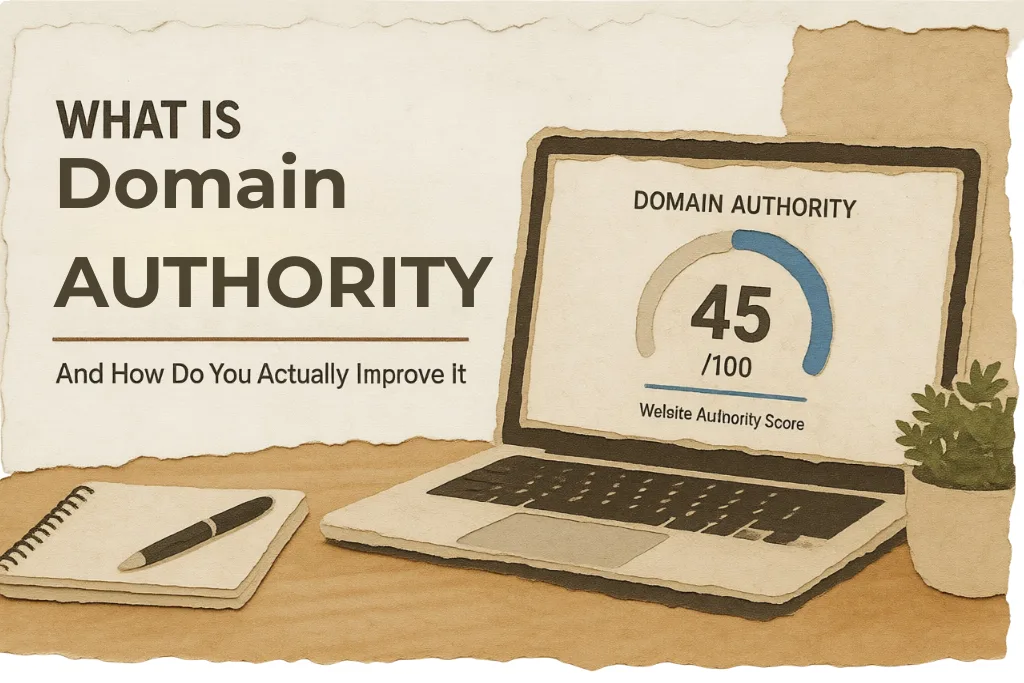
Domain authority is a score developed by Moz that predicts how likely a website is to rank in search engine results pages. The domain authority score runs on a scale from 1 to 100. The higher your score, the stronger your site’s overall ranking potential.
It is important to understand that domain authority is not a Google ranking factor. Google does not use the Moz domain authority score in its algorithm. However, domain authority SEO value is real in an indirect sense. Sites with high domain authority scores tend to have strong backlink profiles, which is something Google does factor heavily into rankings.
According to Moz, domain authority is calculated using dozens of factors including the number of linking root domains, the quality of those links, and the overall link profile strength of a website.
Think of domain authority as a useful benchmark for comparing your site’s strength against competitors, not as a direct ranking signal.
How Is Domain Authority Score Calculated?
Your domain authority score is calculated based on several factors that Moz analyses across your entire website. The most important ones are:
Linking root domains. This is the number of unique websites linking to yours. One link from ten different websites is far more valuable than ten links from the same website.
Quality of backlinks. A single link from a high domain authority site like Forbes or Wikipedia carries more weight than dozens of links from low-quality directories.
Link profile diversity. A natural link profile includes links from blogs, news sites, forums, social platforms, and industry publications. An unnatural profile with links from only one type of source can raise red flags.
Internal linking structure. A strong internal linking strategy helps distribute authority across your site and signals to search engines which pages are most important.
Your domain authority score is also relative. As the web grows and more sites earn links, scores shift across the board. This is why a score of 30 today might represent more effort than a score of 30 did five years ago.
What Is a Good Domain Authority Score?
This is one of the most common questions bloggers ask, and the answer depends entirely on your niche and competition.
There is no universal benchmark for what is a good domain authority score. What matters is how your score compares to the sites you are competing against in search results.
A general guide:
| Domain Authority Score | What It Typically Means |
|---|---|
| 1 to 20 | New or very young website with few backlinks. |
| 21 to 40 | Growing site with some backlinks and moderate authority. |
| 41 to 60 | Established site with a solid backlink profile. |
| 61 to 80 | Strong authority site, well-established in its niche. |
| 81 to 100 | Major publications, news sites, and industry leaders. |
If your competitors are ranking with domain authority scores between 20 and 35, you do not need a score of 60 to compete. You need to be close to or above theirs while producing better content.
Focus on your niche competitors, not global benchmarks. A domain authority score of 25 can rank well for low competition keywords in most niches.
Why Domain Authority SEO Matters for Bloggers
Even though domain authority is not a direct Google ranking factor, understanding domain authority SEO helps you make smarter decisions about your content and link building strategy.
Here is how domain authority SEO is practically useful:
Competitor analysis. When you do competitor content analysis, checking domain authority scores helps you understand whether a keyword is realistic for you to target right now or whether you need to build more authority first.
Guest posting decisions. When pursuing guest posts, always check the domain authority score of the site you are targeting. A guest post on a site with a domain authority score of 40 is far more valuable than one on a site with a score of 5.
Tracking progress. Domain authority score gives you a long-term metric to track your site’s overall growth beyond just individual keyword rankings.
How to Improve Domain Authority: 8 Proven Steps
Now that you understand what is domain authority and how it is calculated, here is exactly how to improve domain authority fast with actionable steps.
1. Earn High Quality Backlinks
This is the single most impactful thing you can do to increase domain authority fast. Every high-quality backlink from a relevant, authoritative website signals to Moz and search engines that your site is trustworthy.
Focus on earning links from sites with a higher domain authority score than yours. One link from a domain authority 60 site is worth more than fifty links from domain authority 10 sites.
Ways to earn quality backlinks include:
- Writing original research or data studies that others want to cite
- Creating comprehensive guides that become reference resources
- Getting featured in roundup posts and expert quotes
- Reaching out to sites that have linked to similar content
2. Guest Post on Authoritative Sites
Guest posting remains one of the most reliable ways to improve domain authority when done correctly. The key word is correctly.
Guest posting for volume is dead. One guest post on a relevant, high domain authority site is worth far more than ten posts on low-quality blogs. Always prioritise relevance and authority over quantity.
3. Fix and Remove Toxic Backlinks
Not all backlinks help your domain authority score. Links from spammy, irrelevant, or penalised sites can actually drag your score down.
Use Moz’s Link Explorer or Google Search Console to audit your backlink profile regularly. If you find toxic links, reach out to the linking site and request removal. If that fails, use Google’s Disavow Tool to tell Google to ignore those links.
4. Build a Strong Internal Linking Structure
Internal linking is one of the most underused ways to improve domain authority at a page level. When you link between your own posts using relevant anchor text, you distribute authority across your site and help Google understand your content hierarchy.
Make sure every post you publish links to at least two to three related posts and that no post on your site is an orphan page with no links pointing to it. A strong pillar and cluster structure is the most effective internal linking framework for building site-wide authority.
5. Publish Content Worth Linking To
The fastest way to increase domain authority fast is to create content that naturally attracts backlinks without you having to ask for them.
Content that earns links consistently includes:
- Original research, surveys, and data studies
- Comprehensive ultimate guides that cover a topic better than anything else
- Free tools, templates, or calculators
- Contrarian takes or unique perspectives backed by evidence
If every post you publish is similar to what already exists, there is no reason for anyone to link to you specifically. Content that ranks and content that earns links are often the same thing: something genuinely more useful than what already exists.
6. Improve Your On-Page SEO
Strong on-page SEO does not directly increase your domain authority score, but it helps your pages rank better, which increases visibility, which leads to more people discovering and linking to your content.
Make sure every post you publish follows a complete on-page SEO checklist covering title tags, meta descriptions, heading structure, image optimisation, and keyword placement before hitting publish.
7. Be Consistent With Publishing
Domain authority SEO is a long game. Sites that publish high-quality content consistently over months and years build domain authority far faster than sites that publish in bursts and go quiet.
Random content publishing without a strategy hurts your topical authority and makes it harder for Google to understand what your site is about. Stick to your core topics, publish regularly, and your domain authority score will reflect that consistency over time.
8. Get Listed in Relevant Directories and Citations
Niche-specific directories, industry associations, and local citation sites can provide relevant backlinks that contribute to your domain authority score. These are not as powerful as editorial links from high authority publications, but they add diversity to your link profile.
Focus only on directories that are relevant to your niche and have a reasonable domain authority score themselves. Avoid general low-quality link directories entirely.
How Long Does It Take to Improve Domain Authority?
This is where most bloggers get frustrated. Domain authority does not improve overnight.
For a new site, moving from a score of 1 to 20 typically takes six to twelve months of consistent publishing and active link building. Moving from 20 to 40 can take another one to two years depending on how aggressively you pursue backlinks and how competitive your niche is.
The key is not to obsess over the number week to week. Domain authority score updates periodically, not in real time. Focus on the inputs: publishing quality content, earning relevant backlinks, and building a clean internal linking structure. The score follows the work.
How to Check Your Domain Authority Score
You can check your domain authority score for free using these tools:
| Tool | What It Offers |
| Moz Link Explorer | The original DA score plus backlink data |
| Ahrefs | Domain Rating (DR), Ahrefs’ equivalent metric |
| Semrush | Authority Score, Semrush’s version of the metric |
| Ubersuggest | Basic domain score and backlink overview for free |
Note that Ahrefs uses Domain Rating and Semrush uses Authority Score. These are similar concepts to domain authority but calculated differently. All three are useful for benchmarking and tracking progress over time.
Frequently Asked Questions
What is domain authority and is it the same as page authority?
Domain authority measures the ranking strength of your entire website. Page authority measures the ranking strength of a single page. Both are Moz metrics. When people talk about domain authority SEO, they are usually referring to the site-wide score rather than individual pages.
What is a good domain authority score for a new blog?
For a brand new blog, any score above 10 after six months shows you are earning some backlinks. A score between 20 and 30 after one year is solid progress. Focus on what is a good domain authority score relative to your competitors rather than chasing an arbitrary number.
Can I increase domain authority fast without backlinks?
Not significantly. Backlinks are the primary driver of domain authority score. You can improve your internal linking and technical SEO, which helps at the page level, but to meaningfully increase domain authority fast you need external links from quality sites.
Does social media affect domain authority?
Social media links are almost always nofollow, meaning they do not directly pass link equity. However, social media increases content visibility, which can lead to more people discovering and linking to your content organically.
How often does domain authority score update?
Moz updates domain authority scores periodically, roughly every few weeks to months. Do not check it daily. Track it monthly or quarterly as a long-term growth indicator.
Final Thoughts
Understanding what is domain authority is the first step. Knowing how to improve domain authority consistently is what actually grows your site.
Focus on earning quality backlinks, publishing content worth linking to, building a strong internal linking structure, and staying consistent with your publishing schedule. Your domain authority score will reflect that effort over time.
Domain authority SEO is not about hitting a magic number. It is about building a site that is genuinely more authoritative and trustworthy than your competitors in your niche. Do that, and both your domain authority score and your rankings will follow. EOF