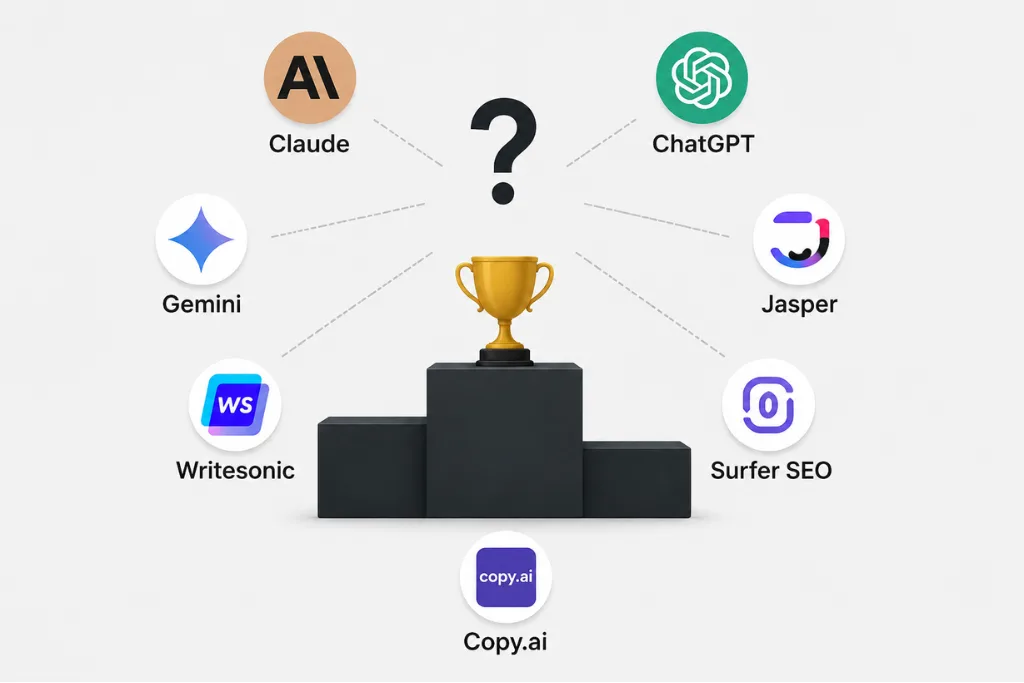
AI writing tools have multiplied faster than anyone can test them. Every week, something new claims to write better, rank faster, or think smarter. Most of it is noise.
I spent the last few months actually using these tools on real blog posts. Not demos. Not “generate a paragraph” tests. Full drafts, edits, outlines, and published pieces. Here’s what actually holds up in 2026.
What makes an AI writing tool worth using?
Before the list: a quick filter. I judged every tool on 4 things.
Output quality. Does the writing sound human, or does it smell like GPT slop? Can it hold a consistent tone across a 2,000-word post?
SEO awareness. Does it understand focus keywords, heading hierarchy, and on-page SEO basics? Tools that ignore this are useless for bloggers.
Speed. Time to usable first draft, not time to a wall of text you have to tear down.
Price vs. output. Most tools sit between $20-$50/month. What you get for that varies wildly.
The best AI writing tools for bloggers in 2026
1. Claude (Anthropic)
Claude is the best AI writing tool for bloggers who care about tone. Full stop.
It doesn’t just generate content. It can follow a detailed style guide, match your voice after a few examples, and write long-form posts that don’t feel like they were assembled from stock phrases. I gave it my own writing rules and it held them across 3,000-word drafts better than any other tool I tested.
The weak spot: it doesn’t have native SEO scoring or keyword integration. You’ll still need a plugin like RankMath to handle that side. But for pure writing quality, Claude sits at the top.
Best for: Bloggers who publish in a strong personal voice and need the AI to adapt, not override it.
Pricing: Free tier available. Claude Pro at $20/month.
2. ChatGPT (OpenAI) with GPT-4o
The most widely used tool for a reason. GPT-4o is fast, versatile, and capable of solid first drafts.
Where it falls short: the default output voice is distinctly AI. Phrases like “delve into,” “it’s worth noting,” and the endless reframe constructions (“it’s not just about X, it’s about Y”) show up constantly. Usable, but you’ll edit a lot.
The Custom GPTs feature helps. You can build a dedicated “blog writing” GPT with your style guide baked in. That narrows the gap with Claude considerably.
The new memory feature (now persistent across conversations) also makes it better for repeat users. It learns your preferences over time.
Best for: High-volume bloggers who need fast output and don’t mind editing.
Pricing: Free tier available. ChatGPT Plus at $20/month.
3. Gemini 2.5 Pro (Google)
Gemini has improved dramatically since its rough 2024 launch. The 2.5 Pro model is genuinely good at research-heavy content.
Its standout feature is real-time web access. It can pull current data, cite sources, and write posts that are factually grounded without separate research steps. For news-adjacent blogging or anything that needs up-to-date stats, this is the biggest time-saver of any tool here.
The writing style is competent but generic. Gemini doesn’t have Claude’s tonal flexibility, and it defaults to a safe, corporate register unless you push it hard.
Best for: Bloggers covering fast-moving topics who need current information baked into drafts.
Pricing: Free tier available. Google One AI Premium at $19.99/month.
4. Jasper
Jasper is purpose-built for content teams and has the workflow features to prove it.
Brand Voice is its headline feature: upload your existing posts, set your tone parameters, and Jasper applies them consistently across everything. It’s more structured than prompting Claude with a style guide, which makes it easier for teams where multiple writers are using the tool.
The SEO integration is also solid. Jasper connects directly with Surfer SEO, which means you can write and optimize in one flow rather than switching tabs.
The downside: $49/month for the Creator plan. Fine for professionals. Steep if you’re a solo blogger just starting out.
Best for: Content teams or serious solo bloggers who publish frequently and need consistent brand voice.
Pricing: Creator plan at $49/month. Teams plan at $69/month.
5. Writesonic
Writesonic occupies the middle ground: better than basic tools, cheaper than Jasper.
The Chatsonic feature is essentially a search-enabled chat interface, similar to Gemini’s real-time data approach. The SEO mode produces posts with keyword targeting built in, which makes it useful for bloggers who want an all-in-one tool.
Output quality is inconsistent. Some drafts are clean and usable. Others need heavy editing. The 2026 update improved the factual accuracy issues that plagued earlier versions, but it still trails Claude and GPT-4o on writing quality.
Best for: Budget-conscious bloggers who want integrated SEO features without paying Jasper prices.
Pricing: Free tier available. Individual plan at $20/month.
6. Surfer SEO + AI
Surfer is primarily an SEO optimization tool, but its AI writing features have caught up in 2026.
The reason to use it: no other tool on this list gives you the same combination of NLP-based keyword density analysis and AI-generated content in one place. You can see your content score update in real time as you write or generate. For bloggers who want to increase organic CTR and rank consistently, this workflow is hard to argue with.
The writing quality is mediocre on its own. Most serious users treat Surfer’s AI as a scaffold, then rewrite in their own voice. That’s an extra step, but the SEO value justifies it.
Best for: SEO-focused bloggers who want data-backed optimization baked into the drafting process.
Pricing: Essential plan at $89/month. Steep, but it’s doing the work of multiple tools.
7. Copy.ai
Copy.ai went through a full rebrand in 2025 and shifted focus toward workflows and automation. The individual writing features are still there, but the product is clearly aimed at marketing teams now.
For solo bloggers, it’s still decent for shorter content: intros, meta descriptions, email subject lines, social snippets. The blog post workflow has improved, but for long-form content it trails the top 3 tools here.
Best for: Bloggers who also run email newsletters or social media and want one tool for all short-form content.
Pricing: Free tier available. Starter at $36/month.
How to pick the right tool
Here’s the honest framework.
If tone and voice matter most: Claude. No other tool adapts to your style as well.
If SEO is your primary concern: Surfer SEO + AI, or Jasper + Surfer integration.
If you’re on a tight budget: ChatGPT free tier + RankMath is a perfectly functional setup.
If you cover current events or fast-moving topics: Gemini 2.5 Pro.
If you run a team: Jasper.
One thing worth knowing: the tools that rank highest for “AI writing quality” in benchmarks often don’t rank highest in actual blogging workflows. Context length, instruction-following, and the ability to handle a real style guide matter more than any abstract quality score.
A note on AI detection
Google has been clear that AI-generated content isn’t penalized on its own. What gets penalized is low-quality, unhelpful content, regardless of how it was written. According to Google’s own guidance on helpful content, the standard is whether content demonstrates expertise, experience, authority, and trustworthiness (E-E-A-T).
The practical upshot: raw AI output usually fails that standard. Edited, fact-checked, voice-matched content usually passes. Every tool in this list is a starting point, not a finished product.
Bottom line
Claude for voice. Gemini for research. Jasper for teams. Surfer for SEO. ChatGPT for volume.
None of them publish great posts on their own. But the right tool in the right workflow cuts your drafting time in half and gives you more room to do the part that actually matters: thinking about what’s worth saying.
That part’s still on you.