You picked a keyword. You wrote a solid post. You got the word count right, added some headers, and hit publish.
And it just… sits there. Page 4. Page 6. Nowhere.
The keyword isn’t too competitive. Your content is decent. So what’s wrong?
Most of the time, it’s search intent. You wrote the right words for the wrong page. And if you’ve been publishing content randomly, this compounds fast.
What search intent actually means
Every search has a job. Someone types something into Google because they want to do something: buy a thing, learn something, find a specific page, or figure out if something is even worth pursuing.
Search intent is just that job. What does this person actually want right now?
Google is obsessive about matching results to intent. If your page doesn’t match what the searcher wants, Google won’t show it, no matter how well-optimized it is. This is also why picking the right keywords from the start matters so much.
The 4 types (with real examples)
Informational: they want to learn something.
Search: “how does compound interest work”
They want an explanation. A blog post, a guide, maybe a video. They’re not ready to open a savings account. Show them a product page and they’ll bounce in 8 seconds.
Navigational: they want to find a specific place.
Search: “HDFC bank login”
They know where they’re going. They just want the door. You can’t rank for this unless you are HDFC bank. Don’t try.
Commercial: they’re comparing options before buying.
Search: “best accounting software for small business India”
They’re close to a decision but not there yet. They want a comparison, a breakdown, pros and cons. A product landing page won’t satisfy them. A listicle or detailed comparison will.
Transactional: they’re ready to act right now.
Search: “buy QuickBooks subscription” or “book CA consultation online”
They want a page where they can do the thing. A blog post here is the wrong answer. They want a landing page with a button.
Where small businesses get this wrong
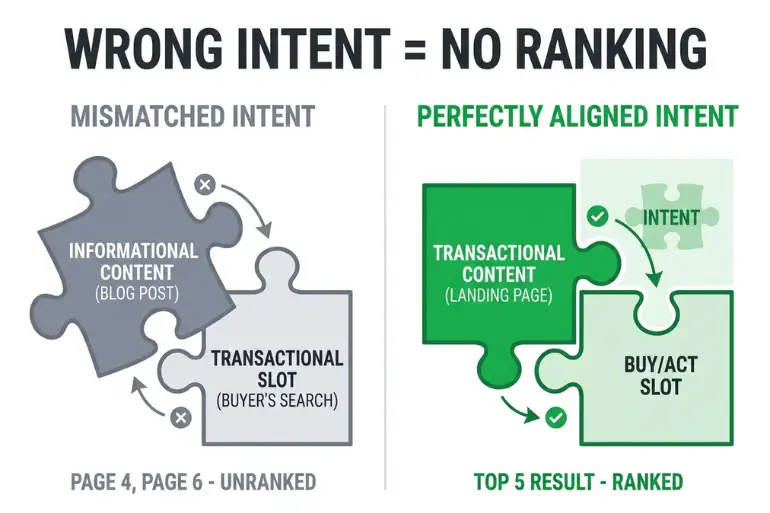
Here’s the most common mistake: writing a blog post for a transactional keyword.
Say you run a small bakery in Delhi and you want to rank for “custom cakes Delhi.” You write a blog post about the history of custom cakes and why they’re popular at weddings.
That’s an informational page for a transactional keyword. Someone searching “custom cakes Delhi” wants to order a cake. They want to see your flavors, your prices, your WhatsApp number. Your blog post sends them elsewhere.
The fix: that keyword needs a service/product page, not a blog post.
The reverse happens too. Someone searches “how to choose a wedding cake flavour” and that’s informational. If you send them straight to your order page, they’re not ready. They’ll leave. Google notices everyone leaving. Your ranking drops.
How to check intent before you write
Don’t guess. Just Google the keyword yourself.
Look at the top 5 results. Ask:
- Are they blog posts or product/service pages?
- Are they how-to guides or comparison lists?
- Are they short answers or long deep-dives?
That’s Google telling you exactly what intent it has assigned to that keyword. Match it. (Google’s own Search Quality Evaluator Guidelines are built around this idea — they call it “needs met.”)
Search “protein powder for women” — you’ll see comparison articles and listicles. Commercial intent. Search “buy protein powder online” — you’ll see product pages and brand sites. Transactional.
Same topic. Completely different intent. Different content format needed.
A real example from a service business
A freelance accountant wanted to rank for “GST filing for small business.”
She wrote a detailed guide on how GST filing works. Good content. But the top results for that keyword? All service pages. “We handle your GST filing. Contact us.” Transactional intent.
Her guide was excellent for “how does GST filing work”, an informational keyword. But she’d matched the wrong format to the wrong keyword.
She needed 2 pieces of content: one guide for the informational keyword, one service page for the transactional one. The format and content structure of each would look completely different.
Both exist. Both serve a purpose. They just aren’t the same page.
The quick audit for your existing content
Go through your posts one by one. For each one, ask:
- What keyword is this targeting?
- Google that keyword. What format are the top results?
- Does my page match that format?
If your format doesn’t match, you have 2 options: rewrite the page to match intent, or retarget it to a keyword where your format fits. A full SEO content audit will surface a lot of these mismatches at once.
Neither is wasted work. Both will move the needle more than adding another 300 words to a page that’s wrong at its core.
The short version
Google’s job is to give people exactly what they’re looking for. Your job is to be that thing.
Pick a keyword. Google it. Look at what’s ranking. Build that, but better. Then make sure what you build is content people actually want to read, not just content that ticks SEO boxes.
Intent first. Everything else second.