While many sites have regular content updates, they often fail to establish authority or any type of online presence. In many instances, the issue is not about the poor quality of their content; it is the structure of that content which hampers their progress.
When there is no coherence in the way information is arranged on a website, it makes it hard for readers and even search engine crawlers to follow. This explains why content structure can mean much more than people realize when optimizing for SEO.
Creating content in an unstructured fashion is like creating rooms without hallways. The rooms may be there but lack connection.
Just like keyword research opens doors to new possibilities, content structure will turn these opportunities into authorities.
What Is Content Structure in SEO
Content structure can be defined as the arrangement of the information on your website. This means the following:
- Topic structuring
- Relationship among the posts
- Linking between pages
- Hierarchy of content
- Flow of navigation
- How users navigate from one page to another
This will help the search engine understand:
- The purpose of your site
- The importance of different pages on the website
- How various topics are linked
- The areas where you have deep knowledge
In addition, this will improve the user experience as well because users will be able to naturally browse the website rather than bouncing off it after reading just one post.
Why Content Structure Matters for SEO
Today’s search engines are more context-based when it comes to analysing web pages. Rather than simply examining individual pages, they now assess how related content on the website is interconnected.
When your content is well-organised:
- Related pages reinforce each other
- Authoritativeness flows seamlessly via internal links
- Relevance becomes clear
- Search engines can determine your expertise
This results in stronger SEO signals in the long run.
Conversely, websites that are not well-organised tend to cause confusion rather than creating authority. The pages end up competing with each other, valuable content gets hidden, and search engines find it difficult to pinpoint the main theme of the website.
This is one of the reasons why certain websites manage to post thousands of articles but still have no success with organic traffic.
Occasionally, the problem does not lie in bad content; it lies in bad organisation.
Random Publishing Creates Structural Problems
Most sites generate content that revolves around current trends, quick ideas, or even keyword opportunities without thinking about how the topics tie together.
Eventually, this results in a scattered structure where each article has no connection with any other article.
For example:
- One article talks about SEO
- Another about finance
- Another about mental health
- And another about travel
Even if all these articles are written exceptionally well, the entire site starts losing its topical focus.
The search engine might have difficulty determining:
- What the site really excels at
- What topics hold weight for the site
- Where authority lies
This is one of the major reasons why random publishing hinders SEO success.
Most webmasters assume that writing additional articles will boost their ranking. However, the disconnection associated with such practices leads to dilution rather than authority. One small but crucial change that most websites must consider is transitioning from asking:
“What should we publish today?”
to asking:
“How does this content fit into our overall structure?”
Consistency Without Structure Creates Weak Growth
It is essential to be consistent with your content marketing efforts; however, consistency by itself does not necessarily equate success.
Many websites post numerous articles each week but fail to establish any sort of credibility as their efforts are disorganised.
Successful websites do not simply post consistently but post with purpose.
That is why it makes perfect sense for content marketing to thrive based on consistent content with underlying themes.
Publishing consistently around related topics gradually strengthens topical relevance. Publishing Regular publication on relevant topics will help develop topic relevance, while random publication will simply generate more content.
There is a big distinction between building up a content repository and developing an organized knowledge base
Search engines have started favoring the latter.
Internal Linking Is the Backbone of Content Structure
One of the most effective methods of optimizing content structure for SEO purposes is by using internal links.
Internal links assist in:
- Linking related concepts
- Navigating smoothly
- Spreading site authority
- Search engine discovery
- Creating article connections
Without internal links, even good content may become disconnected.
Consider internal links as connections between concepts.
When users read an article on low competition s and come across another piece on content structuring or orphan pages, the connection is natural and purposeful.
Search engines view such connections as indicators that the site provides detailed and relevant information.
It’s a basic principle that websites often overlook:
If pages do not link to each other, search engines will likely infer that the subject matter itself is not closely related.
Internal linking can make all the difference here.
Orphan Pages Quietly Damage Website Structure
One of the most typical issues websites experience in their structure is that of orphan pages.
Orphan pages are those with few or zero internal links leading to them.
It doesn’t matter how good your content is, but if it’s not connected to other pages in your website, then you’re doomed.
When there is lack of structure on your pages:
- The search engines will have trouble crawling it
- It won’t pass authority
- You will never receive organic traffic
- You won’t be able to engage visitors
That is why structure is just as important as publishing good content.
Every time a website publishes new content without taking into consideration where it fits within the website,
They’re creating an orphan page.
Keywords Need Structure Too
Keyword selection is vital but keywords by themselves won’t create any authority.
Topic relationships are just as critical.
As an illustration, keyword-related topics such as:
- Keyword research
- Internal linking
- Content structure
- Orphan pages
- Topic organization
naturally reinforce each other since they all fall under the same SEO topic.
This provides relevancy to your content.
Conversely, choosing irrelevant topics for the keywords over and over again makes it more difficult to establish topics.
This is the reason why low competition keywords can work wonders for SEO if only used strategically.
What happens is that people tend to pay much more attention to choosing keywords than organizing their web pages properly.
It makes it easier to rank if related topics reinforce one another rather than compete against one another.
Good Structure Improves User Experience
SEO is not only about search engines, but website structure influences user behavior too.
As soon as users can flow smoothly from page to page:
- their engagement rises
- duration increases
- trust builds slowly
- bounce rates become lower
A structured website provides for easy navigation.
No one should get confused after reading an article.
The question “What shall I read next?” comes up naturally.
It explains why many large and trusted websites tend to be user-friendly. All their articles have a certain interconnection.
- It is enough just to add:
- Links to related topics
- Clusters of similar topics
- Clear navigation
in order to change everything dramatically.
Sometimes the line between successful and unsuccessful websites depends on better organization.
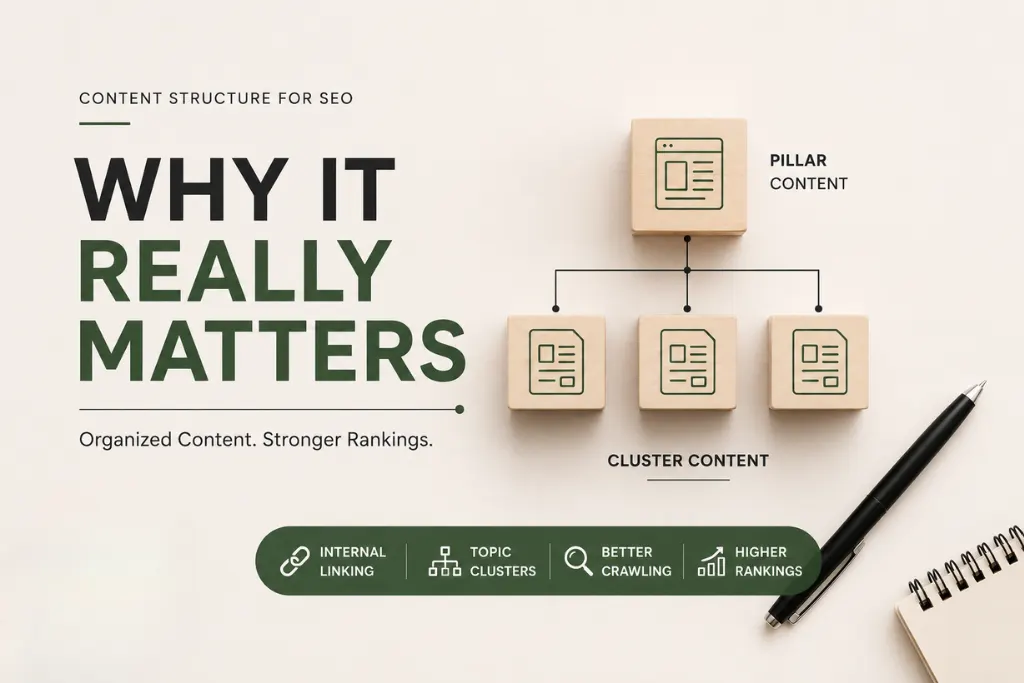
Content Hierarchy Helps Search Engines Understand Importance
Not all pages are equally important on a website.
Some pages serve as building blocks, whereas others help build around subtopics.
The result is an internal content hierarchy.
For example:
an overview piece on content organization might include information regarding:
- Internal linking
- Orphan pages
- Content clusters
- Topic authority
- Website architecture
This type of structure can inform search engines of:
- Core topics
- Related discourse
- Depth of topic
A hierarchy allows sites to have more structure and clarity.
Poor Structure Can Create Keyword Cannibalization
Another underlying problem brought about by the poor structuring of contents is cannibalization.
Cannibalization takes place when various pages have almost the same information without having any difference at all.
This causes the pages to compete among themselves rather than helping each other.
Some examples of such problems are:
- Overlap of articles
- Repetition of topics
- Ambiguous page intent
- Poor structure of content
Proper structure makes each page have its distinct role on the website.
How Google Understands Structured Content
According to Google, internal links help search engines understand the structure of a website and the relationship between pages.
Search engines look into:
- Links on-site
- Relationships contextual
- Consistent themes
- Semantics of content
- Navigation architecture
So as to understand your website better.
If multiple interlinked pages have topics revolving around similar themes, then it becomes easier for Google to detect that.
For instance, when a website covers:
- Keyword research
- On-page optimization
- Orphans
- Content organization
- Clusters
It is considered way more concentrated than one which just keeps posting random information all the time.
It does not mean sites cannot cover various categories. It just means that the more you do so, the better organized you must be.
Clarity matters.
And this is one way to get it.
How to Improve Content Structure for SEO
However, optimizing the website structure doesn’t necessarily mean you have to make extensive modifications on the technical side of things.
Here are some effective tips that will help you structure your content for SEO purposes:
Group Your Articles by Topics
Putting together similar articles helps increase topical relevance.
Enhance Internal Links
Make navigation easier for both visitors and search engines.
Don’t Isolate Content
All significant articles must link back to the site’s general structure.
Don’t Lose Focus on Your Topics
It isn’t advisable to write about entirely irrelevant subjects unless there’s a specific reason behind it.
Write Some Foundation Articles
Sometimes, you’ll need to write articles that can serve as foundations for several other pages.
Think About Your Website as a Whole
Don’t try to consider each individual article as a separate piece of content; consider its role in the entire website context.
Content Structure Supports Long-Term Authority
Authority cannot be achieved by disconnected articles.
It must be created through articles that continually tie into relevant subjects.
As search engines keep seeing:
- Related topics
- Connected relationship
- Interlinking
- Relevance
The site will gain authority.
That is why it becomes crucially important for websites to have structure as they grow in size.
Without structure, growth equals confusion.
With structure, growth equals authority.
Final Thoughts
The creation of valuable content is essential, yet without proper organization, even the most valuable articles will lose steam after some time.
With the right content structure, you not only make it easier for search engines to understand what your site is about but also give the users a better experience when visiting it. Rather than writing isolated blog posts, it’s far better to forge connections between your pages and create a system of mutual support.
Because at the end of the day, the best sites don’t survive on their separate articles but on the systems that underlie them.
And with your site becoming increasingly organized, the next step is learning how to establish your authority over certain topics rather than just writing related articles.