There are many sites that post regularly yet fail to rank well or establish authority. Most often, the problem isn’t the lack of content, but the lack of structure and connection between those content pieces. This is where Content Clusters in SEO become important, helping search engines understand topical relevance and relationships across your website.
Posting separate articles on various subjects will add more pages to a website but won’t do anything to make Google comprehend the true expertise of your site. And here comes the importance of content clusters for SEO.
In contrast to posting articles independently, content clustering groups similar topics into an interconnected structure to provide clarity for the user and the engine.
The authority of a site with interconnected content tends to be higher than a site with scattered articles, despite publishing at the same frequency.
What Are Content Clusters in SEO
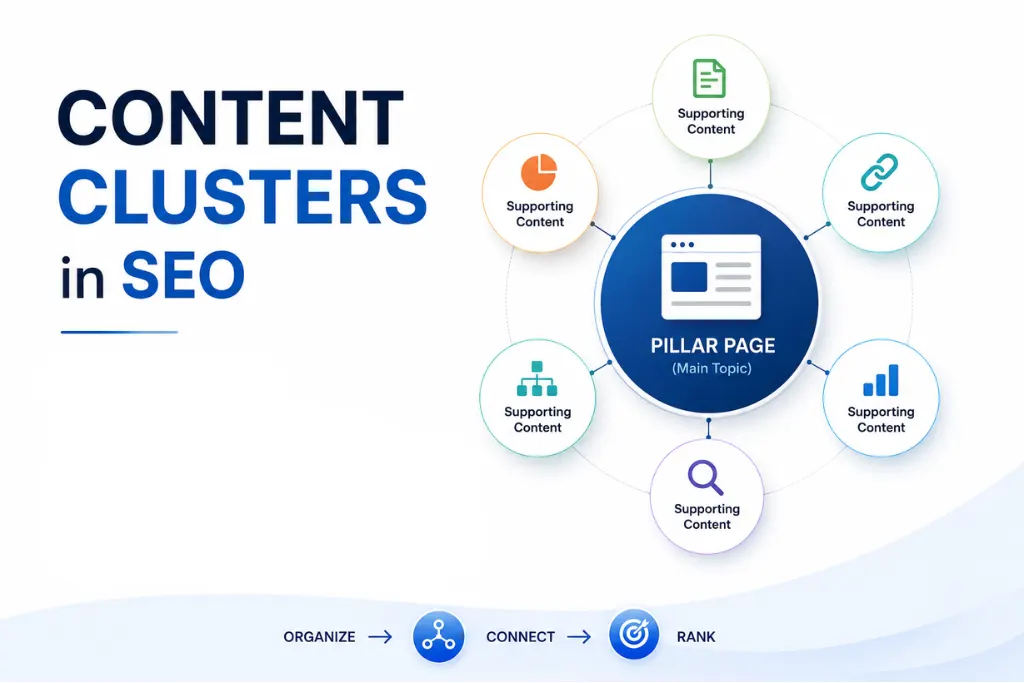
Content clusters comprise related articles that revolve around an overall central theme.
This central article is referred to as a:
- Pillar page
Or
- Central topic page
Articles that come after this include other minor topics surrounding the main topic.
For instance:
Central Topic:
- Content Marketing
Sub Topics:
- Content marketing consistency
- Random publishing
- Internal linking
- Orphan pages
- Content structure
- Keyword research
As opposed to standing alone, these articles help each other by virtue of context and links.
Why Content Clusters Matter in SEO
Search engines attempt to comprehend:
- Topic depth
- Content relationship
- Website expertise
- Contextual relevance
When several articles are interlinked and talk about topics that are interconnected, it becomes easy for Google to determine the topic or purpose of the website.
This is one of the reasons that make sites with well-organized topics outperform sites that post unrelated topics in terms of SEO.
Content clustering will help achieve:
- Topical relevance
- Internal linking
- Website structuring
- Page Authority Distribution
- Easy Navigation
It’s when content starts working towards building website authority.
Random Publishing Weakens Topic Clarity
Many websites publish articles based only on trends or temporary keyword opportunities without Considering connections between different topics.
This results in creating confusion rather than authority for that website.
A website that covers topics like:
- SEO
- finance
- psychology
- technology
- Food
with no proper structure will have a hard time establishing topic relevance.
One of the main reasons why publishing randomly can result in weaker SEO over time.
Content clustering is the solution to all this since it helps create connections between relevant topics.
Content Structure Creates the Foundation
Prior to developing content clusters, it’s imperative that the websites be well structured.
Organization ensures that the search engines will know:
- What pages are linked to each other
- What subjects work hand-in-hand
- What content sections are specialized
This is precisely the reason why content structure in SEO becomes necessary prior to creating bigger clusters.
Internal Linking Connects the Cluster Together
Internal linking is one of the most essential aspects of the implementation of a content cluster strategy.
- It allows us to
- link related articles
- direct visitors easily
- distribute the authority of a website
make it easier for search engines to recognize relationships between various pages.
Without the use of internal links, we cannot build proper content clusters.
For instance, a page talking about the basics of keyword research could logically connect to other pages, such as a page discussing content structure or orphan pages.
As Google itself suggests, it becomes easier to establish the importance of pages and their relationship by building links between them.
Orphan Pages Break Content Clusters
The effectiveness of a content cluster relies on keeping all pages connected.
Without any internal linking to those pages, they are separated from the overall topic architecture. Such pages are called orphan pages.
Valuable content pages can easily become irrelevant if they are not related to other pages on the website.
Therefore, keeping clusters connected over time becomes a crucial task as sites expand.
Low Competition Keywords Work Better Inside Clusters
Most websites tend to aim at individual keywords where there’s low competition without making any links between these keywords to form a topic.
Even if some websites rank using this strategy, the SEO potential isn’t always high in the long run.
A more effective SEO strategy would be to target relevant keywords which complement each other.
The following topics fall under the same general SEO topic:
- Internal link building for small websites
- Orphan pages SEO
- Content structure for SEO
- SEO content cluster
These are all more relevant to SEO than unrelated topics.
Search engines increasingly reward websites that demonstrate connected expertise instead of isolated information.
Content Clusters Improve User Experience
Content clustering is useful not just for search engines but also for the user experience to a great extent.
When users are able to seamlessly transition from one article to another that are relevant to each other:
- Engagement is improved
- Users stay on the page for a longer time period
- Trust develops gradually
- It is easy for them to explore more information
In contrast to getting stuck at one point after viewing a single article, users will be exploring related themes.
It helps to have a better experience while browsing through the content.
Pillar Content vs Supporting Content
An effective content cluster generally includes:
- 1 broader article
- Several supportive articles
The broader article serves as the central article, whereas the supportive articles provide insight into the smaller subtopics.
Example:
Central Topic:
- Content Cluster Strategy for SEO
Supportive Topics:
- Internal linking
- Orphan pages
- Content structure
- Topical authority
- Keyword organization
Such an approach aids the search engine in comprehending:
- Central topic
- Supportive topics
- Association of concepts
Ultimately, it leads to improved topical coherence.
Why Content Clusters Build Website Authority
Authority is hardly ever developed by a single article.
Rather, authority is typically generated through the publication of related content on consistent bases via websites.
Whenever the search engines notice:
- Related conversations
- Related relationships
- Related depth
- Related organization
their confidence in the authority of the website over that topic increases significantly.
It is because of this that content clusters are becoming increasingly relevant in SEO nowadays.
While before, SEO involved mainly the generation of lots of content, nowadays, the connections between content have become more crucial.
Sometimes, fewer content pieces that are well-connected can produce better results than numerous pieces of irrelevant content.
Common Mistakes Websites Make With Content Clusters
Content clusters are something many websites comprehend but fail to execute effectively.
Some frequent errors when executing content clusters may be:
- Creating unnecessary internal links
- Publishing similar pieces of content
- Creating content clusters that lack coherence
- Clustering topics that have no relationship to each other
- Having orphan pages in your site
producing supporting content that lacks a unifying topic direction
Content clustering should be natural and organic, not forced.
How to Start Building Content Clusters
It is not necessary to have hundreds of content pieces in your cluster right away.
Even small websites can start with:
- Selecting one main subject
- Finding sub-topics associated with the main topic
- Publishing supporting pieces slowly
- Linking the pages organically with each other
- Keeping your topics consistent
It is better for your SEO than posting unrelated topics randomly.
The key thing is having a strategic plan.
Final Thoughts
Regular publication of content is necessary, but SEO gains tend to emerge from integrated systems rather than single pieces of content.
Content clustering assists in clarifying topic connections to the search engine algorithms while simultaneously providing a more navigable experience for your audience. Rather than focusing on individual pages, clustering ensures that content is organized in a way that builds website authority through the passage of time.
The truth is that SEO ultimately requires more than just the creation of additional content; it involves making sure the search engines understand how it all fits together.
When websites become better at establishing topic connections, the logical next step is to determine how topical authority builds within a website as a whole.