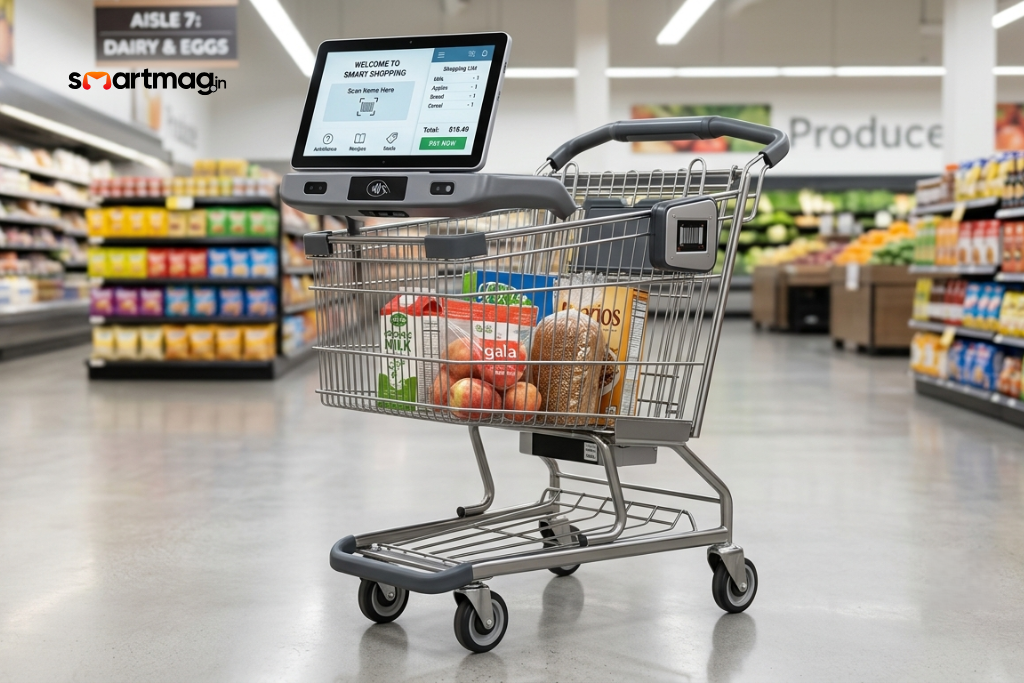
A smart shopping cart is a normal shopping trolley, augmented with sensors, cameras, a display and link to the store’s systems. It automatically detects your items, tracks the total as you shop and, in some models, enables you to pay without going to a cashier. This may seem like a minor tweak to an everyday object, but it is in fact the tip of the iceberg.
In all on the smart shopping cart: how it works, what it provides users and stores, its shortcomings, and the near future.
What Is a Smart Shopping Cart?
A smart shopping cart is a shopping trolley or basket integrated with a computer system to record the items that you place into it and tie that data to your payment method. The idea is straightforward: eliminate the most time-consuming phase of your shopping trip, the checkout counter.
This isn’t a new idea. The first demos were in the early 2000s, but the technology was expensive and out of commission. Cheap cameras, improved machine learning and the global spread of mobile payments have made it feasible to bring this technology into the real world.
Common Features
Most of the smart carts have a common feature set that includes:
-
- A touchscreen that displayed your running balance and items in your basket
- Recognition of product by cameras, weight sensors, barcodes or through RFID identification
- Guidance to store for product picks or notation for items on your list
- Related to digital offers and coupons associated with what you’re buying
- Auto-pay or send to mobile app to exit quickly
How Does a Smart Shopping Cart Work?
Below the bonnet there are three things working in tandem: recognition, observation and payment.
Identifying Products
The recognition of what goes into the cart can be done in three different ways.
Computer vision. Cameras fitted to the cart picture anything that’s added. An AI compares the image to a product library. This can be combined with weigh sensors built into the cart’s base to verify the scan, which helps to reduce errors like having two items put in together.
Barcode scan. The consumer uses a built-in or phone-based scanner to scan in every item. This is the easiest and most precise form of checkout, although it still takes work on the part of the consumer.
RFID tags. All products have a tiny radio tag on them, which the cart reads automatically. This is quick and accurate, but adding tags to all items costs more, which is why it is more widespread in clothing and electronics than food.
Tracking and Verification
Once the item is identified, the cart will then start updating its digital shopping basket. For example, when a customer takes an item away from the cart, the sensors will identify it and subtract it. Weight data can be used to verify this – if the total weight of the cart doesn’t match what it should be, it can alert a member of staff.
Paying Without a Queue
Most of the time saving takes place in the payment. Some systems require the user to pay on the cart’s display, others have the customer approve the total charge in a mobile app or at a dedicated exit lane, where the cart data is checked and the payment is processed automatically.
Advantages for Customers
For busy days, these benefits are especially apparent, but each occurs on all days.
Faster visits. The biggest perk, of course, is skipping the checkout line. Even for a quick-up store run, it can save several minutes overall.
Enhanced budget management. A live total on the screen eliminates any surprises at the register. Customers who are budgeting tightly will be able to halt the check-out process as soon as they have reached their spending limit.
Navigate more easily. A one-direction shopping cart in large supermarkets and hypermarkets can be very helpful in leading you to the correct aisle to avoid aimless wandering. It’s equally helpful for people unfamiliar with a store’s organization.
Related deals. As the cart is aware of what you’ve already purchased, it can provide deals on related items. If it’s a good thing, or just annoying is up to the user.
Advantages for Merchants
Smart carts are used by retailers for operational reasons just as much as they are for customer-facing reasons.
- Lower checkout labor. Less staff at the counters, and those remaining can be allocated to replenish stock or support customers.
- Less costly to customers. Without the checkout bottleneck, stores can accommodate more shoppers.
- More detailed information. The cart monitors which route shoppers follow in your store, the amount of time they spend in each area and what items they pick up and return to the shelf. This data helps to optimise store layout and stock planning.
- Larger baskets. Many pilot programs have seen shoppers in smart carts spend slightly more per trip, in part because of the ability to see how much they are spending and targeted deals and other incentives. Data is preliminary and between-store differences so these results should be viewed as suggestive, not prescriptive.
Problems and Limits
There’s no such thing as a perfect smart shopping cart, and it’s okay to be frank about where the weaknesses are.
Cost & Maintenance
Every cart is fitted with cameras, sensors, batteries, and a screen – adding a lot of cost to the trolleys compared to your standard shopping cart. Batteries need to be recharged, screens may get scratched, and sensors need to be calibrated. The cost may not be worth it for small stores.
Accuracy Problems
Other challenges for computer vision include same style products, loose produce or items piled on top of one another. Both misclassification types are costly: the first to the retailer, the second to the customer. Today, most systems depend on manual checks by staff to control the error rates.
Privacy Concerns
Carts capturing shopping patterns and store cameras measuring shopper presence surely have people wondering about their data. Consumers might have good reasons to want to understand what information is being recorded, how long it remains, and whether it’s being sold to ad tech companies. Policies and regional data laws are important here.
Accessibility and Habit
Not all your customers are comfortable with touchscreens and apps. Older shoppers, or those without smartphones, may find it confusing. Stores that use smart carts often continue to run regular checkouts for this reason.
Smart Shopping Cart vs. Self-Checkout vs. Cashierless Stores
These three ideas are often confused, so a quick comparison helps.
| Feature | Smart Cart | Self-Checkout | Cashierless Store |
|---|---|---|---|
| Where items are scanned | In the cart as you shop | At a kiosk, after shopping | Detected by ceiling sensors |
| Infrastructure cost | Per cart | Per kiosk | Entire store |
| Works in existing stores | Yes, easily | Yes | Usually requires a rebuild |
| Queue at exit | Minimal or none | Often present | None |
A smart cart sits in the middle. It delivers much of the convenience of a cashierless store without requiring the retailer to rebuild the building.
Where Smart Shopping Carts Are Being Used
Smart shopping carts and scan-and-go technology have been tested and implemented by major grocery chains across North America, Europe and Asia, and a handful of startups already sell them as a service to retailers. In India, organized retail is gaining steam-thanks to big-box stores and increasing adoption of digital payments, such as UPI-and a cart-friendly shopping experience seems like a logical step. But adoption remains nascent and shoppers are only beginning to see them in a few stores.
Whats Next For Smart Shopping Carts
The following is likely to be influential in the next generation:
Expense decrease. Costs for hardware will be cheaper so the cart will serve mid-sized customers, not just big box retailers.
Recognition in hand. Better models should be able to recognize loose produce and cluttered carts more accurately so that humans need not be required to double check.
Seamless shopping list and loyalty app integration. A cart will automatically check your saved shopping list and suggest replacements when an item is unavailable.
Less expensive form factors. Low-cost smart baskets and clip-on gadgets that can turn an average trolley into a smart one might be a cheaper route to the same functionality.
Conclusion
The smart shopping cart is an easy solution to an age-old problem: no one wants to wait in line. By bringing sensors, cameras, and mobile payments together, it makes the shopping experience shorter, offers consumers more discretion to control their budget, and provides retailers with valuable operational insights. But it introduces real costs, accuracy issues, and privacy concerns.
For shoppers, the best bet is to take a test ride whenever you see them, and to examine the type of data the store is gathering. For stores, the calculus is similar: size, customer demographics and the ability to keep it operating properly. As the hardware costs come down and it becomes better recognized, the smart shopping cart could go from oddity to norm.
Discover more insights on SmartMag, or write for us to share your expertise with our readers.