Every year, when the tricolour rises against the morning sky, Independence Day feels like a celebration. Schools prepare for the cultural programmes, people listen to patriotic songs, and the Prime Minister of India addresses the nation from the Red Fort. But behind this day lies a story which is far deeper than the flags, speeches, and parades.
India’s Independence Day marks the moment when the country finally broke free from British rule after a long and painful struggle. On 15th August, 1947, India became an independent nation, but freedom did not arrive in one night. It came with decades of protest, sacrifice, imprisonment, political negotiations, mass movements, and public courage.
The freedom of India was not won by one person or one event. It was shaped by farmers, students, workers, writers, leaders, revolutionaries, lawyers, soldiers, and ordinary people who refused to accept foreign control as their destiny.
Therefore, the story of Indian independence is not just about the transfer of power, but it is also about a nation finding its voice.
Why Does the Date of 15th August 1947 Matter?
15th August 1947 became the official date of India’s freedom struggle because of the Indian Independence Act of 1947. The act was passed by the British Parliament and received Royal Assent on 18th July 1947.
It made a legal provision for the end of British rule in India and the creation of two independent dominions, and those were India and Pakistan.
But the date carried more than a legal meaning. It marked the end of nearly two centuries of colonial rule and the beginning of India’s journey as a self-governing nation. For millions of people, it was the first morning of political freedom after generations of exploitation, inequality, suppression, and control.
At midnight, Jawaharlal Nehru delivered his famous “Tryst with Destiny” speech in the Constituent Assembly. His words captured the emotions behind the movement. After all, India was not just changing governments. It was stepping from colonial control into a future it would shape for itself.
The Long Shadow of British Rule in India
To understand India’s Independence Day properly, we have to understand what came before it. British rule in India began through trade, but it gradually turned into political and military control. As a result, the East India Company expanded its influence across different regions, and after the Great Revolt of 1857, power formally shifted to the British Crown.
British rule affected almost every part of Indian life. Land revenue systems were put in place to put pressure on the farmers. Indian industries, especially the textile industry, suffered a lot under colonial economic policies. Administrative decisions were being made to serve British interests more than the welfare of Indians.
At the same time. British rule also led to the creation of a new political awareness. More Indians started questioning why the decisions about their country were being made elsewhere. Newspapers, public meetings, reform movements, and early political organisations helped the people discuss rights, representation, and self-government.
This awareness slowly got converted into a national movement.
Key Events That Shaped Indian Independence
India’s road to independence was not a bed of roses. It moved through many stages, from early resistance to organised national campaigns.
| Year | Event | Why It Mattered |
|---|---|---|
| 1857 | Revolt of 1857 | One of the earliest major uprisings against British control. |
| 1885 | Formation of the Indian National Congress | Created a national political platform for Indian demands. |
| 1905 | Swadeshi Movement | Encouraged Indians to boycott foreign goods and support local production. |
| 1919 | Jallianwala Bagh massacre | Deepened anger against colonial rule. |
| 1920 | Non-Cooperation Movement | Took mass protests to towns, villages, and ordinary households. |
| 1930 | Civil Disobedience Movement | Challenged British laws through direct public action. |
| 1942 | Quit India Movement | Demanded an immediate end to British rule. |
| 1947 | Indian Independence | India became free on 15 August 1947. |
Each event made the demand for freedom stronger. By the 1940s, it had become clear that India could no longer be governed without the consent of its people.
The Role of the Quit India Movement
The Quit India Movement of 1942 was one of the most important phases in the Indian freedom struggle. Launched during the course of the Second World War, it demanded that the British leave India immediately. The movement came at a time when Britain was under constant pressure due to the war, and the Indian leaders were not ready to support the British war efforts without a clear promise of freedom.
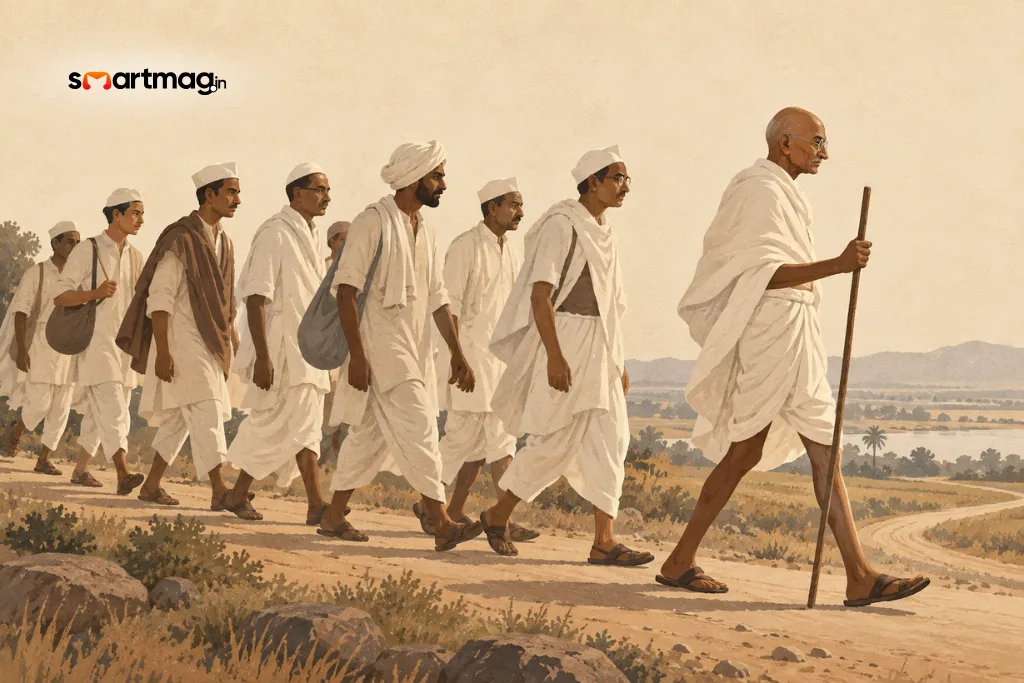
Mahatma Gandhi’s call for “Do or Die” became a powerful slogan. Many leaders were soon arrested after the movement started, but the public anger spread across the different parts of the country. Students, workers, villagers, and local activists took part in various strikes, protests, and demonstrations.
The Quit India Movement did not bring immediate freedom, but it completely changed the political mood. It clearly showed that the British rule in India could no longer depend on administrative power. Public resistance had become too widespread to ignore.
What Happened Around 15th August 1947?
The days leading up to 15th August 1947 were emotionally overwhelming. There was happiness, pride, uncertainty, and fear. Though India was gaining its freedom, at the same time it was also on the verge of partition.
On the night of 14th August 1947, the Constituent Assembly met in New Delhi, and as the clock moved towards midnight, India prepared to become independent. When the date 15th August 1947 arrived, the country formally became free.
The first Independence Day was celebrated with hope. People had gathered on the streets, public buildings were decorated, and the tricolour became the symbol of a new beginning. However, the celebrations were not the same everywhere. In many regions, especially Punjab and Bengal, freedom arrived along with violence and displacement due to partition.
Partition of India: The Pain Behind Indian Freedom
Considered as one of the most painful periods in Indian history, Partition had divided British India into 2 dominions, namely India and Pakistan. Millions of people had to cross the newly drawn borders due to their religious differences. Families left homes, land, memories, and livelihoods behind.
As per the National Archives, approximately 15 million people are thought to have migrated across the new borders during that period. The human cost was enormous. Violence, fear, and uncertainty have affected countless families.
That is why India’s Independence Day carries both pride and pain. It celebrates the end of British rule, but it also reminds us of the lives disrupted during partition. So, it would not be wrong to say that the freedom of India came with responsibility, healing, and the challenge of building unity after years of deep suffering.
What Did the First Independence Day Represent?
The first Independence Day represented more than a change of political authority. It marked the moment when India could finally speak for itself on the world stage. For generations, laws, resources, trade policies, and all the major decisions had been controlled by the colonial government.
However, after 15th August 1947, India had the power to shape its own future. For ordinary people, this meant hope. It meant the possibility of building schools, institutions, industries, and public systems as per the needs of the Indians. It also meant the possibility of staying united after years of struggle and deep wounds of partition that had not even healed properly.
The day brought together many emotions at once. There was pride because independence had finally been achieved. There was grief because many families were facing loss and migration. There was also determination because a newly free country had to get started with the difficult task of nation-building.
This is why Independence Day continues to feel powerful even today. It is not only a reminder of what India achieved but also of what India had to overcome.
Why Does Independence Day Still Matter Today
Independence Day is not only about remembering the past. But it is also about what freedom actually means in the present.
Political freedom gave India the power to make its own laws, elect its own representatives, and build its own institutions. But the actual freedom also includes education, dignity, equality, opportunity, and justice. The meaning of Independence Day continues to grow with every generation.
For students, it is a reminder that the rights they enjoy are earned through sacrifice. On the other hand, for citizens, it is a reminder to protect democracy and participate responsibly. For the nation, it is a reminder that freedom is not a finished achievement. It has to be respected, strengthened, and passed forward.
Important Lessons We Can Learn From Indian Independence
The story of Indian independence teaches us that freedom is never accidental. It is built through courage, organisation, sacrifice, and belief.
One lesson is the power of collective action. India’s freedom struggle involved different methods and ideologies. Some believed in non-violence, while some chose revolutionary action, and some worked through law, writing, education, and social reform. Together, they helped create pressure that the British rule could not permanently resist.
Another lesson is that freedom needs responsibility. After 15th August 1947, India had to face poverty, displacement, illiteracy, integration of the princely states, and the mammoth task of writing India’s constitution. The journey did not end with independence. In many ways, it began there.
That is why Independence Day should not only be seen as a holiday. It is a national reminder of where India came from and what it must do to continue protecting its freedom and constitutional rights.
Wrapping Up
15th August 1947 was not just the end of British rule. It was also the starting point of India’s life as an independent nation. The days were filled with celebrations, but it also carried the pain of the partition of India and the responsibility of building a new future.
India’s Independence Day reminds us of the people who fought, marched, wrote, protested, suffered, and sacrificed for freedom. Moreover, it also reminds us that the freedom of India should be valued beyond ceremony. It must reflect in how citizens think, act, vote, question, and contribute.
Independence was won once, but its meaning has to be protected every day; that is the real story behind Independence Day.
FAQs
Why is Independence Day celebrated on 15th August?
Independence Day is celebrated on the 15th of August, as India became free from British rule, and the Indian Independence Act of 1947 officially provided for the creation of independent India and Pakistan.
What happened on 15th August 1947?
On 15th August 1948, India became an independent nation after the end of British rule in the country. Jawaharlal Nehru delivered his famous speech, “Tryst with Destiny”, and India began its journey as a self-governing nation.
What was the significance of the Quit India Movement in Indian independence?
The Quit India Movement in 1942 had put immense pressure on the British government to give up control. It demanded that the British leave India immediately and showed that Indians were no longer willing to accept colonial control.
How was the Partition of India connected to Independence Day?
The Partition of India happened at the time of independence and divided British India into India and Pakistan. While Independence Day celebrates freedom, Partition also reminds us of the violence, migration, and pain that came with 1947.