Freedom does not arrive quietly. It is carried by people who believe that fear cannot be bigger than the future. Well, India’s independence was shaped by its leaders, reformers, revolutionaries, writers, workers, students, and ordinary citizens. When we talk about freedom fighters, we are not only remembering the names from textbooks.
But we are remembering courage in many forms, that is, from peaceful protests to public mobilisation and revolutionary sacrifice.
As per the Indian government, India attained its independence on 15th August 1947, ending nearly two centuries of colonial rule. That is why Independence Day is not just a celebration. It is also a moment to remember the great freedom fighters who sacrificed their lives for our country and the values they stood for.
The Lasting Legacy of the Freedom Fighters of India
The legacy of the freedom fighters of India can never be forgotten, as their courage gave the nation its voice, its dignity, and its right to dream freely. India’s independence was not won by one method or one person. The freedom struggle involved many Indian independence activists, with some leaders choosing non-violence and peaceful protest, while others took the revolutionary path. Many of them even built institutions, organised workers, raised powerful public voices, defended civil rights, and inspired the young Indians to stand against the colonial rule.
The freedom fighters of India came from different regions, spoke different languages, and belonged to different communities, but all of them were united by one core purpose, and that was to see India free. Their stories remind us that patriotism was not only an emotion. Instead, it was courage in action, discipline in difficult times, sacrifice without hesitation, and responsibility towards the generations yet to come.
This is the reason why Independence Day holds such a deep meaning. It is a time to honour our great leaders and the lesser-known martyrs of India whose names may not always be repeated, but whose sacrifices helped shape the nation we proudly call our own.
Important Freedom Fighters of India and Their Contributions
Mentioned below is a table that will give you a quick look at some of the important freedom fighters and the role they played in India’s freedom struggle.
| Freedom Fighter | Main Contribution | Method of Struggle |
|---|---|---|
| Mahatma Gandhi | Led Non-Cooperation, Civil Disobedience, and Quit India. | Non-violent resistance |
| Shaheed Bhagat Singh | Became a symbol of fearless revolutionary patriotism. | Revolutionary action |
| Chandrashekhar Azad | Strengthened revolutionary networks and inspired young nationalists. | Armed resistance |
| Lala Lajpat Rai | Promoted nationalism, Swadeshi, and national education. | Public leadership and reform |
| Khudiram Bose | Became one of the youngest revolutionaries to sacrifice his life. | Revolutionary resistance |
| Subhas Chandra Bose | Led the Indian National Army and called for complete freedom. | Military and political mobilisation |
| Sardar Vallabhbhai Patel | Organised peasants and later helped unite princely states. | Political organisation |
| Rani Lakshmibai | Became a symbol of resistance during the 1857 revolt. | Armed resistance |
| Sarojini Naidu | Supported civil disobedience and women’s participation. | Public leadership |
| Jawaharlal Nehru | Became a key voice for complete independence. | Political leadership |
Mahatma Gandhi: The Leader Who Turned Protest Into a People’s Movement
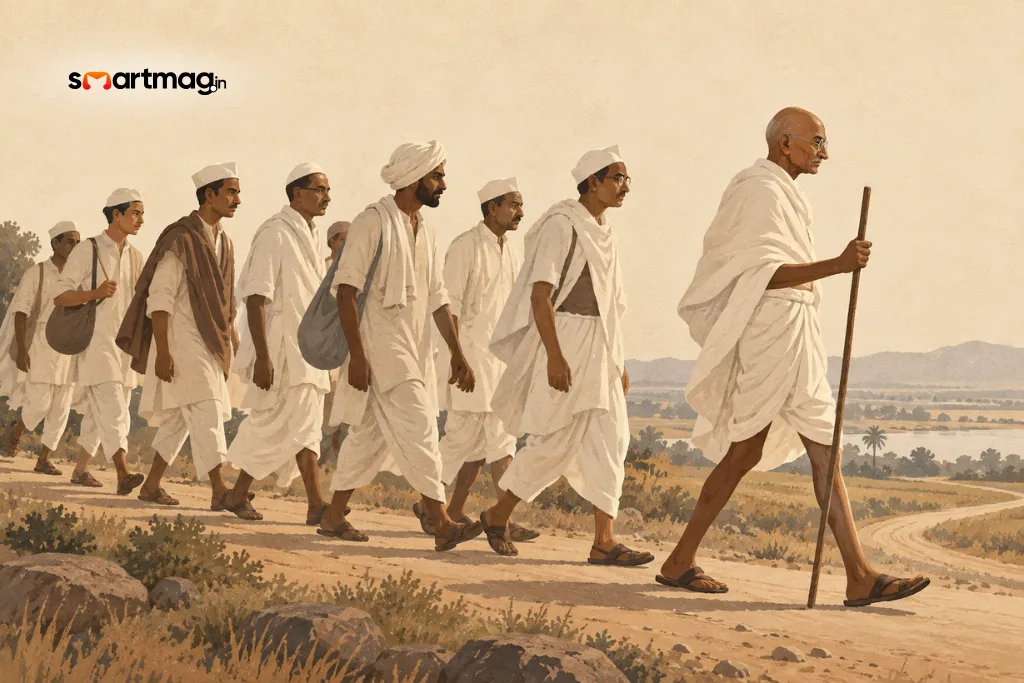
Profoundly remembered as “The Father of the Nation”, Mahatma Gandhi completely changed the direction of India’s freedom struggle by making ordinary people an important part of the national resistance. His idea of Satyagraha focused on truth, non-violence, and moral strength. Rather than limiting politics to a small educated group, he encouraged the farmers, workers, women, students, and traders to take part. His belief was reflected in one of his most remembered lines: “Non-violence is the greatest force at the disposal of mankind.”
Movements like Non-Cooperation, Civil Disobedience, and Quit India showed that colonial power could be easily challenged through collective refusal. Moreover, Mahatma Gandhi made the spinning wheel, salt, and khadi important symbols of self-reliance. His role proves that freedom fighters did not always fight with weapons. Sometimes they also fought with patience, discipline, and mass unity.
Shaheed Bhagat Singh: The Voice of Fearless Youth
Shaheed Bhagat Singh continues to remain one of the most powerful names in India’s revolutionary history. He was young, sharp, well-read, and deeply committed to the idea of an independent India. His courage made him an icon for students and the youth who wanted freedom immediately, not as a distant promise. His belief in revolution was not limited to action alone. In his famous statement, he said, “Revolution is an inalienable right of mankind.”
Along with Rajguru and Sukhdev, Shaheed Bhagat Singh became one of the most remembered martyrs of India. His sacrifice on 23rd March 1931 turned him into a symbol of fearless resistance. Even today, his name brings fire to the conversations around freedom fighters because he clearly showed that age does not limit conviction.
Chandrashekhar Azad: The Revolutionary Who Refused to Surrender
Chandrashekhar Azad was well-known for his boldness, discipline, and commitment to revolutionary struggle. After joining the nationalist activities at a very young age, he became associated with several groups that wanted to directly challenge British rule.
His evergreen identity as “Azad” reflected his belief that he would never get captured alive. He is popularly remembered through the line, “Dushman ki goliyon ka hum saamna karenge, Azad hi rahe hain, Azad hi rahenge,” which reflects the fearless spirit attached to his name.
Chandrashekhar Azad inspired many young nationalists, including those who were connected with the Hindustan Socialist Republican Association. His life remains closely linked with the stories of the great martyrs of India, as he chose sacrifice over surrender.
Lala Lajpat Rai: The Lion of Punjab
Lala Lajpat Rai, also known as Punjab Kesari, was one of the strongest voices of Indian nationalism. As a part of the famous Lal-Bal-Pal trio, he supported the Swadeshi movement, national education, and awakening against colonial suppression.
His protest against the Simon Commission in 1928 became a major turning point in the history of the freedom struggle. Well, Lala Lajpat Rai was seriously injured during a police lathi charge, and he later died. His famous words, “Every blow that they hurled at us drove one more nail in the coffin of the British Empire,” became a powerful reminder of his courage. His death deeply affected the young revolutionaries like Shaheed Bhagat Singh.
Lala Lajpat Rai is remembered for combining political courage with social reform.
Khudiram Bose: The Young Revolutionary Who Chose the Nation First
Khudiram Bose was one of the youngest revolutionaries who was associated with India’s freedom movement. Born in Gengal, he became involved in anti-colonial activities from a very young age. His courage, especially at an age where most people are still discovering life, made him an unforgettable hero.
Khudiram Bose was executed in 1908 when he was only 18 years old. His story is often remembered when speaking about the martyrs of India since it shows the emotional intensity of the freedom struggle. The cry of “Vande Mataram” became closely associated with young revolutionaries like Khudiram Bose, reflecting the patriotic spirit with which they faced sacrifice.
Though his life was short, the impact he left was enormous.
Other Freedom Fighters Who Shaped India’s Struggle
India’s independence story is much larger than a few names. Subhas Chandra Bose gave the call for complete freedom through the Indian National Army. His famous call, “Give me blood, and I shall give you freedom,” inspired many Indians to see freedom as a responsibility that demanded action and sacrifice. Sardar Vallabhbhai Patel organised peasants in Gujarat and later became central to national integration. Rani Lakshmi Bai became a symbol of courage during the Revolt of 1857. She is still remembered through the powerful line, “Main Apni Jhansi nahi doongi,” which captured her refusal to surrender her kingdom.
Sarojini Naidu encouraged women’s participation and also became an important voice in the national movement. Her words carried a deep belief in India’s awakening, as she once said, “The Soul of India cannot be silent.”
Jawaharlal Nehru, on the other hand, helped by giving political direction to the demand for complete independence. His “Tryst with Destiny” speech gave independent India one of its most memorable lines: “At the stroke of the midnight hour, when the world sleeps, India will awake to life and freedom.”
These are some of the freedom fighters who worked in different ways, but their efforts met at the same destination, and that was freedom from colonial struggle.
What Can We Learn from the Freedom Fighters of India?
The freedom fighters of India teach us that change needs more than just emotions. It needs clarity, courage, and continuous effort. Mahatma Gandhi showed the strength of non-violence. Shaheed Bhagat Singh showed the power of conviction. Chandrashekhar Azad showed the importance of being fearless. While Lala Lajpat Rai reflected on the importance of public leadership. Khudiram Bose, on the other hand, showed that the sacrifice can come from the youngest hearts.
Their stories also remind us that freedom is not only a date in our Indian history. Independence Day truly becomes meaningful when the citizens understand the actual cost behind it. After all, these freedom fighters did not just fight for our memory alone but also for a responsible future.
Wrapping Up
The story of India’s independence is not simply a straight road. It is a wider river fed by many streams, including peaceful movements, revolutionary sacrifices, public speeches, prison years, student protests, social reform, and the act of courage. The freedom fighters of India gave the nation more than just political freedom. They also gave it confidence, an identity, and a definite direction.
As we continue to remember our freedom fighters on every Independence Day, we should also remember that their legacy is not just limited to statues, slogans, or school essays. It lives in how well we value justice, unity, responsibility, and the India they helped build.
FAQs
Who are called freedom fighters?
reedom fighters are people who worked, struggled, or sacrificed for the freedom of their country. In India, the term refers to those who opposed British colonial rule through movements, protests, revolutionary action, social reform, or public leadership.
Who are the main freedom fighters of India?
Some main freedom fighters of India include the following: Mahatma Gandhi, Shaheed Bhagat Singh, Chandrashekhar Azad, Lala Lajpat Rai, Khudiram Bose, Subhash Chandra Bose, Sardar Vallabhbhai Patel, Rani Lakshmibai, Sarojini Naidu, and Jawaharlal Nehru.
Why do we remember Shaheed Bhagat Singh?
Shaheed Bhagat Singh is known for his bravery, revolutionary thinking, and sacrifice when he was very young. Bhagat Singh, along with Rajguru and Sukhdev, became one of the most respected martyrs of India.
What was the contribution of Mahatma Gandhi to the freedom struggle of India?
Mahatma Gandhi made the Indian freedom struggle into a mass movement through the principles of nonviolence, truth, and peaceful protest. He mobilized common men to participate in the struggle for freedom.
Loved this blog? explore more on SmartMag.