In 1993, psychologist Anders Ericsson studied violin students at a Berlin music academy and found something surprising: the top performers weren’t more gifted than the rest.
They simply showed up and practised the same way, every single day, for years.
It was not the talent that explained the gap. Consistency did.
Discipline and consistency are the real lessons behind lasting success. Small, simple daily habits, and not grand 5-year plans, are what actually change lives.
The Trouble With Big Goals
Big goals feel exciting. They give us something to dream about. Like a shiny finish line to picture on a Sunday evening when we’re planning our week. But most big goals share a fatal flaw: they describe an outcome without describing a process.
“Lose 10 kgs by next month”, “write a novel”, “double your business profits”; these are destinations, not directions.
The main problem is your brain doesn’t know what to do first on a weekend morning to achieve your end goal. It needs a next action. Without one, motivation fades easily within days, and the goal quietly slides off your roadmap and out of mind.
Doesn’t it happen with most of your New Year’s resolutions? You are all fired up to hit the gym on 1st January but literally quit on 1st February.
No, it isn’t due to a lack of willpower. It’s a lack of consistent, repeatable action to carry the goal forward when motivation runs out.
Why Small, Repeated Actions Beat One-Off Ambition
Daily rituals work because they remove decision-making from the equation.
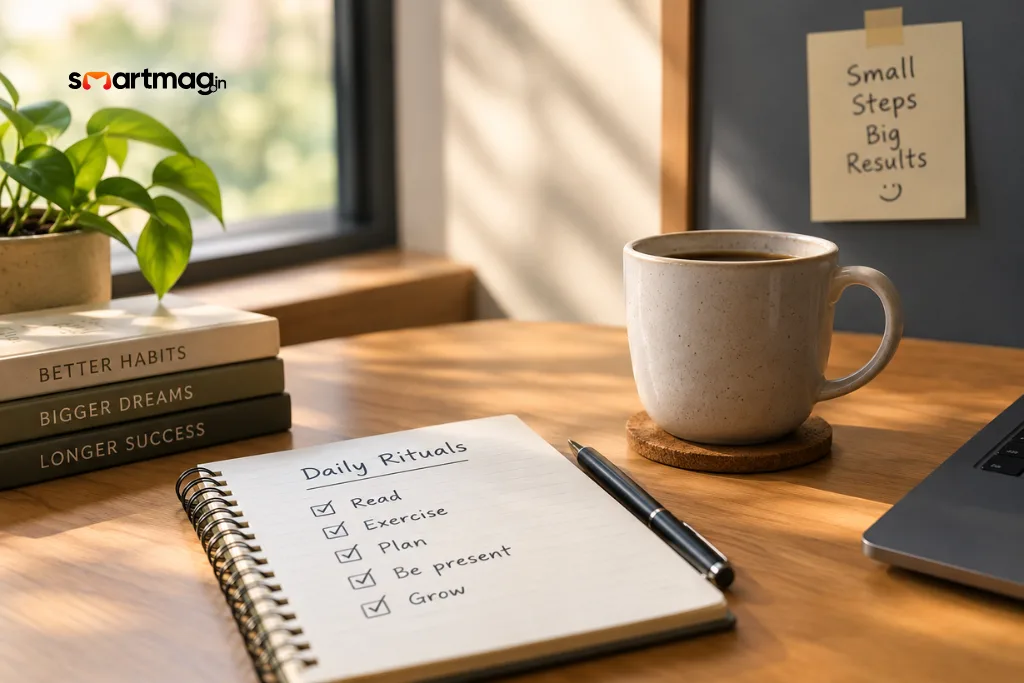
A ritual is a short, repeated act done at roughly the same time and in roughly the same way. A ritual has a tendency to become automatic. You don’t decide whether to do it; you simply do it.
The way you brush your teeth without debating the merits each morning is a ritual. With time, without managing, it becomes your routine. Outcome: better oral hygiene.
This is a simple example of the quiet power behind small, repeated acts. They turn intention into behaviour without requiring fresh motivation every single day.
Athletes understand this instinctively. Ask any long-distance runner about their morning stretch, or any writer about their pre-dawn cup of tea before the laptop opens, and you’ll hear the same thing.
The ritual doesn’t have to be inspiring, but it’s habitual and reliable, and reliability is what compounds in the long term.
The Psychology Behind Small Daily Rituals
Let’s understand the basic science behind small daily habits.
Research led by health psychologist Phillippa Lally tracked 96 people for 12 weeks forming new behaviours and found it took an average of 66 days for a new behaviour to become automatic, with variations depending on the type of behaviour, person, and circumstances.
The key finding debunked the theory that it takes 21 days to build a habit and that missing the behaviour occasionally (or skipping a day) didn’t derail habit formation, but being very inconsistent did.
In simple words, repetition in a consistent context with stable cues (same time, place, and situation) are crucial for a habit to stick.
This matters enormously for anyone chasing long-term goals.
Small daily habits are effective precisely because they ask so little of you on any given day. For example, ten minutes of reading, five press-ups, or one paragraph written, etc., none of these feel like progress in the moment, which is exactly why they can survive the long weeks but big, ambitious plans don’t.
This kind of small habit doesn’t rely on a good mood, a motivational speech, or a burst of willpower. It simply relies on repetition, and repetition is available to everyone, every day, regardless of how you feel. A simple motto of ‘just do it’, can go a long way.
How Habit Building Actually Works
Effective habit building rests on a simple loop that behavioural scientists call cue, routine, reward:
- Cue: Something triggers the behaviour, such as your alarm going off.
- Routine: The behaviour itself, such as getting up and stretching.
- Reward: Something reinforces it, such as feeling more awake and alert.
Miss any one part, and the whole process becomes harder to sustain.
It’s the same loop that shapes your digital habits, too. This article explains that algorithms don’t control your behaviour; your repeated habits control what the algorithm shows you.
However, the most common mistake people make with habit-forming is starting too big.
A few common examples are as follows:
- Once on a habit-building loop, like after getting up early, you decide to meditate for 30 minutes, rather than 1 minute.
- You decide to run 10 km, rather than a 20-minute walk.
- You decide to write 1000 words daily, rather than 100.
The major drawback of each of these ambitious versions is that they cause burnout within a week.
The better approach favours a version of the behaviour so small it feels almost silly to skip. Like 1 minute of meditation, an easy walk, writing 100 words a day. Once that’s automatic, the habit can grow.
Until then, quantity is the enemy of consistency, and consistency is the entire point.
Designing Daily Routines That Stick
Daily routines differ from single habits in that they string several small rituals together into a sequence. A well-designed sequence acts as your backbone for the day, reducing the number of decisions you need to make before 9 am and protecting your energy for the choices that actually matter.
The best daily rituals I’ve seen, in clients, in research, and in my own life, share three traits:
- Short enough to survive a bad day: No sequence should take so long that a busy morning knocks it out entirely.
- Anchored to something that already happens: Waking up, making coffee, and closing the laptop are all reliable hooks to build around.
- Be forgiving of the occasional missed day: One skipped morning shouldn’t disrupt the whole sequence for the next day.
Tough versions of rituals that demand perfection tend to collapse easily when life gets in the way. Whereas flexible ones, which are built around a few non-negotiable anchors, tend to last for years.
Productivity Habits Worth Borrowing
Take advantage of social media and follow genuinely productive people. Most probably you’ll notice that their habits are almost boringly simple:
- They plan tomorrow the night before or, better yet, make a weekly calendar.
- They tackle the hardest task first, before any distractions come in the way.
- They save a block of uninterrupted time daily, even if it’s only twenty minutes.
You see, none of these productivity habits are clever or complicated. But their power lies entirely in repetition.
A single productive day changes very little; the same productivity habits, repeated across a year, change almost everything. This is the part that big-goal thinking tends to miss.
Outcomes are the by-product of small, repeated inputs, not the input itself.
A Simple Framework to Start Today
If you’d like to put this into practice, try this routine:
- Choose one small daily habit, not five. Pick something you can do in under two minutes on your worst day.
- Attach it to an existing anchor, like right after your morning coffee, before you check your phone, or after you brush your teeth.
- Track it simply. A tick on a calendar is enough. Digital apps can help, if you prefer.
- Let it stay small for at least a month. This is very important. Resist the urge to expand your routine duration before it feels automatic.
- Build your week around two or three of these anchors, rather than trying to overhaul your entire day at once.
This approach won’t feel dramatic. That’s rather the point.
Daily rituals are quiet by design, and quiet, repeated action is what carries people past the point where big goals usually give up on them.
Final Takeaway
While you should plan your big goals as they tell you where you want to go in life, small daily habits are how you actually get there.
If long-term success is the destination, then habit building is the vehicle, and daily routines are the road. Choose your rituals with care, keep them small, and give them time.
The results tend to arrive rather late, quietly, and then all at once. This is how long-term success can be achieved.
Explore more blogs on daily living, healthy habits, and practical wellness tips on SmartMag.