When people think about PepsiCo, the first name that often crosses their mind is Pepsi. However, the company’s real strength lies not only in soft drinks, but a major proportion of its global power also comes from its snacks.
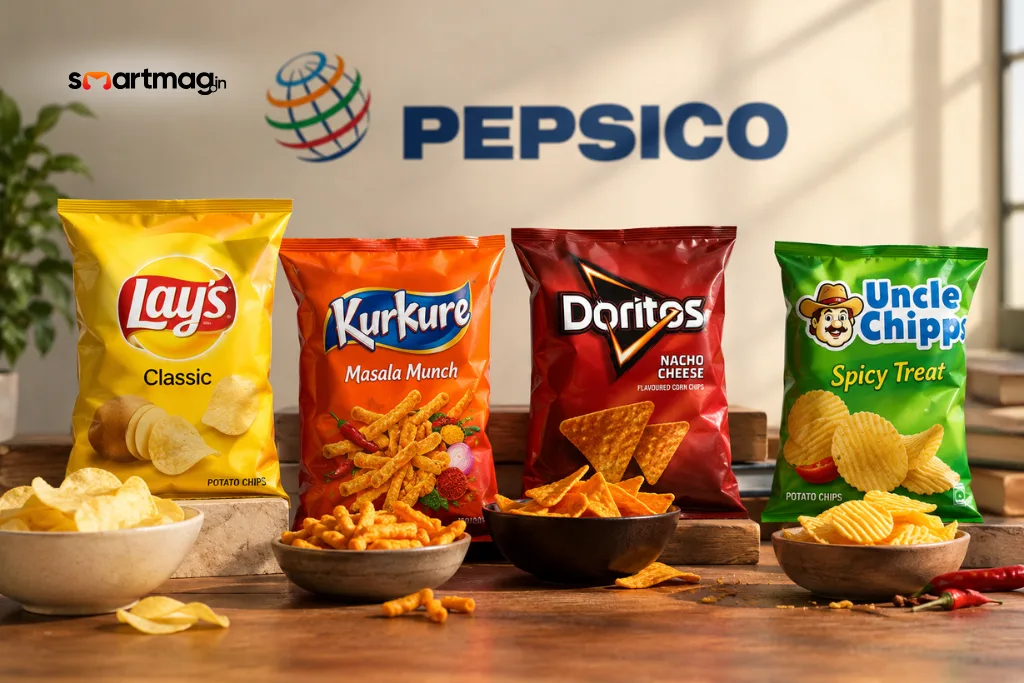
In India, this is especially visible. You walk into any random grocery store, supermarket, cinema counter, or college canteen, and several familiar packets will also appear on the shelf. Lay’s, Kurkure, Doritos, and Uncle Chips may look like separate snack choices, but they are all an important part of a larger business machine.
In fact, the success of the PepsiCo snack brands is not at all accidental. It comes from sharp positioning, a strong distribution network, an understanding of the local flavours, and a multi-brand strategy that enables the company to speak to the different types of customers at the same time.
This is where PepsiCo’s snack empire takes an interesting turn. It is not merely selling chips. But it is also selling moods, memories, flavours, and snacking occasions.
PepsiCo Snack Brands and the Power of Portfolio Thinking
One of the core strengths of PepsiCo snack brands is that they do not all try to do the same thing.
Based on its hero product, PepsiCo builds a portfolio. Each brand has a specific role, personality, and customer base. This, in turn, helps the company occupy more shelf space and reach more snacking moments.
For instance, Lays is positioned as a light, easy, and widely loved potato chip brand. Kurkure, on the other hand, brings a more Indian, masaledaar, and playful personality. Doritos appeals more to the younger segment of customers with its bold range of flavours and global snack formats. Uncle Chipps carries nostalgia and familiarity for Indian customers.
Together, these brands help PepsiCo cover some of the major consumer moods.
| Brand | Core Positioning | Likely Consumer Appeal |
|---|---|---|
| Lay’s | Light, fun and everyday snacking | Mass audience, students, families |
| Kurkure | Indian masala flavour and playful snacking | Consumers who prefer local taste |
| Doritos | Bold, global and youthful | Gen Z, young adults, party snacking |
| Uncle Chipps | Familiar, nostalgic potato chips | Older loyal consumers and family snacking |
This is the heart of the PepsiCo brand strategy. Instead of forcing one brand to cater for everyone, the company makes use of multiple brands to serve different taste preferences and occasions.
Why Does a Multi-Brand Strategy Work So Well?
It is quite easy for a single snack brand to become popular, but it can also become limited. Consumers’ tastes can change quickly. Some people want classic salted chips, while others crave spicy Indian flavours. Some want nachos, while some want a familiar brand that will take them back to their childhood.
A multi-brand approach provides PepsiCo with more flexibility and ease.
If one particular type of snack slows down, another one can grow. If a new flavour trend appears, the company can easily test it through the most suitable brand. If younger customers are looking for bold flavours, Doritos can lead that conversation. If some people are craving the classic Indian tadka, Kurkure can continue to fill that space.
Therefore, this makes PepsiCo’s snack brands one of the strongest groups rather than separate products.
Moreover, PepsiCo also benefits from shared scale. The company can easily use its manufacturing strength, retail relationships, marketing knowledge, and distribution networks across several brands. This further helps in reducing the dependency on one particular product and also helps in improving the overall market reach.
How Does PepsiCo India Localises its Global Strength
One reason PepsiCo India has established a strong snack presence is its ability to combine global brand power with an understanding of the local consumer.
Lay’s and Doritos have global recognition; however, their success in India will depend on their local adaptation. The Indian customer base often prefers stronger flavours, similar spices, and value-friendly packet sizes. This is the reason that brands should introduce flavours and formats that will feel suitable for Indian shelves.
Kurkure is one of the clearest examples of localisation. It does not feel like a foreign brand trying to fit into India. It feels Indian in its flavour, humour, and communication. Moreover, its branding has largely revolved around family moments, playful conversations, and everyday snacking.
On the contrary, Uncle Chipps plays a different role altogether. It has a strong memory value for many customers who grew up seeing the brand in different stores. By keeping Uncle Chipps in its wider portfolio, PepsiCo benefits greatly from nostalgia while continuing to cater to a similar potato chip segment.
The Role of Uncle Chipps in PepsiCo’s Snack Empire
Compared to Lay’s or Doritos, Uncle Chipps does not receive the same level of spotlight, but it has an equally important role in the portfolio.
For many Indian consumers, Uncle Chipps is not just another packet of chips. But it carries memory. It belongs to the school canteens, birthday parties, travel snacks, and old neighbourhood shops, and that kind of recall is difficult to create quickly.
From a business point of view, this gives PepsiCo an added advantage. The company does not compete with newness, but now it also competes with the familiarity angle.
While Lays can continue to focus on the mass appeal and constant flavour excitement, Uncle Chipps can hold the space as a trusted, known, and nostalgic brand. With this approach, PepsiCo will be able to cover both modern and memory-led snacking.
Doritos and the Youth-Led Snack Segment
Doritos performs a completely different job in the portfolio.
It brings in an old, global, and youth-driven identity to PepsiCo’s snack brands. The brand is not entirely built around potato chip comfort. But, in reality, it is built around stronger flavour, nacho-style snacking, and a more expressive personality.
This definitely matters as the younger segment of the audience eagerly looks forward to snacks that feel exciting, social, and shareable. Doritos will be your perfect companion for late movie nights, gaming sessions, parties, and unplanned hangouts.
For PepsiCo, in particular, Doritos helps strengthen its premium and youth-driven snack space. It will enable the company to compete beyond traditional potato chips.
Perhaps the best part about PepsiCo’s brand strategy is that it avoids making all snack brands look similar. For example, Doritos is not trying to become Lay’s. Kurkure is not trying to copy Doritos. Each brand has its own unique identity.
Kurkure and the Indian Taste Advantage
Kurkure is one of the strongest examples of how well PepsiCo understands the Indian snacking ecosystem.
Indian consumers thoroughly enjoy snacks that are crunchy, spicy, and full of flavour. Kurkure directly sits in that space. It does not simply rely on the concept of a quick bite. But it also helps create a more expressive eating experience.
The brand also communicates in a tone that feels light, humorous, and familiar. This gives it a personality beyond taste.
With Kurkure in its kitty, PepsiCo can easily compete with the local namkeen, regional snacks, and other Indian masala-based products while still operating at a large scale as a major packaged food company.
The Distribution Benefit
One needs to understand that brand strategy is not only about brand advertising, but it also focuses on brand availability.
PepsiCo’s snack business benefits from a wide network of distribution. Its products can be easily found across modern retail stores, small kirana shops, online grocery platforms, food courts, and travel points.
This matters a lot because snacks are often impulse purchases. Consumers may not always “plan” to buy chips. They might simply pick up a packet since it is visible, affordable, and easy to consume.
A strong distribution network lends PepsiCo brands an everyday advantage, and that is, the more often customers see a product, the more likely it is to become a part of their routine snacking.
The company also uses different packet sizes to cater to different buying needs. Small packs work well for students, children, and quick snacking. Large packs will be a perfect option for family sharing, social gatherings, and at-home consumption.
What Businesses Can Learn from PepsiCo?
PepsiCo’s snack empire provides several lessons for other brands.
First and foremost, one product cannot always serve every customer. Different audiences might need different brand identities, price points, and messages.
Secondly, local understanding matters a lot. A global brand may have scale, but at the same time, it also requires cultural relevance to be able to succeed in India.
Thirdly, nostalgia can be seen as powerful as innovation. Uncle Chipps, for instance, clearly shows that even old brands can still hold relevance when they carry memory and familiarity.
Fourth, distribution is an important part of branding. A product that is easier to find becomes easier to remember.
Lastly, clear positioning helps in preventing confusion. The overall success of the PepsiCo snack brands often comes from giving each brand a specific role within a larger portfolio.
Wrapping Up
PepsiCo’s snack brand strategy doesn’t revolve around a single flavour, a single packet or a single advertising campaign. Instead, the strategy involves managing a portfolio of brands.
Lays, Kurkure, Doritos and Uncle Chipps satisfy different consumer needs and help PepsiCo be relevant and present across various snacking needs.
For PepsiCo India, the multi-brand strategy gives the advantage of not only being relevant but also being able to challenge international snack brands and even traditional Indian snacks at the same time.
This is what gives PepsiCo its real edge over the other snacks. While PepsiCo’s brands are present on the shelves, more importantly, they are present at different points in a consumer’s life.
And this is why PepsiCo’s snack brand strategy is such an excellent illustration of how to manage brands wisely.
FAQs
List some PepsiCo snack brands in India.
Listed below are the major PepsiCo snack brands in India, including Lay’s, Kurkure, Doritos, Cheetos and Uncle Chipps. Each of these brands appeals to a different snacking appetite.
Mention how Uncle Chipps is relevant to PepsiCo India.
Indians recognise Uncle Chipps as a nostalgic brand, thereby allowing PepsiCo India to reach out to consumers who prefer familiar and trusted snack brands.
Discuss the brand strategy followed by PepsiCo.
PepsiCo has its own multi-snack brand strategy wherein it uses various snack brands for different consumer segments. Lay’s, Kurkure, Doritos and Uncle Chipps have their unique positioning, flavour appeal and recall.
Mention how the PepsiCo brand strategy works in the snack industry.
The PepsiCo brand strategy enables the company to reach multiple segments of audiences, reduce dependency on one product, and maintain strong visibility across different snacking occasions.
Explore SmartMag for brand stories and strategies, or share your own story with us — Write for Us.