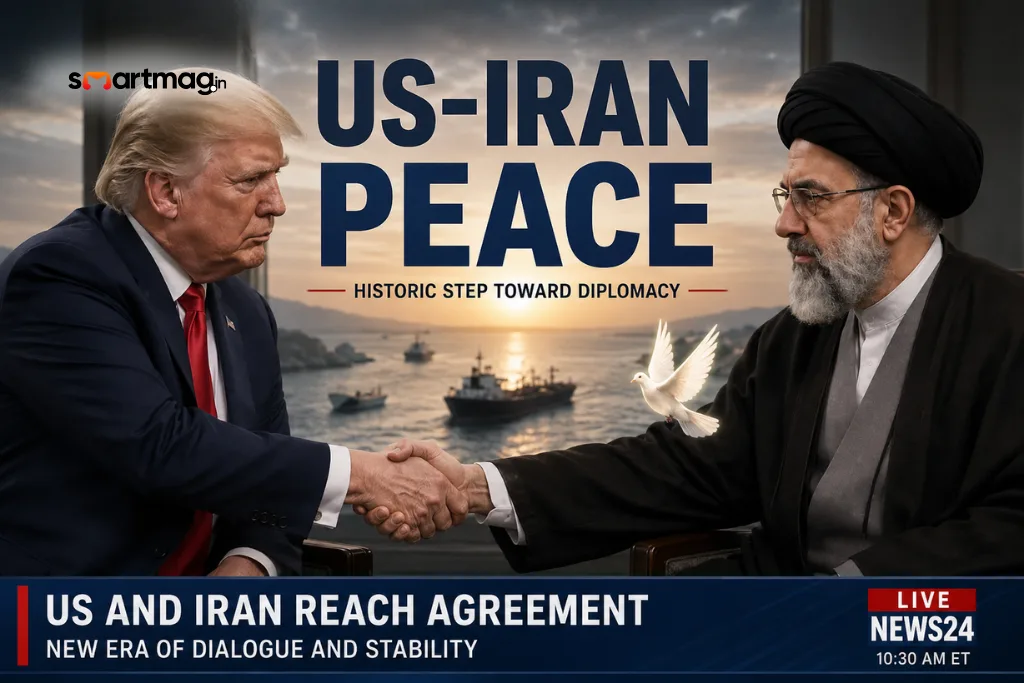
One of the biggest geopolitical developments of 2026 happened on Sunday, June 15. The United States and Iran announced a US-Iran peace deal 2026 to end nearly 4 months of active conflict, with both sides declaring the immediate and permanent termination of military operations on all fronts, including in Lebanon.
Pakistan’s Prime Minister Shehbaz Sharif, who played a key mediation role alongside Qatar and Saudi Arabia, broke the news on X. President Donald Trump confirmed it shortly after on Truth Social. The official signing ceremony is scheduled for Friday, June 19, in Switzerland.
What the US-Iran peace deal actually covers
The deal, described as a memorandum of understanding, covers several key areas.
The most immediate impact is the Strait of Hormuz reopening. Trump announced toll-free shipping through the strait, which has been largely closed since the US and Israel launched strikes on Iran on December 28, 2025. The strait handles around 20% of global oil and liquefied natural gas shipments. Its closure has been one of the biggest drivers of energy price pressure over the past several months.
Beyond shipping, the deal includes a fundamental commitment to non-aggression from the US, lifting of primary and secondary sanctions on Iran, an end to all UN Security Council resolutions against Iran, and acceptance of Iran’s nuclear enrichment programme under conditions yet to be made fully public.
European nations including the UK, Germany, France and Italy separately signalled they are willing to lift sanctions on Iran in exchange for steps on its nuclear programme.
What’s notably absent from the current deal: Iran’s ballistic missile program and its support for regional armed groups. These remain unresolved and are expected to be taken up in follow-on talks.
How this affects fuel prices in India and globally
The Strait of Hormuz reopening is the part with the most direct economic consequences for ordinary people.
Before the conflict, the strait was the transit point for roughly 20% of the world’s oil and LNG. Its closure contributed significantly to the fuel price spikes seen in early 2026. With the deal announced and shipping set to resume, markets responded immediately, with oil prices dropping on the news.
For India, which imports over 85% of its crude oil, this matters a lot. If you’ve been tracking why fuel prices have been climbing, this piece on why fuel prices are rising again explains the broader picture. The Strait of Hormuz situation has been a central part of that story.
Relief at the pump won’t be instant. Prices typically take a few weeks to reflect changes in global crude markets. But the direction is clear.
Who brokered it and why that matters
Pakistan’s PM Shehbaz Sharif announced the deal, with mediation credited to Pakistan, Qatar, and Saudi Arabia. Qatar’s Foreign Ministry welcomed the agreement and specifically noted its provisions for freedom of navigation in the Strait of Hormuz.
Iran’s deputy Foreign Minister Kazem Gharibabadi confirmed the deal from Tehran’s side. Iranian state TV also noted that the Foreign Ministry holds the US and Israel responsible for earlier regional instability, signalling the deal was not without domestic friction on Iran’s side.
Israeli Prime Minister Benjamin Netanyahu stated that Israel is not a party to the deal, though he and Trump are in “full agreement” that Iran must not be permitted to develop nuclear weapons. Israel continued strikes on Iran on Sunday even as the deal was being announced, which indicates the situation on the ground remains delicate until the formal signing on June 19.
What happens next
The formal signing is set for June 19 in Switzerland. Trump indicated the deal may be signed electronically, with Vice President JD Vance potentially present in person. The logistics are still being finalized.
After signing, mediators are expected to facilitate a series of meetings covering the unresolved nuclear questions. The current agreement effectively buys a 60-day window for those follow-on talks, according to Axios, which described the deal as an extension of the earlier ceasefire framework rather than a final comprehensive settlement.
The Iran nuclear deal 2026 dimension is the most consequential long-term question. European nations have already signalled willingness to engage. Whether Iran’s nuclear program can be brought into a verifiable framework within that window is the question that will define whether this peace holds or unravels.
The bigger picture on the US Iran war end
The conflict began on December 28, 2025 when the US and Israel launched strikes on Iran. What followed was nearly 4 months of exchanges including missile attacks, strikes on Gulf nations, and the closure of one of the world’s most critical shipping lanes.
The US Iran war ended after multiple rounds of negotiations going back to April 2025, with talks held in Oman, Rome, Geneva, and Islamabad before reaching this point. Pakistan’s sustained mediation role over more than a year was central to getting both sides to this agreement.
For now, the war is over on paper. The hard part, securing the nuclear question, preventing re-escalation, and getting a durable settlement, begins on June 19.
Disclaimer: This article is based on information sourced from The Hindu, News18, and other credible news outlets. Smartmag has compiled this for informational purposes only and does not take responsibility for the accuracy of the original reports. Readers are encouraged to refer to the original sources linked below.
- The Hindu: US-Iran reach peace deal, signing set for Friday, Pakistan says
- The Hindu: US-Israel-Iran war live updates, June 15 2026
- News18: CNN-News18 breaks down the preliminary US-Iran peace agreement