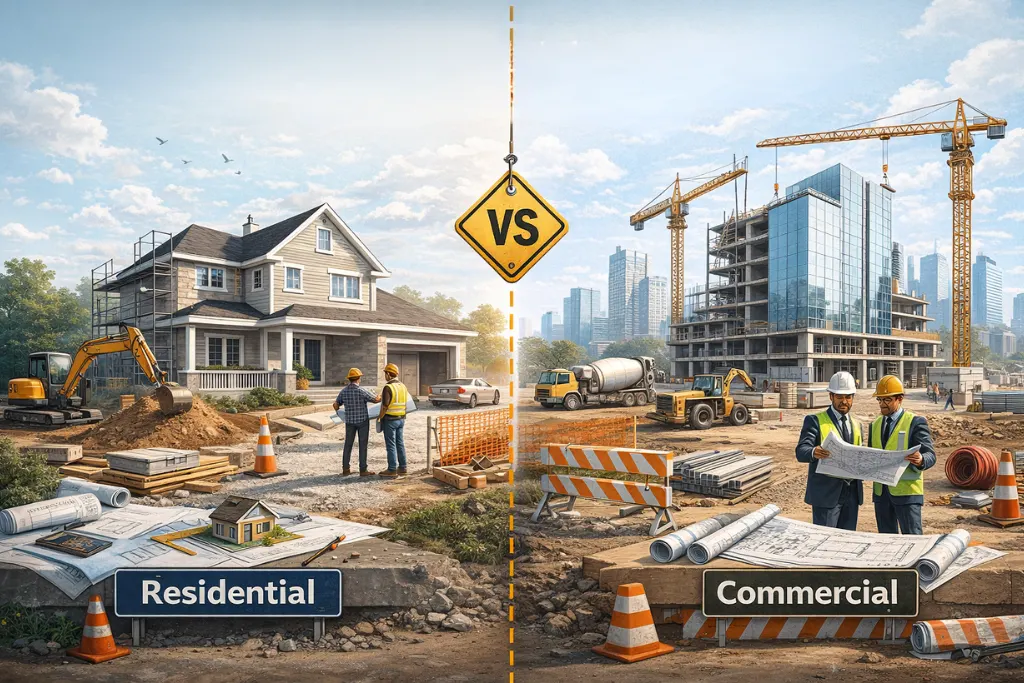
People often start with the same assumption. A building is a building. You hire a contractor, work begins, and slowly the structure appears.
Then reality kicks in.
The difference between Residential vs Commercial Construction shows up in small moments. A drawing revision that needs three approvals instead of one. A site meeting where ten people have opinions. A compliance checklist that changes the order of work. Even the way timelines are discussed feels different.
Understanding the gap early does not just help with planning. It helps avoid the frustration that comes when someone expects a home-style workflow on a commercial site, or a commercial-style rigidity on a home project.
What Is Residential Construction?
Residential construction is built around one simple purpose. People will live there.
That includes independent houses, villas, duplexes, and apartment units. Most of these projects are smaller in scale, but they are not always simpler. Homeowners care about things that never show up in structural drawings. Where the light falls in the morning. Whether the living room feels cramped. How storage is handled. Whether the kitchen workflow makes sense.
Residential construction usually involves:
- A more direct line of communication
- Higher focus on finishes and comfort
- A lot more personal input from the owner
There is also more flexibility. A homeowner may change finishes mid-way or tweak the layout slightly. That happens because the project is personal, and small decisions matter.
Residential construction is often judged by how it feels to live in the space, not just how well it was built.
What Is Commercial Construction?
Commercial Construction is built for use, performance, and capacity.
Offices, retail buildings, hospitals, hotels, warehouses, industrial facilities. These are not designed around personal comfort. They are designed around operations, footfall, safety, and long-term efficiency.
Commercial projects usually involve:
- Multiple stakeholders and consultants
- More detailed compliance requirements
- Heavier coordination between trades
- Tighter timelines linked to business plans
There is also more documentation. Progress reports, approvals, inspections, and certifications. Many steps need sign-off before work can move forward.
Commercial construction is less forgiving when timelines slip because delays have a cost outside the site boundary.
Key Differences Between Residential and Commercial Construction
-
Project Scale and Size
The easiest difference to see in Residential vs Commercial Construction is scale.
Residential projects are usually smaller, with fewer floors and less complicated spans.
Commercial construction often involves larger floor plates, heavier load requirements, and more complex structural planning. A commercial building may need bigger spans, higher ceilings, and systems that support heavy services.
Scale changes everything. It changes supervision intensity. It changes scheduling. It changes the kind of specialists required on site.
-
Design and Regulatory Requirements
Residential construction has approvals, but commercial projects come with extra layers.
Commercial construction typically requires stricter checks for:
- Fire safety compliance
- Accessibility requirements
- Occupancy rules
- Service infrastructure guidelines
The design itself also behaves differently. Commercial spaces need to support a large number of people, movement patterns, and service routes. That affects planning.
In many cases, regulations influence the layout more strongly in commercial projects than in residential ones.
-
Budget and Cost Structure
Residential budgets are usually personal. People build based on savings, loans, and what they want for their family.
Commercial Construction budgets behave differently. They are often tied to investment plans and long-term returns. Cost planning is more structured because deviations affect business projections.
In residential projects, a client may upgrade something because they like it. In commercial projects, upgrades are often questioned because they affect operational cost or ROI.
That does not mean residential projects are casual. It just means the budget logic is different.
-
Timeline and Scheduling
Residential projects often move stage by stage. Foundation, structure, plaster, finishing. It follows a fairly linear path.
Commercial projects rarely move in such a straight line.
Commercial construction often runs multiple activities in parallel. MEP coordination starts early. Interiors may overlap with services work. External works may run alongside finishing.
That overlap makes scheduling in Residential vs Commercial Construction very different. It also means coordination mistakes can cause bigger delays.
-
Materials and Structural Systems
Material choices are influenced by usage.
Residential construction usually uses standard RCC systems, conventional plumbing, and typical electrical loads.
Commercial construction often needs:
- Higher capacity services
- Stronger fire-rated systems
- More advanced ventilation and HVAC planning
- Heavier electrical demand
It is not just about materials being “better.” It is about materials being fit for the kind of load and usage the building will face.
Differences in Project Management and Coordination
Residential construction management is usually more direct. Fewer people are involved, and communication is simpler.
Commercial construction management is layered. There may be project managers, consultants, multiple contractors, vendors, and specialist teams.
Meetings are more frequent. Reporting is more structured. Documentation becomes part of daily work.
That is why commercial projects need stronger coordination systems. Without them, the site becomes reactive, and reactive sites rarely stay on schedule.
Choosing the Right Expertise for the Right Project
A contractor who builds great homes may not automatically be the right fit for a complex commercial project. The reverse is also true.
Residential projects require patience with personal decisions and attention to fine detailing.
Commercial projects require strong coordination discipline, technical depth, and comfort with compliance-heavy workflows.
This is where firms like RS Builders often highlight a practical point. The approach needs to match the project type. People like Ravijeet Singh have also spoken about the importance of systems and planning discipline, because commercial and residential workflows demand different management styles.
Choosing the right team is less about reputation and more about fit.
Common Misconceptions About Residential vs Commercial Construction
A few misconceptions keep showing up.
One is that commercial projects are simply bigger versions of residential ones. That ignores regulations, services coordination, and stakeholder complexity.
Another misconception is that residential projects are always simpler. They might be smaller, but they can be demanding in a different way because expectations are personal and highly specific.
Some also assume the same contractor can handle both without changing their process. In reality, process matters. A lot.
Why the Right Approach Impacts Long-Term Performance
The difference between Residential vs Commercial Construction carries into how the building performs after handover.
Residential buildings are judged by comfort, durability, and how easily they can be maintained.
Commercial buildings are judged by efficiency, compliance performance, and operational cost.
The approach taken during planning and execution affects long-term maintenance issues, service performance, and even user experience.
Many building problems do not start years later. They start in early decisions that seemed small at the time.
Final Thoughts
Understanding Residential vs Commercial Construction is not about deciding one is harder than the other. It is about recognising they are built for different outcomes.
Residential construction is personal and detail-driven. Commercial construction is structured and compliance-heavy.
Both need skill. Both need planning. But they need different systems and different expectations.
Knowing the difference before starting helps clients choose the right expertise, plan realistically, and avoid the kind of confusion that turns a project into a daily headache.