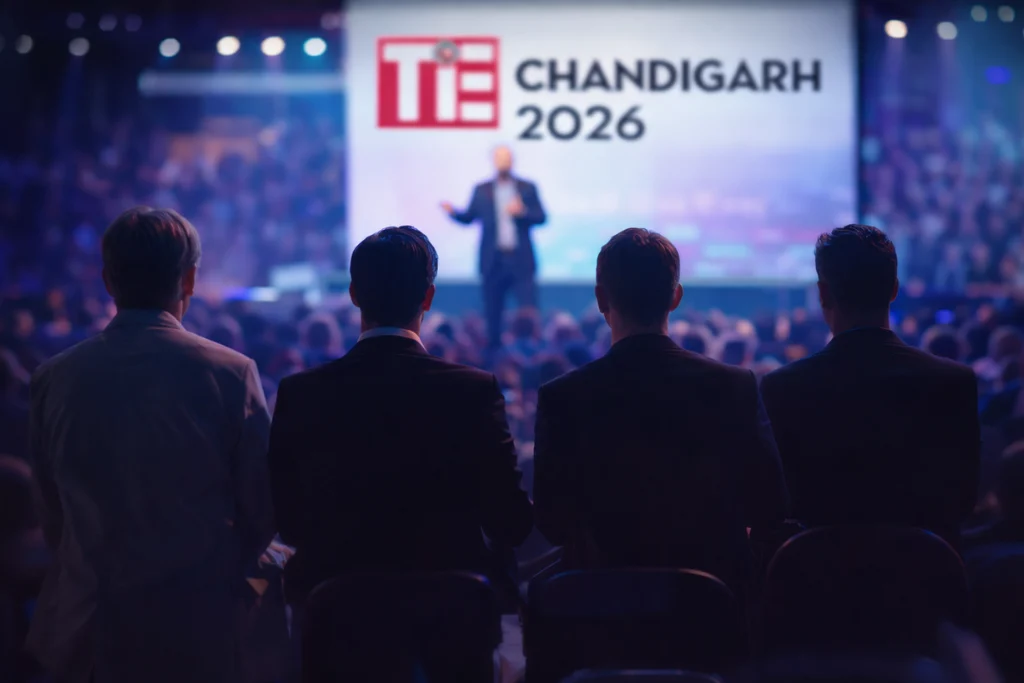
All startup events don’t change your perspective.
They provide you with a lot of information, a couple of contacts, and some temporary inspiration. However, once the event finishes, there is not much that gets translated into action. This starts becoming evident after the event when the buzz subsides, and decisions are back to being the same old decisions.
That’s where TiEcon Chandigarh 2026 made its mark.
The reason is, while founders can take lessons from TiEcon Chandigarh 2026 in terms of what is discussed on the stage, the most important thing is to understand what was clearly seen at TiEcon Chandigarh 2026.
Lessons for Founders at TiEcon Chandigarh 2026 on How to Grow a Start-Up Business
There was a lot of discussion about growth. However, the focus is no longer about what was traditionally talked about.
A clear move away from focusing on vanity metrics and toward learning about the architecture that makes them work is being made. It is necessary now to understand the growth, not only to show it. Acquisition, retention, and scalability strategies are key aspects for founders today.
The following recurring topic became very apparent. Growth is not simply about gaining new users anymore. The question of what makes them loyal and what maintains the stability of the business is much more relevant.
That means that growing a start-up business is different from before.
Why is Execution Today More Valuable than Ideas?
Ideas are plenty. It’s in execution that most startups falter.
At TiEcon Chandigarh 2026, this point was implicitly made by some veteran founders and operators. There was no talk about ideation; instead, there were talks about fine-tuning systems, distribution models, and creating repeatability.
For instance, the founder of one of those SaaS firms revealed how, when their first product was launched to solve a genuine problem, it did not find success due to the wrong positioning strategy. By narrowing down their audience and adjusting their message, the same product was able to take off.
That is because execution is never after ideas. Execution is what determines whether the idea will live to see the light of the day.
TiEcon Chandigarh 2026 and the Changing Definition of Sustainable Growth
There is a new definition of growth, and this transformation was evident at the conference.
While most entrepreneurs in previous years have been interested in rapid scalability, this year the founders of various start-ups and companies, particularly those operating within the D2C and fintech industries, emphasized sustainability.
For instance, one founder in the D2C industry revealed that lowering customer acquisition costs and repeat purchases had more influence on long-term business profits compared to spending more on advertisements.
Today’s growth is no longer measured by its speed but rather its sustainability.
This mirrors the current digital evolution that is taking place within businesses, as discussed in long-term business visibility in 2026.
What Types of Startups and Industries Were Present in TiEcon Chandigarh 2026
One of the most prominent features of TiEcon Chandigarh 2026 was its diverse representation of startups.
It was not restricted to any single sector alone. The industries showcased at the event included:
- SaaS and AI-based platforms
- fintech startups working on accessibility and online transactions
- D2C companies catering to niche consumer markets
- healthtech and edtech startups addressing complex issues
This demonstrates a significant trend that needs to be taken into account. These days, startups are not restricted to any particular technological framework. Entrepreneurs are launching startups in various sectors.
It also demands a new perspective towards problem-solving. Innovation is no longer sufficient. Relevance plays a critical role in startup development.
How Founders Can Build Trust Instead of Just Visibility
Visibility has become easier. Trust has not.
Many founders today can generate attention through ads, content, or social media presence. But attention does not guarantee belief. Users evaluate what they see much more critically now.
At TiEcon Chandigarh 2026, several discussions reflected this shift indirectly. Founders spoke about consistency, product experience, and clear communication rather than aggressive marketing.
In practical terms, this means:
- aligning messaging with actual product experience
- avoiding exaggerated claims
- focusing on long-term user relationships
This shift is also aligned with how Google evaluates content today, where credibility, reliability, and user value are prioritized, as explained in Google’s guidelines on creating helpful and reliable content.
The Biggest Mistake Founders Make After Attending Events
The Most Common Misstep Founders Take After Participating in Events
The misstep is not about failing to learn anything valuable. It’s about the misconception that something meaningful was done.
Events give you the impression of forward momentum. You listen intently, take copious notes, and have newfound clarity. However, if nothing happens afterward, that clarity dissipates fast.
Some of the most common items founders leave events with are:
- insights
- tactics
- approaches
but rarely anything that is executed.
This phenomenon mirrors a wider trend towards information consumption being mistaken for progress, similar to how thoughts evolve in the age of artificial intelligence.
Learning is not the issue; implementation is.
How Can You Apply What You’ve Learned at a Startup Event
The true value of any event is defined by your actions after it.
Rather than trying to implement all you have learned, entrepreneurs must concentrate on choosing just one or two ideas applicable to their current situation and test them in practice.
If a founder learns how to increase retention, he does not need to make drastic changes right away. Instead, he needs to conduct a small-scale experiment – for instance, work on improving onboarding or user experience touchpoints.
In that way, one can learn something tangible.
What matters is not what you learned. What matters is what you were ready to change.
Why Adaptability Trumps Certainty in 2026
Start-ups exist in contexts where certainty is scarce.
The market changes rapidly. Consumer behavior changes rapidly too. Tactics that proved successful a few months ago won’t necessarily work today.
One theme that emerged at TiEcon Chandigarh 2026 was that of adaptability. Success isn’t about waiting until you have all your ducks in a row. It’s about going forward with partial knowledge and adapting along the way.
Adaptability isn’t just a desirable trait. It is essential.
Conclusion
Everything has an end. Conversation is even shorter than events.
However, the true benefit from such an event as TiEcon Chandigarh 2026 lies not in conversation itself, but rather in its aftermath. In your changed approach to decision-making. In your realization of what truly matters. In your growing awareness.
Because founders do not develop through participation in more events. They develop through change resulting from events.