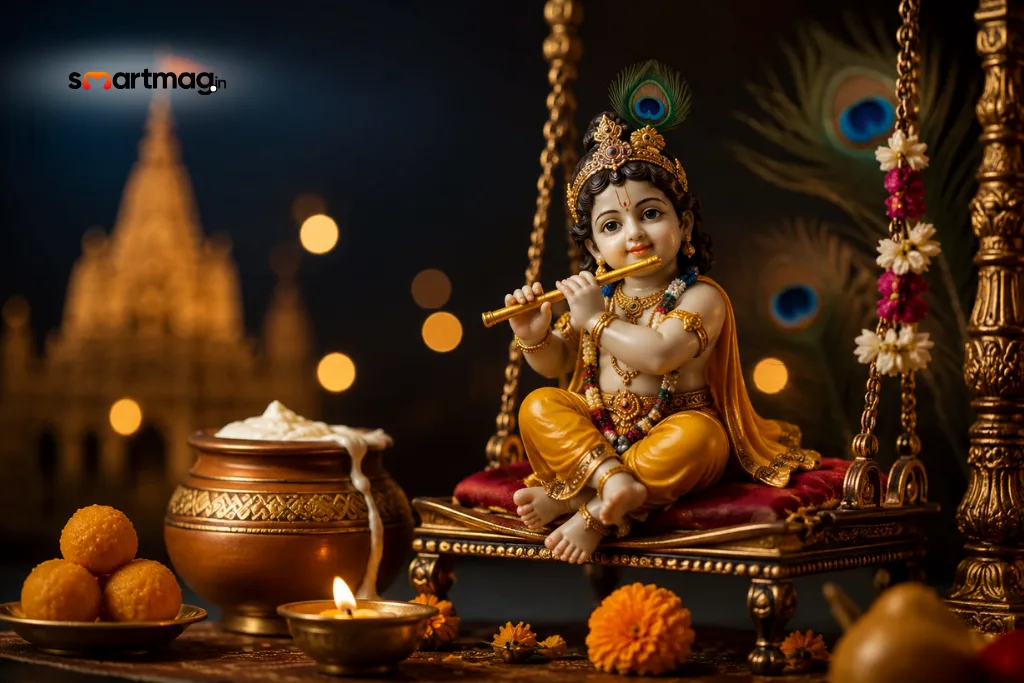
There is something magical about the night of Janmashtami. The narrow lanes of your home start smelling of the freshness of homemade sweets, temples glow with lamps, children dress up as little Krishna, and families wait for the clock to approach midnight. Then, the hour believed to mark the birth of Lord Krishna, prayers, bells, and the devotional songs fill the air.
However, the beauty of Janmashtami is not just limited to one particular region or one ritual. From the midnight celebrations of Mathura and Vrindavan to the energetic dahi handi events of Maharashtra and the tiny footprints of Krishna outside homes in Tamil Nadu, the festival takes on a different character across the country.
So, why is Janmashtami celebrated, and what makes its traditions so diverse? Let’s take a closer look at the festival, its meaning, and the customs in different parts of the country.
When is Janmashtami 2026?
One of the first questions that people often ask every year is when Janmashtami is.
So, this year, Krishna Janmashtami will be celebrated on Friday, 4th September, in most parts of the country. As per Drik Panchang, the Ashtami Tithi will begin at 2:25 am on 4th September and end at 12:13 am on 5th September.
The Nisha period that is associated with the midnight birth celebration falls around midnight, and it slightly varies by location.
| Detail | Janmashtami 2026 |
|---|---|
| Main date | Friday, 4 September 2026 |
| Festival | Krishna Janmashtami |
| Significance | Birth of Lord Krishna |
| Important period | Nishita or midnight |
| Dahi Handi | 5 September 2026 in many places |
The exact timings for puja and fasting can differ by city, as they depend on local sunrise, tithi, and traditional practices. So, devotees should always check a local Panchang before planning for the specific rules.
Why is Janmashtami Celebrated?
At its heart, Janmashtami marks the birth of Lord Krishna, who is worshipped as the eighth avatar of Lord Vishnu as per Hindu traditions.
According to traditional folklore, Krishna was born to Devaki and Vasudeva in Mathura at a time when the city was ruled by the tyrant Kansa. A prophecy had already warned Kansa that Devaki’s eighth son would bring about his downfall, thereby leading him to imprison the couple.
Krishna was born at midnight. Vasudeva then carried the newborn across the Yamuna to Gokul, where he was raised by Nanda and Yashoda.
This story is central to the understanding of why Janmashtami is celebrated. The festival also represents the arrival of Lord Krishna and the triumph of righteousness over oppression. For devotees, on the other hand, it is also the occasion for prayers, devotion, fasting, and reflection.
The festival is particularly important in the Vaishnav tradition, and as per the Government of India’s Incredible India portal, they have described fasting, singing, reading from the Bhagavad Gita, and midnight celebrations as some of the primary customs associated with the festival.
Common Janmashtami Rituals Followed Across India
Though customs differ greatly from one community to another, several Janmashtami rituals are observed widely across the country.
Fasting During the Day
Many devotees observe a fast during the day and eat only after the midnight birth ceremony or as per their family traditions.
The nature of the fast varies too. Some people only consume fruits and milk, while others follow a stricter vrat regime. The focus is more on devotion and self-discipline than simply avoiding food.
Decorating the Home and Temple
Homes and temples are cleaned and decorated with flowers, lamps, rangoli, and images of little Krishna.
A small swing is often prepared for the infant Krishna, especially in households where Laddu Gopal is worshipped. Some families also create miniature scenes depicting Krishna’s childhood in Gokul.
Krishna’s Midnight Birth Ceremony
Midnight is generally the emotional centre of most of the Janmashtami celebrations.
Devotees gather for prayers and bhajans as the birth hour approaches. The idol of little Krishna is then given a ceremonial bath, dressed in new clothes, and placed in a decorated swing. Bells and conch shells are sounded as devotees celebrate the memorable moment.
In Mathura and Vrindavan, these midnight traditions have become elaborate, with temple decorations, devotional performances, and large gatherings.
Bhajans, Kirtans, and Ras Leela
Music and storytelling are an important part of the Janmashtami celebrations.
Devotees sing bhajans and kirtans describing Krishna’s life, while some communities also organise Ras Leela or Krishna Leela performances. These are the dramatic and colourful presentations that bring stories from Krishna’s childhood and his life in Vrindavan to the stage.
This tradition is mainly associated with the Mathura region, but it is also practised in places like Manipur, Assam, Gujarat, and Rajasthan.
Bhog and Traditional Sweets
Food forms an important part of the celebration, though fasting comes first for most of the devotees.
Milk, curd, butter, sweets, and fruits are commonly associated with Krishna’s offerings. In some traditions, elaborate bhog is also prepared and shared with family members and the wider community.
In Odisha, for example, as per the Incredible India portal, Chhapan Bhog, an offering traditionally consisting of 56 varieties of food, forms an important part of Krishna-related devotional food traditions.
How Janmashtami Celebrations Change Across India
One of the most fascinating aspects of the festival is how each region adds its own cultural identity to the Janmashtami celebrations.
| Region | Traditional Janmashtami Customs |
|---|---|
| Mathura & Vrindavan | Midnight birth ceremony, temple rituals, bhajans, Jhankis and Ras Leela. |
| Maharashtra | Dahi Handi, processions, music, and human pyramids. |
| Gujarat | Temple celebrations, devotional singing, and Krishna-themed cultural programmes. |
| Tamil Nadu | Kolams, Krishna footprints, devotional songs, and traditional offerings. |
| Kerala | Temple worship, processions, and Krishna-themed celebrations. |
| Assam & Manipur | Devotional performances, dance, and dramatic presentations. |
| Odisha | Krishna-related temple rituals and elaborate food offerings. |
Mathura and Vrindavan: Celebrating Krishna’s Childhood
There are a few places in India that are closely associated with Krishna, and these places are iconically known as Mathura and Vrindavan.
Mathura is regarded as Krishna’s birthplace, while Vrindavan is associated with his childhood. During the Janmashtami festivities, temples are decorated, devotional songs are performed, and scenes from Krishna’s life are often depicted through Jhankis and cultural performances.
As per the Government of India, leading temples like Shri Krishna Janmabhoomi, Banke Bihari, and other important shrines have become the major centres of the festival.
Well, Vrindavan manages to attract approximately 5 lakh pilgrims every year, with Janmashtami among the periods when the town is at its festive best.
Maharashtra: The Energy of Dahi Handi
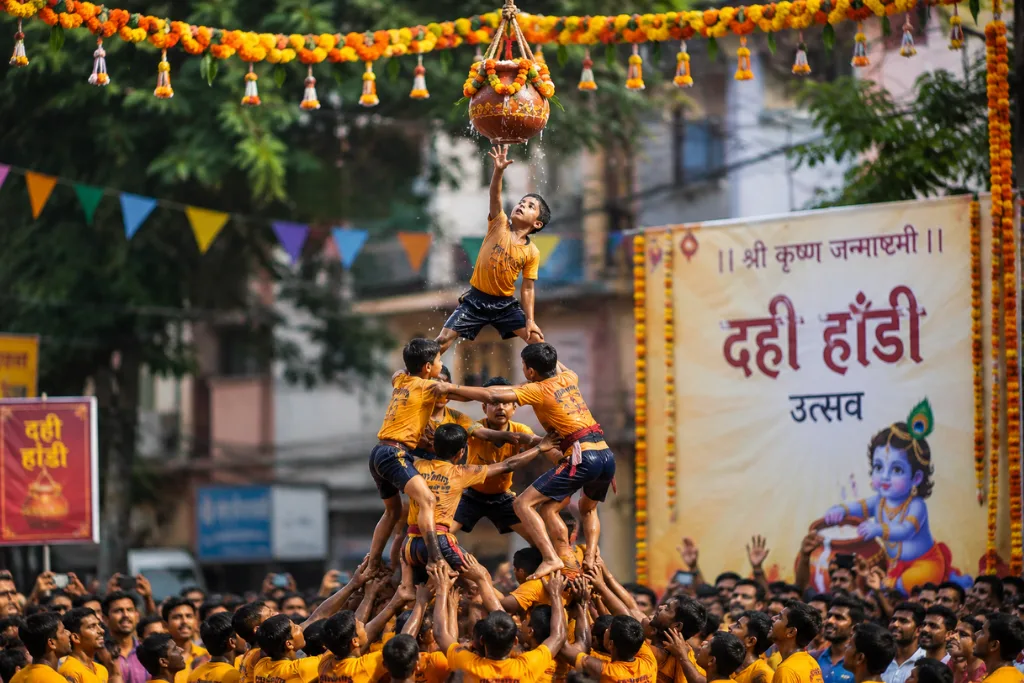
In Maharashtra, the festivities take on a more energetic turn with Dahi Handi.
A clay pot is filled with curd, butter, and other offerings and is generally suspended high above the ground. Teams known as Govindas form human pyramids to reach the clay pot and break it.
This tradition is linked to the story of young Krishna stealing butter and curd with his friends.
Mumbai, Thane, and Pune are famous for hosting Dahi Handi events.
Tamil Nadu: Little Footprints of Krishna
In Tamil Nadu, Janmashtami is often celebrated as Gokulashtami or Sri Krishna Jayanti.
One of the most charming customs is leaving tiny footprints from the entrance of the home towards the puja room. These footprints symbolise baby Krishna entering the house.
Moreover, families also prepare traditional offerings and decorate their homes with kolams. This makes the festival feel particularly intimate, with Krishna’s childhood represented through simple household traditions.
Assam and Manipur: Devotion Through Performance
Moving from the south to the northeast part of India, where Krishna’s story is often expressed through music, dance, and theatre.
Communities make use of devotional performances to bring stories of Krishna’s life to audiences. Such traditions beautifully demonstrate how Janmashtami is not only a religious activity but also a way of preserving regional art and storytelling.
Odisha: Food and Temple Traditions
Odisha adds another unique dimension to Krishna worship through temple-based traditions and devotional food offerings.
The connection between Krishna and the Jagannath tradition often gives the region a rich devotional culture. Food offerings, recitations, and temple rituals form an integral part of the religious celebrations.
Wrapping Up
Janmashtami holds its charm in its ability to bring generations closer effortlessly.
Grandparents may tell children stories about Krishna’s childhood. Parents decorate the house and prepare traditional sweets. Children are often seen dressed as Krishna or Radha, taking part in jhankis, and waiting excitedly for the midnight celebrations.
Furthermore, regional traditions keep on adding new layers to the festival. For instance, a family in Tamil Nadu may welcome Krishna through tiny footprints, a group in Maharashtra may gather for Dahi Handi, while the devotees in Mathura may spend the night at a temple surrounded by bhajans and devotional performances.
A variety of these traditions is what makes Janmashtami 2026 more than just a date on a Hindu calendar. It is a living tradition, shaped by communities and passed on from one generation to the next.
FAQs
1. When is Janmashtami in 2026?
Janmashtami is expected to be celebrated on Friday, 4 September 2026. Puja and fast timings can vary from place to place, and hence, one must check the Panchang of his/her place.
2. Why is Janmashtami celebrated at midnight?
According to the belief, Lord Krishna was born at midnight. Therefore, the Nishita period becomes special during this occasion, and people conduct major birth ceremonies during this period.
3. What is Dahi Handi? Why is it celebrated?
During Dahi Handi, groups of people create human pyramids to break pots containing curd and various items of offering. This celebration is based on the tales about young Krishna’s fun trying to steal curd and butter.
4. How is Janmashtami celebrated in various parts of India?
The theme of celebration is the same, i.e., the birthday of Lord Krishna, but different traditions are followed in different regions. Mathura & Vrindavan celebrate temple rituals and Ras Leela; Maharashtra celebrates Dahi Handi; Tamil Nadu celebrates Krishna footprints and kolams, whereas Northeastern regions celebrate songs, music, dance and drama. (Incredible India)
For more insights on the latest news, business, lifestyle, and trends, explore more stories on SmartMag.