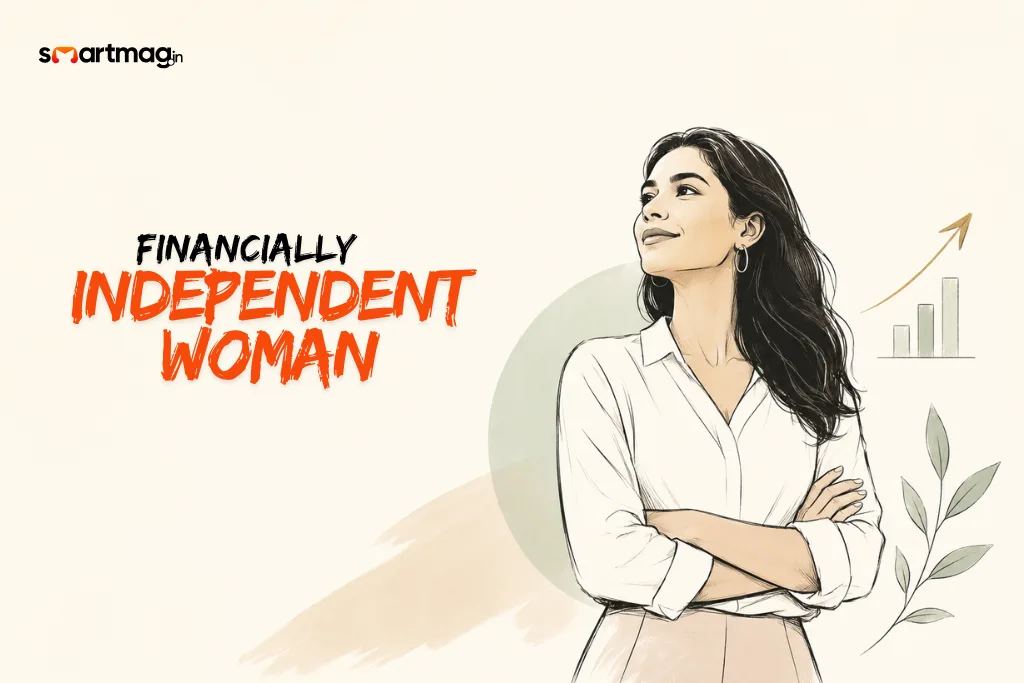
Do you realise that a woman who controls her own finances behaves so differently just in the way she moves around? She enters any room a little taller. She can negotiate better. She can say no for no without asking anyone. This is the subtle confidence of a financially independent Women.
For generations, Indian women have been conditioned to be “good savers” and not be a part of decision-making. The “man of the house” managed money, and women took care of everything else. But the tables are finally turning.
Overall, the complete idea of “being an independent woman” doesn’t relate to only a bank balance. It is about what “money” can do. It lets women live on their own terms, make their own choices, and build a dignified life.
What Does Financial Independence Actually Mean?
Financial independence as a woman means that you are capable of supporting yourself without the need for any man to tell you what to do or how to spend your money.
Here, Kotak Mahindra Bank’s study provides a very valid point of demarcation between economic freedom and financial freedom. Having an income is an example of economic freedom. Having the freedom to make decisions regarding the earnings and whether to save, invest, or spend on whatever you like is financial freedom. One could earn a good amount of money but lack financial freedom if the person is not in control of their earnings.
Why Financial Independence Builds Real Confidence
It is a well-comprehensible fact that there is a direct connection between strong finances and enhanced self-worth. As per the findings of Project Chirag, financially empowered women have the freedom and ability to be helpful to their family and community. When a woman stops seeking validation, they rely only on themselves in all aspects of life.
No, it doesn’t just feel good; it fills one with so much power that they make bold decisions in life without any hesitation. Women with independent finances can reinvest the income for children’s education, nutrition, healthcare, entertainment, and among others. (Overall, they are well-equipped to strengthen everyone in their family)
Financial Independence and Women’s Safety
“Domestic Abuse Hurts One in Five Indian Women”
About 18% women in India in 2025 experience either domestic or marital violence. Twisha Sharma & Deepika Nagar are the most recent relevant examples who lost their lives due to dowry pressure. Twisha, an MBA degree-holder, allegedly faced immense pressure from her in-laws related to dowry.
Unfortunately, this is not the only story we have heard. There have been many Twishas and Deepikas before who have suffered under patriarchal oppression. This has been the bitter truth of our past and, sadly, our present too. It should not define the future of women. Financial independence gives a woman more choices, greater confidence, and the ability to walk away from unsafe situations.
At the same time, education and money are not enough to promise safety. Unconditional support from family, the legal system, and resilience contribute to their safety.
However, financial independence remains the biggest factor that promises safety to a woman. According to a community-based study on domestic violence conducted in Haryana, factors like financial freedom, education, and occupation were found to have a statistically significant relationship with abuse. Educating women and men is essential for their harmonious interpersonal interactions, reducing the gruesome events.
What Radhika Merchant Ambani Says About Financial Independence
Women who have been born into privileged families also feel that being financially independent is non-negotiable. Radhika Merchant Ambani, a director on the board of Encore Healthcare, belongs to the biggest influential family of India, recently said,
“It doesn’t matter whose daughter you are or whose wife you become; you should have financial independence so you can make your own decisions.”
From someone who can easily live off her entire life on her family’s health, this message says a lot. Being an independent woman is about how much control one has over their life choices that too freely.
Case Study: Falguni Nayar and the Confidence Behind Nykaa

Falguni Nayar, the woman behind Nykaa, previously worked for 20 years as the Managing Director at Kotak Mahindra Capital Company. She took a bold decision to quit her corporate job at the age of 49.
Later, she went on to find Nykaa along with three employees in a small office. However, in less than a decade, the app took the Indian marketplace by storm. In fact, the company’s IPO was oversubscribed by almost 82.5 times, making her the richest SELF-MADE woman billionaire in India.
Not only the result but also the mindset that leads to it is important. In the words of Nayar herself, entrepreneurship requires courage, and experience cannot be viewed as a drawback. Her years of experience in finance have helped her feel confident enough to create Nykaa as a sustainable business venture rather than pursue a higher valuation, which is something she learned from her previous experience in banking. Academic sources also point to the fact that Nykaa can serve as an example of entrepreneurship among women.
Women Who Have Shaped India’s Financial Landscape
Falguni Nayar is not the only example. Speaking about India’s financial sector, there are many proud women who are examples of financial independence and empowerment in a true sense.
| Leader | Contribution |
|---|---|
| Shanti Ekambaram | 27 years at Kotak Mahindra Bank; CEO of Kotak Investment Banking. |
| Arundhati Bhattacharya | First woman to chair the State Bank of India; later became CEO of Salesforce India. |
| Madhabi Puri Buch | First woman and first private-sector professional to chair SEBI. |
| Kalpana Morparia | Led leadership roles at ICICI Bank and JP Morgan; also played a key role in the ICICI merger. |
| Renu Sud Karnad | Served as HDFC director for over 30 years and was named Fortune India’s Most Powerful Woman for seven consecutive years. |
How to Become Financially Independent: Practical Steps
- Make sure that you set yourself realistic and achievable targets. Taking into account the inflation rate, a course that costs a few lakhs at present would probably cost much more in about ten years.
- Conduct your own independent analysis, along with seeking guidance from a financial advisor, because then you will never be entirely reliant on the advice of one person.
- Make a plan according to your personal risk profile and life stage instead of imitating your friend’s decisions.
- Invest in diverse areas like equity, bonds, insurance, etc.
- Create an emergency fund that should be sufficient for six months, along with a proper life and medical insurance.
- Monitor your investment portfolio on a regular basis rather than just expecting returns to arrive.
- Keep your records organised because a lack of proper documentation is one of the major reasons why women find themselves deprived of what is rightfully theirs.
- Plan and opt for something structured, such as a SIP each month, because little by little can make a huge difference.
Where Most Women Are Getting Stuck
The survey done by DSP Winvestor Pulse in 2019 showed that only 33% of women in India make independent financial decisions, while 13% of them are coerced into making such decisions after getting divorced or losing their husbands. In addition to this, 80% of women have been introduced to investing by their husbands or fathers rather than taking the initiative themselves.
Taking into consideration that the rate of female participation in the labor force in India was 41.7% as per the Periodic Labour Force Survey 2023-24, it can be said that more needs to be done for women to achieve financial independence.
Conclusion
Being a financially independent woman does not mean how much she makes monthly. What makes her independent is the self-assurance and confidence that come from making her own decisions and securing her own future without asking for permission to do so. And for Indian women, this is certainly not a small thing. Hence, begin slowly, make a plan, be consistent, and results are sure to come.
FAQs
How to become financially independent as a woman?
To begin with, set your financial goals, create a personal bank account, and learn about mutual funds, SIPs, and insurance. Have an emergency fund in place, diversify your investments, and analyse your successes on your own, not according to others’ choices.
What is the role of finance in women’s empowerment?
Financial independence provides women with the power of choice in all matters, including education, healthcare, and the ability to exit situations of domestic abuse. Economically empowered women provide greater income contributions in the household and get a voice in decision-making.
What are the 7 principles of women’s empowerment?
The seven principles have been set out by the UN in its Women’s Empowerment Principles, which were jointly created by UN Women and the UN Global Compact. These include gender equality leadership, non-discrimination at work, health and safety, education and training, inclusive business practices, community engagement, and accountability.
Why does financial independence matter for women’s confidence?
It eliminates the necessity to seek approval for every little thing and, hence, boosts self-respect and decision-making skills. Independent women in terms of money are more confident when it comes to decision-making about their own lives.