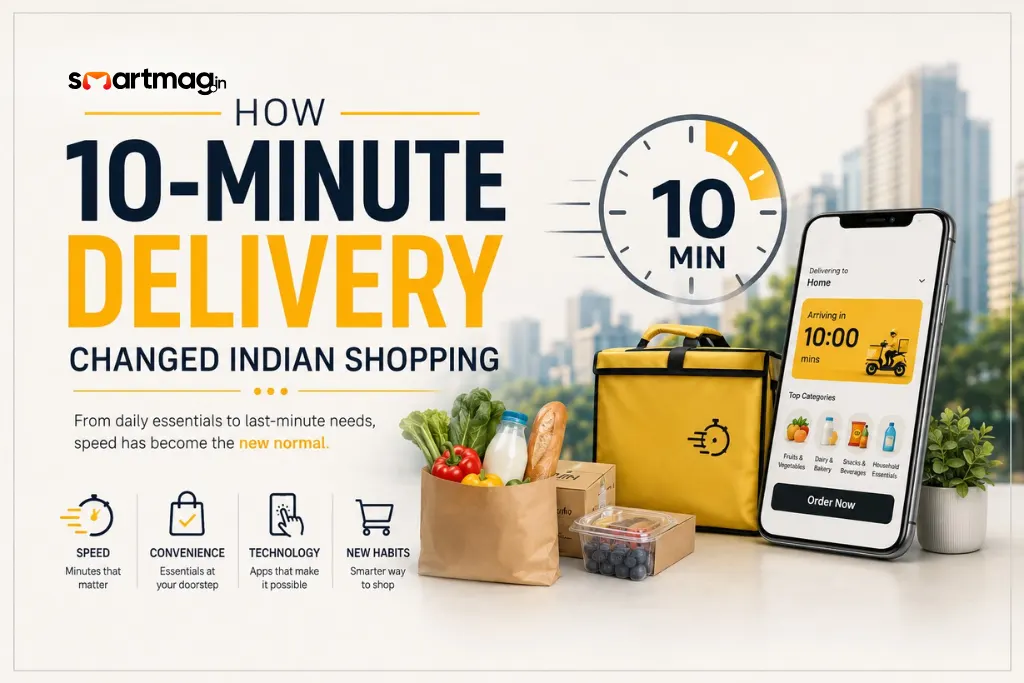
There was a time when running out for milk meant calling the local shop, sending someone downstairs, or adding it to tomorrow’s list. But now, many people open an app, tap twice, and expect it at the door even before the tea water starts boiling.
A change of this kind says a lot about how India shops today.
10-minute delivery has turned convenience into a daily habit. It is no longer about the emergency groceries or forgotten ingredients. People now order snacks before the guest arrives, batteries before a remote dies, sunscreen before leaving home, and even small electronics without planning a store visit.
For the readers of SmartMag, this shift is not simply a retail trend. It clearly shows how technology, lifestyle, traffic, time pressure, and consumer expectations are changing altogether. In fact, the sudden rise of quick commerce has made the speed feel normal, and once the shoppers get used to that speed, slower options start appearing outdated.
What Made 10-Minute Delivery So Popular?
The success of 10-minute delivery did not happen overnight, nor was it because of people becoming impatient. It happened because Indian urban life created the perfect gap.
People are busier. Commutes take much longer. Nuclear families have less help at home. Many young professionals live alone or with flatmates. Weekend shopping is still common, but daily needs have become more unpredictable.
At the same time, smartphones, UPI payments, app-based ordering, and dense city neighbourhoods have made fast fulfilment a breeze. A customer no longer compares shops, calls a retailer, checks for availability, or waits for long hours. Quick delivery apps like Blinkit, Swiggy, Instamart and Zepto bring the shop into the phone.
As per IBEF, India’s e-commerce market was valued at around USD 125 billion in 2024 and is projected to reach USD 345 billion by 2030. This will help in giving a stronger base for the rise of e-commerce brands in India, especially when more shoppers are becoming comfortable with digital buying.
From Planned Shopping to Instant Buying
Conventional online shopping was mostly planned one-on-one. People ordered clothes, applications, books, cosmetics, or electronics and used to wait for delivery. Even same-day delivery felt fast, as the usual expected date of arrival for the parcel would range between one and two days.
However, 10-minute delivery changed this pattern. It reduced the gap between need and purchase. A shopper no longer thinks, “I will order this for tomorrow. Rather, the question becomes, “Can I order this now?”
This is definitely a major psychological shift.
| Earlier Shopping Behaviour | New Shopping Behaviour |
|---|---|
| Weekly or monthly grocery planning | Daily and need-based ordering |
| Waiting one or two days felt normal | Delivery in minutes feels expected |
| Large baskets were common | Smaller, more frequent baskets are rising |
| Search-based buying | App-led discovery and reminders |
| Store visit for urgent needs | Instant order through quick delivery apps |
This is why Q-commerce is totally different from your regular e-commerce. It does not simply sell products online. But it also sells time, certainty, and relief from small everyday problems
Online Grocery Delivery Became the First Big Winner
One of the strongest and most noteworthy impacts of 10-minute delivery has been seen in online grocery delivery. Groceries are repetitive, urgent, and familiar. People already know which milk, bread, flour, oil, or tea they consume. This, in turn, makes the purchase decision quick.
As per the Redseer report, quick commerce commands approximately 70% of online grocery, although online grocery is still around 2% of India’s total grocery retail. This simply means that the opportunity is large as more and more cities and categories are coming online.
For shoppers, online grocery delivery solves three core problems at once, and those are availability, effort, and timing. People can easily order what they need, avoid traffic, and skip long checkout queues.
Why Does Quick Commerce Feel Different from E-Commerce?
Well, regular e-commerce brands grew in India by providing variety, better pricing, reviews, and doorstep delivery. Quick commerce, on the other hand, added something sharper, and that was immediacy.
A customer may still visit traditional shops for a washing machine, sofa, festive outfit, and planned purchase. However, toothpaste, curd, coffee, pet food, cleaning spray, and phone chargers, with quick delivery, feel more convenient.
| Factor | Traditional E-commerce | Quick Commerce |
|---|---|---|
| Main promise | Choice and price | Speed and convenience |
| Delivery time | Same day to several days | Around 10 to 30 minutes |
| Common use | Planned purchases | Urgent and frequent needs |
| Basket size | Usually larger | Often smaller but more frequent |
| Best categories | Fashion, electronics, home items | Grocery, FMCG, beauty, snacks, essentials |
This also does not mean that one model replaces the other one. Both will continue to exist. The major difference is in the shopping moment. When people have time, they compare. When they need something quickly, they use 10-minute delivery.
The Rise of Dark Stores and Local Fulfilment
Behind every fast order is a quiet network of dark stores. These are small fulfilment centres that are placed close to high-demand neighbourhoods. They are not designed for walk-in customers. They simply exist to pick, pack, and dispatch orders quickly.
This is the engine of quick commerce. These platforms study the demand pattern, stock fast-moving items, and assign readers based on the location. The model works best in dense urban areas where many customers live within a short delivery radius.
This is also the reason why 10-minute delivery is much easier in cities like Delhi NCR, Mumbai, Bengaluru, Hyderabad, Pune, and all other sections of the urban markets. In addition, high density also enables the platforms to serve many orders from each fulfilment point.
But this model is not simple. It requires rental costs, proper inventory planning, delivery staff, technology, and strong demand. Speed may look effortless on the app, but the backend is a tightly timed system.
How Are Brands Changing Their Strategy?
The growth of q-commerce has also changed the manner in which brands think. Earlier, brands used to focus heavily on supermarkets, kirana stores, modern retail shelves, and large e-commerce marketplaces.
But now many brands also plan products for fast app-based buying.
Smaller pack sizes, snackable products, impulse categories, beauty minis, ready-to-cook items, and daily-use essentials perform very well on these quick delivery apps. A product that appears at the right time inside an app can also become part of a shopper’s instant decision.
Deloitte and Google have projected that India’s e-commerce market is set to reach USD 250 billion by 2030, with quick commerce becoming a USD 50 billion opportunity. Moreover, the report also suggests that the non-food categories may drive a large part of the future quick-commerce spending.
All this matters because 10-minute delivery is no longer about groceries. Beauty, personal care, stationery, gifting, electronics, accessories, toys, home essentials, and festive products are also joining the cart.
Benefits for Indian Shoppers
The popularity of 10-minute delivery is easy to understand from a customer’s point of view.
| Benefit | How It Helps Shoppers |
|---|---|
| Saves time | No need for a quick store visit |
| Solves urgent needs | Useful for forgotten or last-minute items |
| Reduces planning pressure | People can order as needs appear |
| Offers easy payment | UPI and wallets make checkout smooth |
| Improves access | Many categories are available in one app |
For working professionals, parents, students, and elderly customers, online grocery delivery can reduce daily efforts. While for the households in metro cities, it can make small but repeated tasks easier.
The Concerns That Still Remain
Every fast model comes at a price. Quick commerce still faces questions around profit margin, delivery pressure, packaging waste, traffic safety, worker conditions, and impulse buying.
There is also an added risk of over-ordering. When ordering becomes too easy, people may end up buying things they don’t really need. Delivery charges, handling fees, platform fees, and higher product prices can also make convenience more expensive over time.
Customers should use 10-minute delivery when it genuinely saves time and solves a need. For planned purchases, comparing prices and opting for regular online shopping might be a better option.
The Future of Shopping in India
The future of e-commerce in India will neither be fast nor only cheap. But it will also be flexible.
Customers will be using different channels for different needs. A monthly ration order may still happen through a supermarket or planned app delivery. A mobile may still be purchased after research. But a missing ingredient or a personal care product may come through 10-minute delivery.
This layered behaviour is the real change. Indian shoppers are not moving from offline to online in a single line. But they are moving between kirana stores, malls, marketplaces, brand websites, same-day delivery, and quick delivery apps, depending on the moment.
This is the reason why quick commerce is not only the faster version of shopping, but it has become an instant shopping reflex.
Wrapping Up
10-minute delivery has completely transformed the Indian shopping landscape by making speed an important part of everyday decisions. It has shifted many purchases from planned to instant actions. Moreover, it has also pushed brands to rethink packaging, availability, and app visibility.
It has also made retailers aware of how much convenience matters.
At the same time, not every purchase needs to arrive in minutes. Smart shopping still means knowing when speed is worth paying for and when patience provides better value.
For now, one thing is clear: 10-minute delivery has reset customer expectations. In India’s fast-growing digital retail world, convenience is not simply a bonus. But it is becoming the baseline.
FAQs
What is 10 Minute Delivery?
10-minute delivery refers to a fast retail format that makes products available to consumers in minutes using nearby fulfilment centres or dark stores. This format is commonly found in groceries, snacks, personal care and other essential categories.
How is quick commerce different from conventional online shopping?
Conventional online shopping emphasises variety and comparison, while quick commerce stresses rapid execution, typically for urgent or high-frequency product categories.
Are all quick delivery apps related to groceries?
No, although quick commerce apps gained prominence through groceries initially, their scope has since expanded to cover beauty, electronics, accessories, stationery, gifts, pet care, household, and festival products.
Is q-commerce likely to displace kirana stores in India?
Q-commerce is unlikely to completely displace the kirana stores because some consumers prefer the benefits of local kirana stores, such as trust, credit, and personal service. Nonetheless, kirana stores may have to become more efficient in terms of ordering, payment and delivery.
Stay updated with the latest tech, business, and innovation news, and explore our Write for Us opportunities on SmartMag.