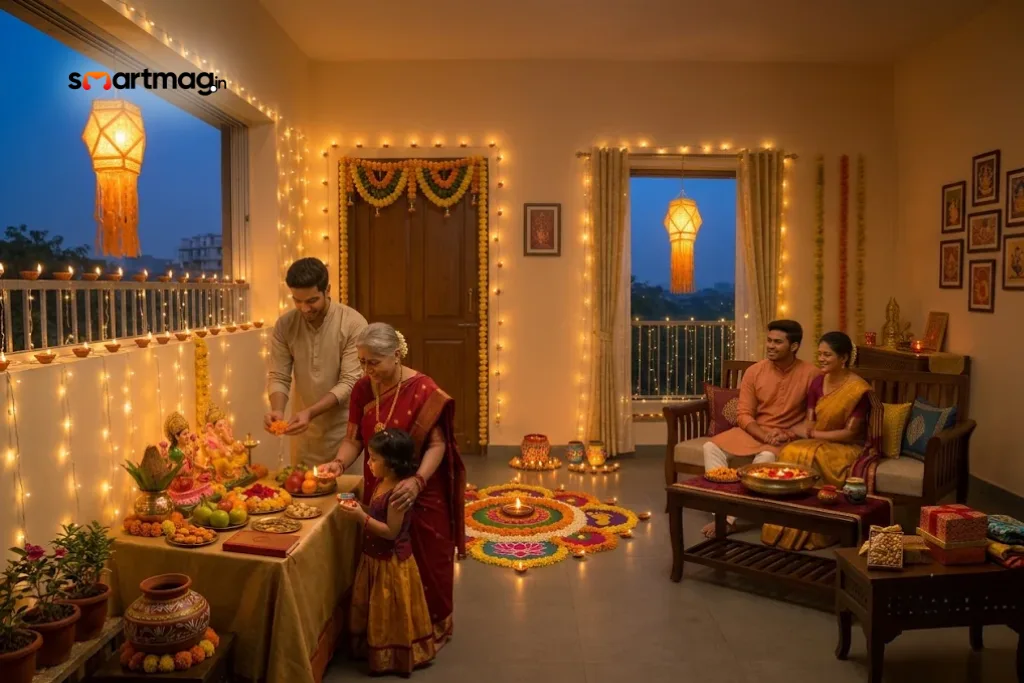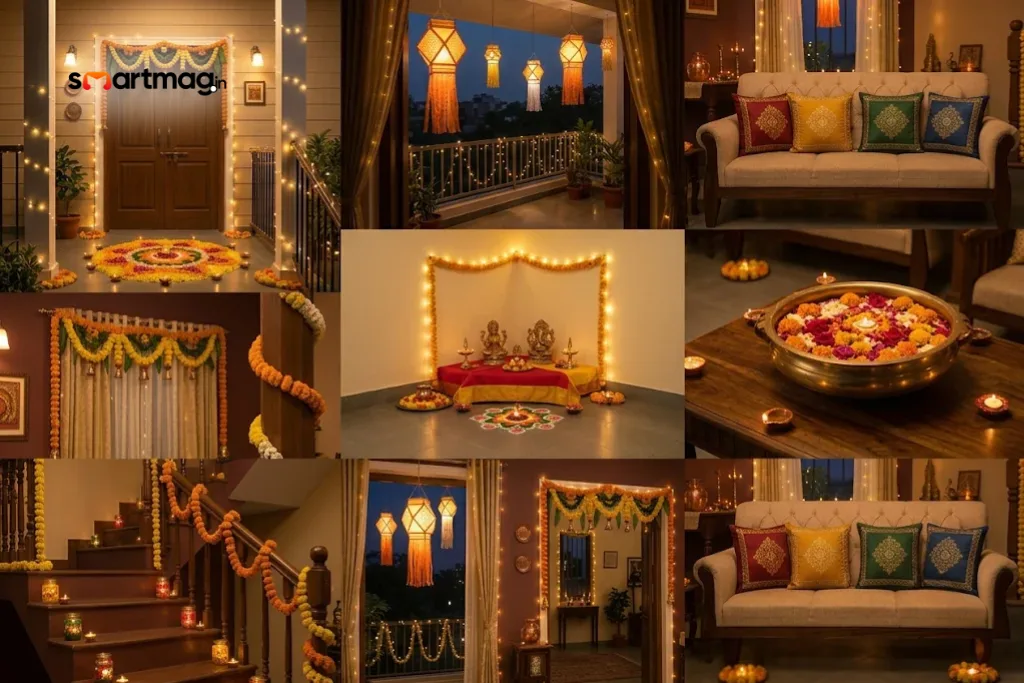
Looking for Diwali decoration ideas that don’t cost a fortune? You’re in the right place, because Diwali 2026 is on Sunday, 8 November, and there isn’t much time left.
Good news: most Diwali home decoration ideas cost under ₹2,000 and take one afternoon. They work in a 2BHK flat, an independent house or a rented room.
Below you’ll find 10 ways to decorate (each with a pro tip), 5 quick extras, a budget plan and a day-by-day checklist for the last few days before Diwali.
When is Diwali 2026?
Diwali 2026 falls on Sunday, 8 November, following Dussehra, which marks the victory of good over evil. Celebrated on Kartik Amavasya, Diwali includes Lakshmi Puja in the evening during Pradosh Kaal. The exact muhurat varies from city to city, so check your local panchang or consult your family pandit.
Diwali celebrations run for 5 days:
| Day | Festival | Date |
|---|---|---|
| 1 | Dhanteras | Friday, 6 November |
| 2 | Choti Diwali (Naraka Chaturdashi) | Saturday, 7 November |
| 3 | Diwali, Lakshmi Puja | Sunday, 8 November |
| 4 | Govardhan Puja | Monday, 9 November |
| 5 | Bhai Dooj | Tuesday, 10 November |
Finish the heavy decorating before Dhanteras. Save fresh flowers and rangoli for 7 and 8 November so they look good on the main night.
Why is Diwali celebrated?
There’s no single answer, and that’s part of the charm. Across India, people celebrate Diwali for different reasons.
In much of north India, it marks Lord Rama’s return to Ayodhya after 14 years of exile and his victory over Ravana. Ayodhya’s people lit rows of diyas to welcome him, which is why we light them today.
Many families also worship Goddess Lakshmi on this night for wealth and wellbeing. In parts of south and west India, Diwali celebrates Lord Krishna’s victory over the demon Narakasura.
Sikhs observe Bandi Chhor Divas on the same day, remembering Guru Hargobind Ji’s release from Gwalior Fort. Jains mark the day Lord Mahavira attained nirvana.
The common thread is light winning over darkness. Which is why decorating your home with lights and flowers is the heart of the festival.
10 Diwali decoration ideas for your home (with pro tips)
1. Hang a fresh marigold toran on the main door
The main door is the first thing guests see. Many families also believe it’s where Goddess Lakshmi enters, so it gets the most attention.
A toran of orange and yellow marigolds with a few mango leaves is the classic Diwali decoration idea for a reason. It looks right, smells great and costs very little.
Pro tip: Buy flowers on the morning of 7 November. Prices jump before Dhanteras, and marigolds only stay fresh for 2 to 3 days. Short on time? A good artificial toran (₹200 to 500) can be reused every year.
2. Draw a rangoli at the entrance
Rangoli is the fastest way to make a doorway look festive. Use rangoli colours, rice flour, coloured sand or flower petals.
A 2 foot circle is enough for a flat. You don’t need a big design to get the effect.
Pro tip: If freehand isn’t your thing, buy a stencil (₹30 to 100 at any puja or stationery shop). Draw on a clean, dry floor, then place a diya on each side once you’re done.
3. Light diyas in clusters
Diyas on every windowsill, staircase step and balcony ledge. Plain clay diyas cost roughly ₹50 to 100 per dozen in local markets.
Group them in odd numbers (3, 5 or 7) and vary the heights with small stands or inverted steel bowls. Clusters look richer than single diyas spread evenly.
Pro tip: Soak new clay diyas in water for 20 to 30 minutes, then dry them before use. They absorb less oil and burn longer. Keep every flame at least 2 feet from curtains, sofas and garlands.
4. Wrap the house in warm white string lights
LED string lights (jhalar) are the easiest way to light up a balcony, window or wall. Expect to pay ₹150 to 500 depending on length.
Warm white looks like diya glow. Multicolour blinkers make a flat look like a wedding venue, which is fine if that’s the mood you want.
Pro tip: Check the box for 2700K to 3000K if you want that golden look. Use adhesive clips instead of nails if you’re renting, and read how many strands you can plug together on one socket.
5. Refresh your puja corner
This is where the family gathers on Diwali night, so it deserves the most care. Wipe down the shelf or mandir, spread a fresh red or yellow cloth and arrange the Lakshmi-Ganesh idols.
Many families set up the puja space in the northeast corner of the home, following Vastu.
Pro tip: Add a tiny rangoli on the floor in front and a diya on each side. A thin string of warm lights around the frame makes the whole corner glow during aarti.
6. Float flowers and tea lights in a brass urli
An urli is a wide, shallow bowl. Fill it with water, scatter marigold and rose petals on top, and add a few floating tea lights.
Brass urlis start around ₹500 and go past ₹2,000 for large ones. A glass or steel bowl you already own works fine.
Pro tip: Put it on the centre table or near the entrance, away from the walkway. Add 2 or 3 drops of attar for a light fragrance, and skip scented candles if you’re also burning incense.
7. Hang an akash kandil on the balcony
The akash kandil is a traditional hanging lantern made of paper, bamboo or fabric. It’s a favourite for flat balconies because it takes zero floor space.
Hang 2 or 3 at different heights so the balcony looks layered from the street.
Pro tip: Put an LED tea light inside instead of a real flame. Paper and fire don’t mix, and balconies get windy. If you’re stringing lights outdoors, check that they’re rated for outdoor use.
8. Fill the living room with fresh flowers and garlands
Tie marigold garlands to curtain rods, wrap them around the staircase railing or hang them on the wall behind the sofa. Fresh flowers do more for a room than any amount of plastic decor.
Mix marigold with rajnigandha (tuberose) for colour and a gentle smell.
Pro tip: Sprinkle water on the garlands every few hours and keep them out of direct sun. They’ll last until Bhai Dooj.
9. Swap cushion covers, curtains and table runners
This is the cheapest way to change how a room feels. Pick maroon, mustard, deep green or royal blue with gold zari or mirror work.
Cushion covers cost roughly ₹150 to 300 each in local markets, and a set of 4 changes your whole living room.
Pro tip: Stick to 2 colours plus one metallic. An old Banarasi saree or silk dupatta makes a great table runner, and you’ve already paid for it.
10. Make a few decorations by hand
Paper lanterns, painted diyas and glass jars turned into tea light holders all look charming, and they give kids something to do while you handle the heavy work.
Handmade pieces also make Diwali decoration eco-friendly, since you can reuse jars, old fabric and cardboard.
Pro tip: Use acrylic paint. It dries in under an hour and doesn’t smell like enamel. Skip thermocol and plastic embellishments, since they’re hard to dispose of after the festival.
5 more quick Diwali decoration ideas
These take 10 minutes each:
- Lakshmi charan stickers on the floor, from the door toward the puja room
- Brass bells or a wind chime hung on the main door
- Tea lights in painted glass jars along the staircase
- A mirror behind a cluster of diyas so the light doubles
- A quick declutter of the entrance and living room, because decor looks better on a clean surface
Diwali decoration budget plan
Prices vary by city and by how close you are to Dhanteras. These are rough numbers.
| Budget | What You Can Do |
|---|---|
| Around ₹500 | 2 dozen diyas, a marigold toran, rangoli colours, 1 string light |
| Around ₹2,000 | The above plus 3 cushion covers, an urli with petals and 2 more light strands |
| ₹5,000 and up | Full puja corner, new curtains or runners, balcony lanterns, fresh flowers on the main day |
Pro tip: Local markets are usually the better bet right now, since online delivery slots fill up fast before Diwali.
Diwali decoration checklist for the last few days
Before Dhanteras (6 November): Clean the house. Buy diyas, string lights, rangoli colours and cushion covers. Put up the lights.
Choti Diwali (7 November): Pick up fresh flowers. Make the toran, set up the puja corner and light the first diyas in the evening.
Diwali day (8 November): Draw the rangoli in the morning. Fill the diyas with oil by afternoon and light them before Pradosh Kaal begins.
FAQs:
When is Diwali 2026?
Diwali 2026 is on Sunday, 8 November. Dhanteras is on Friday, 6 November, and Bhai Dooj is on Tuesday, 10 November.
Why is Diwali celebrated?
Diwali celebrates the victory of light over darkness. Many people mark Rama’s return to Ayodhya, others worship Goddess Lakshmi, and Sikhs observe Bandi Chhor Divas on the same day.
What are the best Diwali decoration ideas for small flats?
A marigold toran, a stencil rangoli, warm string lights on the balcony, an urli with floating flowers and new cushion covers. All five fit in a small space and cost under ₹2,000 together.
How much does Diwali home decoration cost in India?
A basic setup costs around ₹500. A full home refresh with flowers, lights and soft furnishings is usually ₹2,000 to 5,000.
Which colours work best for Diwali decoration?
Marigold orange, yellow, red, maroon, deep green and gold are the traditional picks. Warm white lights go with all of them.
Are eco-friendly Diwali decorations worth it?
Yes. Clay diyas, fresh flowers, cloth lanterns and reusable jars look better than plastic and don’t pile up as waste after the festival.
Final word
Pick 3 ideas from this list, buy what you need this week and you’re done. A clean entrance, good lights and fresh flowers will carry the whole house.
Happy Diwali.