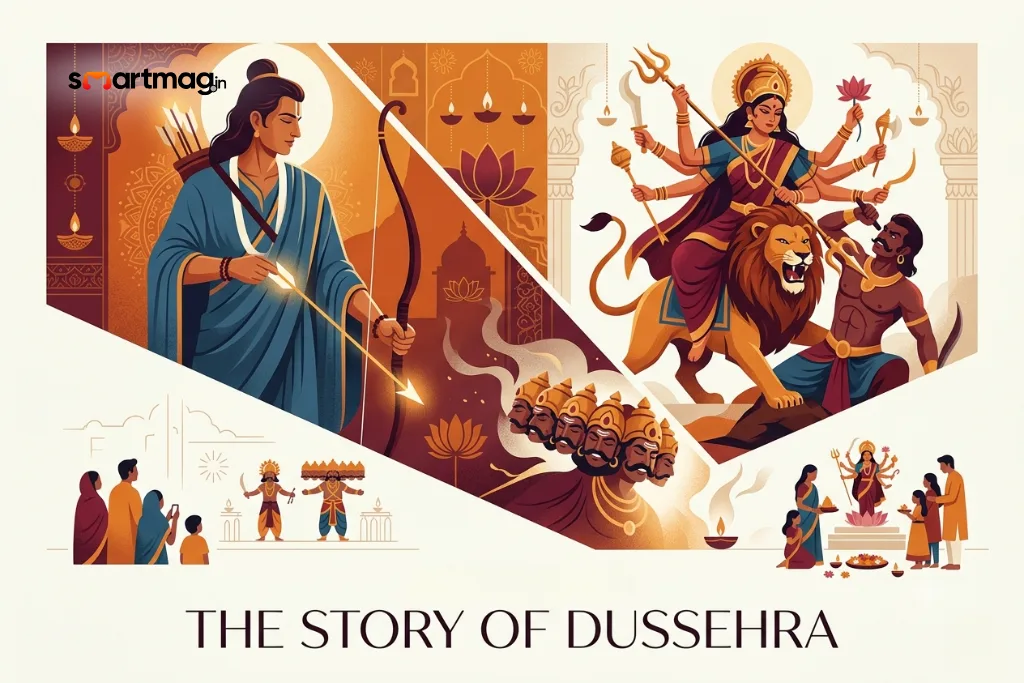
A towering Ravana lights up the evening sky. Somewhere else, families gather to bid farewell to Goddess Durga. Both moments belong to a festival whose message reaches beyond the spectacle.
The tale of Dussehra tells us of the vanquishing of evil and the reestablishment of righteousness. Based on tradition, it may be about either Lord Rama’s triumph over Ravana or Goddess Durga’s defeat of Mahishasura.
Here at SmartMag, we look behind popular celebrations. Here’s why Dussehra is celebrated by delving into its history.
Dussehra Meaning: What Do the Names Tell Us?
Dussehra is also commonly referred to as Vijayadashami. The words “vijaya” and “dashami” in Sanskrit denote victory and the tenth day, respectively.
A common interpretation of Dussehra’s meaning involves the words “dasha” and “hara.” While the former refers to ten, the latter stands for defeat, symbolizing the ten heads of Ravana. According to Maharashtra Tourism, this explanation appears in their festive guide.
The celebration takes place on the tenth day of the bright fortnight of the Hindu month Ashvina after Navratri celebrations during the autumn season. Its date in the Gregorian calendar differs every year.
Knowledge about the meaning of Dussehra allows one to associate the name with the Dussehra legend. Furthermore, it helps us understand why the concept of victory is common among various traditions.
Why Do We Celebrate Dussehra?
Dussehra is celebrated as a reminder of the triumph of good over evil and the divine beings involved in this triumph.
There is much to think about regarding behavior from the Dussehra story. Courage is certainly important; so is restraint and the ability to stand up for what is right.
Dussehra celebrations bring all of these concepts to life in worship, performances, and communal activities. The stories are passed down from one generation to another in the family, and the local culture makes each festival unique.
This means that Vijayadashami is both a religious and a cultural event.
The Dussehra Story of Rama and Ravana
Most of northern India is familiar with the story of Dussehra from the epic Ramayana.
Sita, Rama’s wife, was abducted by Ravana, who ruled Lanka. Rama seeks her rescue and gains assistance from Hanuman and friends.
It results in the defeat of Ravana by Rama. To devotees, such a victory is viewed as the return of dharma, which is regarded as righteousness and morality.
The story of Dussehra is not only a story about two powerful figures vying against each other. It makes the reader think about what will happen when power becomes amoral.
Ravana’s defeat becomes an indication of the fact that ability and social position cannot serve as an excuse for evil deeds. Rama’s success is a sign of the significance of doing right things despite all difficulties.
In many places, the end of the story is made into the core of Dussehra celebrations. The huge effigies of Ravana are burnt along with those of Kumbhakarna and Meghnad.
Such performances provide visibility and popularity for the Dussehra story, especially among family audiences.
Goddess Durga and Another Victory Tradition
Another Dussehra story that goes well with the tradition of Durga Puja is that of Maa Durga defeating Mahishasura. It is yet another way in which the Dussehra tale is narrated differently, keeping the basic theme in mind.
In Bengal, Vijayadashami symbolizes the completion of Durga Puja, with the immersion of idols of Durga. The Incredible India Festival Guide states the regional connection for this tradition.
Having knowledge of both stories helps us get more insight into the Dussehra story. The significance of Dussehra includes resistance against oppression, as opposed to being related to just one version.
In addition, it avoids the common misconception that Dussehra celebrations include the burning of Ravana.
Dussehra History: Stories and Living Traditions
The history of Dussehra includes mythological stories, royal influence, and community traditions formed in different places.
One must make the difference between the story behind Dussehra and its historical development in a specific area. Myths provide explanations of religious beliefs; accounts of processions and royal celebrations relate to ways of celebrating the event.
There is no single history of Dussehra that would provide the answer to all the regional variations.
For instance, there is a clear historical link between the royal Dasara tradition in Mysuru and the Wadiyar rulers. However, other regions have created their own customs with regard to deities or communities.
In order to address Dussehra history at SmartMag, we use the above differences.
They allow us to understand how the same celebration can have several identities at once.
How Does a Dussehra Celebration Differ Across India?
The Dussehra story moves from performance to procession to ritual. The experience of the devotees varies according to the place of celebration.
| Region or Place | A Prominent Tradition | What It Highlights |
|---|---|---|
| Northern India | Ramlila and Ravana effigy burning | Rama’s victory in the Ramayana |
| Bengal | Durga Puja concludes with immersion | Farewell to the Goddess and her victory |
| Mysuru, Karnataka | Dasara processions and cultural programs | Worship of Goddess Chamundeshwari and royal heritage |
| Kullu, Himachal Pradesh | Gatherings and processions of local deities | Community devotion beginning on Vijayadashami |
| Kerala | Vidyarambham ceremonies | An auspicious beginning to learning |
| Bastar, Chhattisgarh | Traditions centered on Goddess Danteshwari | Local religious heritage beyond the Ravana narrative |
According to Kerala Tourism, Vijayadashami is an “auspicious day when children take their first steps in learning letters in a ritual called Vidyarambham.” Kerala 365
Bastar Dussehra does not celebrate the defeat of Ravana but is connected to local religious traditions, says Incredible India.
This is the reason why Dussehra history should be viewed from the regional perspective, as well as because of the changing meaning of Dussehra.
Dussehra Traditions in Numbers
Some of the confirmed numbers go a long way in showing the extent and range of the traditions.
Ramlila was added by UNESCO to the Representative List of the Intangible Cultural Heritage of Humanity in 2008 after having been proclaimed in 2005.
The 10- to 12-day duration of many Ramlila celebrations is mentioned by UNESCO, but there are celebrations such as Ramnagar that last a whole month.
Incredible India mentions that the celebration of Bastar Dussehra lasts for about 75 days.
These numbers do not indicate that the festival of Vijayadashami continues for weeks. It refers to the cultural events connected with the festival.
It also indicates how the legend of Dussehra and the history of Dussehra survive in the form of community participation.
It is only by understanding the significance of Dussehra for the people organizing it that one can truly understand a Dussehra festival.
What Does the Festival Teach Us Today?
What is the importance of Dussehra? Apart from following tradition, there is also something that makes many reflect upon themselves.
The lessons from Dussehra could include lessons about pride, lying, and abuse of power. This is one way of looking at the morals of Dussehra, not necessarily a set rule for all communities.
| Festival Theme | A Practical Way to Reflect on It |
|---|---|
| Victory over destructive behaviour | Recognise a harmful habit and work to change it |
| Courage | Speak up respectfully when something is wrong |
| Renewal | Begin a meaningful task with commitment |
| Community | Participate with consideration for others |
The significance of Dussehra is better understood when it is accompanied by reflection. A meaningful celebration of Dussehra allows one to enjoy it along with understanding its values.
Wrapping Up
The significance of the Dussehra tale is still compelling due to the relation between celebration and introspection. The various customs associated with Dussehra celebrate triumph, devotion, and the opportunity for a new start.
Insight into the Dussehra significance allows one to see beyond the fireworks and parades associated with the festival. Learn about the tales associated with your favorite festivals at SmartMag, and enhance your Dussehra celebrations.
FAQs
What is the main story related to Dussehra?
It is about Lord Rama’s triumph over Ravana in most parts of North India. Goddess Durga defeating Mahishasura forms the essence of the festivals that come under Dussehra celebrations.
What is the difference between Dussehra and Vijayadashami?
The two are synonymous. There is no difference between the two.
Does Dussehra history begin with one recorded event?
No single founding date explains all its traditions. Sacred narratives and the documented development of regional celebrations form different parts of its history.
Are Dussehra and Diwali the same?
No, both are distinct festivals. While in many practices Diwali celebrates the return of Rama to Ayodhya at a later stage, Dussehra is celebrated for the victory of Rama over Ravana.
Explore more articles on SmartMag to discover the history, traditions, and cultural significance behind Dussehra and other Indian festivals.