What does taking a pinch of salt do to an empire? Back in 1930, it exposed the unjust law of the land to the world. That moment captures what made Mahatma Gandhi an unusual political leader: he turned everyday actions into ways for ordinary people to challenge power.
Gandhi Jayanti 2026, observed on October 2, marks the 157th anniversary of his birth. While it serves to revisit the picture of his philosophy through history, one must go beyond the image and ponder how his philosophy functioned. Satyagraha, Ahimsa, Swaraj, and Seva are all interlinked aspects of his philosophy. And of course, who gained freedom from it?
What Did Satyagraha Ask People to Do?
Satyagraha is often explained as holding firmly to truth. However, for Gandhi and his followers, this concept implied being openly defiant against an unjust law without employing violent measures towards those who would enforce it. Protests could involve people rejecting cooperation, enduring arrests, and marching regardless of possible consequences.
This requires patience but also much more. It involves the protesters making injustices known while restraining themselves from reacting violently towards the situation. Gandhi insisted that the way people protested against something was just as important as their objective. They had to reject the oppressive structure while not seeing everyone else as their enemy.
It was a demanding approach. A campaign needed a grievance people understood, volunteers willing to act, and discipline when authorities responded. It also needed people who might otherwise have stayed apart to recognise a shared cause.
How Did a Local Grievance Become a Public Movement?
The struggles for independence initiated by Gandhi were not always founded upon a theoretical discussion of the concept. His efforts frequently stemmed from the practical reality that people had to deal with on a day-to-day basis.
In Champaran in 1917, Gandhi took up the complaints of indigo growers. The struggle dealt with the way farmers were being treated within a system that was formed by colonial rule. The example of Gandhi in Champaran demonstrated the importance of listening to the plight of the poor and bringing their problems into public awareness.
This explains how he managed to reach out to many people through his later moves. Instead of demanding that they take an interest in politics as an abstract entity, Mahatma Gandhi related political power to farming, clothing, labour, and domestic needs.
These are three instances that highlight the diversity of his approaches:
| Campaign or initiative | What people challenged or built | Why it mattered |
|---|---|---|
| Champaran, 1917 | The treatment of indigo cultivators | A local grievance gained national attention |
| Salt March, 1930 | British control over salt | An everyday necessity became a symbol of resistance |
| Constructive program | Work on sanitation, village livelihoods, and social inclusion | Reform became something communities could practise |
Through these instances, Gandhi Jayanti 2026 becomes more than just a date to celebrate; it illustrates how public action may start when individuals understand the larger system involved in a problem.
Why Was the Salt March So Powerful?
The use of salt as the subject of resistance was a very easy and rational decision because all classes of people needed it, and it was governed by law. It was easy for the government to justify the importance of breaking the law since it was controlling something necessary for people’s lives.
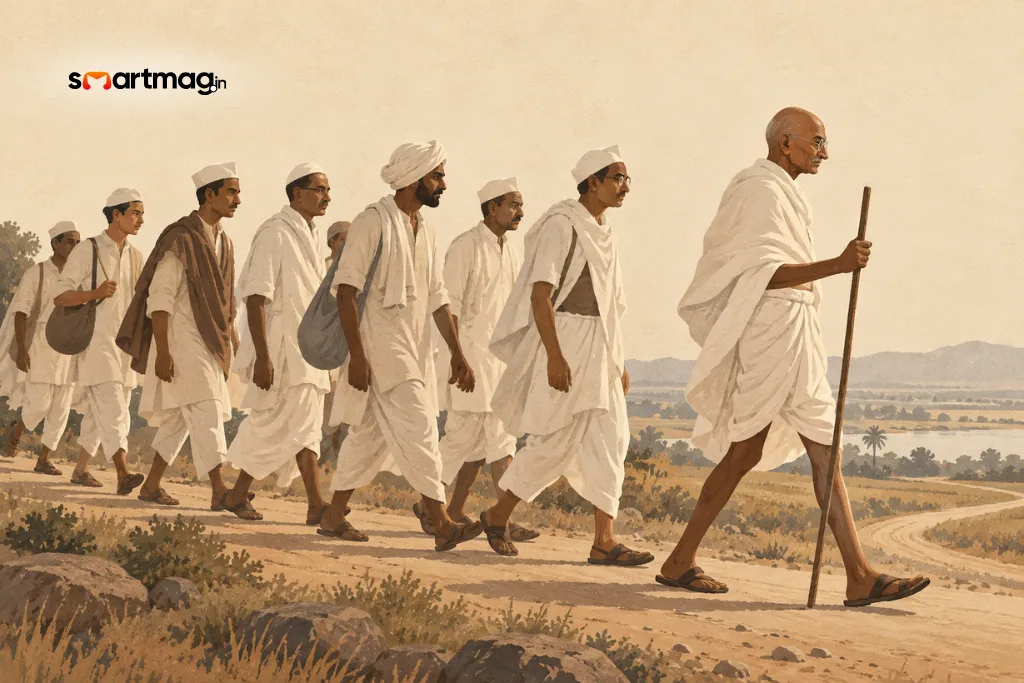
On March 12, 1930, Gandhi left Sabarmati Ashram with 78 followers on his way to Dandi. According to the Gandhi Heritage Portal, it was a 241-mile-long march. This walk gave people time to follow Gandhi’s movement, while the breaking of the salt law became a focal point of the campaign.
The march did not achieve independence instantly. The power of the march came from the ability to demonstrate how a policy could become an issue of legitimacy through civil disobedience. Mahatma Gandhi employed a small gesture to illustrate the scope of colonialism, while others continued the salt protest in the wake of his march.
In the spirit of Gandhi Jayanti 2026, this does not mean that all causes require a symbolic march. It means that people will be better able to organize themselves to bring about changes when they can identify problems and solutions.
Nonviolence Was a Strategy as Well as a Principle
Ahimsa, or the doctrine of nonviolence, was an ethical stance adopted by Gandhi. However, it was also key to how Gandhi mobilised political action. The refusal of violence meant that the protesters were able to assert themselves against authority without forfeiting their right to a new public life.
It certainly did not render the movement risk-free. Protesters had to deal with arrest and even more unpleasant punishments. It did not imply passivity either. Nonviolent protests such as boycotts, marches, and even breaking the law could disturb everyday activities.
Gandhi’s influence reached well beyond India. The Martin Luther King, Jr. Research and Education Institute documents how Gandhian ideas shaped King’s approach to nonviolent struggle in the United States. King and other civil rights leaders developed their own movement in a different context; they did not simply repeat India’s campaign.
That global reach is one reason October 2 has a second meaning. The United Nations established it as the International Day of Non-Violence in 2007. On Gandhi Jayanti 2026, both events would present an opportunity to reflect on not only Gandhi’s historical significance to India but also nonviolence elsewhere.
Why Did Gandhi Connect Freedom With Everyday Work?
In the view of Mahatma Gandhi, freedom was not merely about one regime being replaced by another; it was also about people changing their way of life.
Through his constructive program, emphasis was laid on activities like sanitation, village industries, education, and anti-untouchability campaigns. Khadi and spinning were one such activity, which allowed one to challenge one’s dependence on foreign-made clothes while producing local ones. The Government of India’s Gandhi Smriti describes this program as an effort to pursue individual and social change together.
This part of his legacy receives less attention than a march because much of it was slow and repetitive. Cleaning a shared space or sustaining local work does not produce a single famous photograph.
Yet it addresses a difficult question: what happens after a protest ends?
Gandhi Jayanti 2026 can be a day to ask that question. If a community wants change, what can its members build or improve while they continue pressing institutions to act?
Can We Remember Gandhi Without Ignoring Disagreement?
One constructive interpretation of Gandhi’s legacy is that it allows for critique. The role played by Gandhi in opposing untouchability was important, but it did not end the debate about the larger issue of caste and political power.
R. Ambedkar, one of the major figures advocating for the protection of the rights of oppressed castes, was critical of Gandhi’s philosophy. This dispute was particularly brought out in connection with the 1932 Poona Pact, which related to separate electorates.
The conflict is described in Columbia University’s history guide to South Asia.
Recognizing this point clarifies the historical narrative. Mahatma Gandhi was instrumental in India’s struggle for independence, whereas other figures presented alternatives to the problems plaguing the nation. Social transformation could not have been the product of any one individual.
That may be the most valuable way to observe Gandhi Jayanti 2026: read his ideas seriously, examine their results, and listen to those who disputed them.
Wrapping Up
The problems of 2026 are unlike those faced in colonial India. Even so, Gandhi’s approach poses some pragmatic concerns. Is it possible to define an injustice properly? Is it possible for people to cooperate without needing agreement on everything? Is it possible for an activist movement to attack the establishment and create something constructive at the same time?
Gandhi Jayanti 2026 need not have ready-made solutions to everything. Rather, it can be the start of an open discussion on the issues of courage, non-violence, and persistence in achieving any change. The Salt March is one example of a memorable event because of the way a small step conveyed a much bigger message. But Gandhi’s legacy as a whole teaches us that it is only half of the job done.
FAQs
When is Gandhi Jayanti 2026, and what does it commemorate?
Gandhi Jayanti 2026 falls on Friday, October 2. It marks the 157th birth anniversary of Mahatma Gandhi, who was born in 1869. The date is also observed worldwide as the International Day of Non-Violence.
What is Satyagraha?
The term ‘Satyagraha’ means sticking to the truth. It was a technique of non-violent resistance against injustice through methods like marches, boycotts, and civil disobedience by Gandhi.
What is the reason why Gandhi picked salt for the protest of 1930?
Salt was a basic need, and the British Salt Act affected all strata of Indian society. When Gandhi marched to Dandi and broke the Salt Act, he highlighted colonial rule through an easy-to-understand process of civil disobedience.
Was there consensus on Gandhi’s method for social transformation?
No. Dr. B. R. Ambedkar disputed Gandhi’s stand on caste and politics during the discussions preceding the signing of the Poona Pact in 1932. The controversy between them is crucial to the history of the Indian independence struggle and its ongoing battle for
For more blogs related to Indian history and current affairs, explore SmartMag