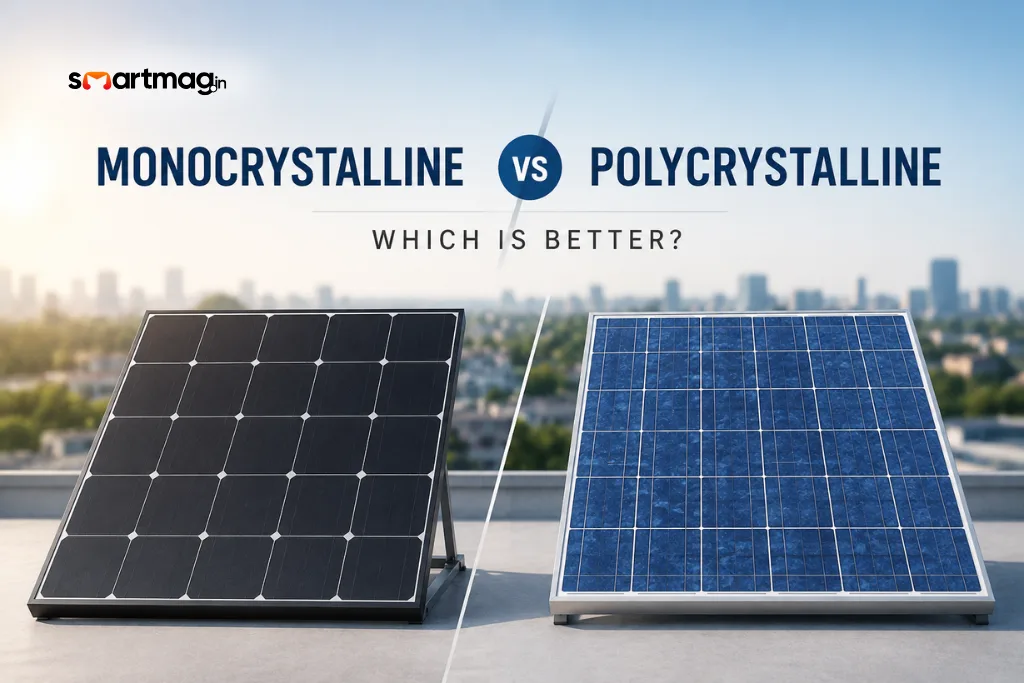
When your roof size is limited, monocrystalline solar panels make more sense than polycrystalline panels. While they have a higher upfront cost, their efficiency makes up for that, as fewer solar panels will be required. For larger and budget-friendly Indian families who do not mind spending extra on their rooftops, polycrystalline solar panels work well. There is no best option for all since the choice will depend upon roof space available, budget, and climatic conditions. However, for compact urban households with limited rooftop space, choosing monocrystalline panels will prove to be a smart solar investment.
Key Takeaways
- Monocrystalline panels consist of single-crystal silicon cells and have an efficiency ranging from 17 to 23 percent.
- Polycrystalline panels consist of multiple silicon fragments and have an efficiency of 13 to 17 percent.
- Monocrystalline panels are black in color, while polycrystalline panels are distinctly blue.
- Monocrystalline panels and polycrystalline panels both last for 25 years or more, with warranties for the same period in India.
- Monocrystalline panels perform better in heat and low-light conditions, making them suitable for Indian summers.
- Polycrystalline panels are cheaper on a per-watt basis and hence are more preferred for large rural roofs.
- Under the PM Surya Ghar Yojana scheme, subsidies up to ₹78,000 are available.
- Choosing the right solar panel company in India is as important as choosing the panel itself.
What Are Monocrystalline Solar Panels?
Monocrystalline solar panels are made up of one solid block of silicon crystals arranged in a cylinder-like shape. The ingot of this material is then cut into thin slices and used to make the solar panels. Due to the uniform arrangement of the crystals, electrons can move easily inside each cell, and that is why monocrystalline solar panels are so efficient. Additionally, monocrystalline solar panels can be as high as 23 percent efficient.
What Are Polycrystalline Solar Panels?
Polycrystalline panels are produced by melting several silicon fragments in the mould together. It is an easier and more cost-effective production process. But several crystal boundaries limit the movement of electrons, decreasing their efficiency rate. While monocrystalline panels exhibit a deep black color, the polycrystalline cells have a blue appearance along with spots. Speaking about the efficiency of poly solar cells, it can reach a maximum of 20%.
Monocrystalline vs Polycrystalline Solar Panels: Quick Comparison
| Factor | Monocrystalline Solar Panels | Polycrystalline Solar Panels |
|---|---|---|
| Efficiency | 17% to 23% | 13% to 20% |
| Cost per watt | Higher | Lower |
| Appearance | Black, uniform | Blue, speckled |
| Lifespan | 25+ years | 25+ years |
| Performance in heat | Better | Slightly weaker |
| Roof space needed | Less | More |
| Best suited for | Small urban rooftops | Large rural or suburban rooftops |
Efficiency: Why It Matters for Indian Rooftops
Efficiency determines the amount of energy that is generated by the solar PV panels per square meter of your roof area. Monocrystalline solar panels are very efficient in generating energy and take up less space. This is important because Indian residential terraces have limited space. Polycrystalline solar panels require additional space in order to generate the same amount of energy. If your terrace has a water tank or is being used for gardening, go for monocrystalline.
Cost: What an Indian Household Actually Pays
For most Indians, money makes all the difference when considering the adoption of solar power. The monocrystalline panels cost more due to the complicated procedure involved in their manufacturing process. On the other hand, the polycrystalline panels cost less, which works perfectly for those who have an expansive roof and are mindful of the money. Take note that the cost of the inverter, wiring, mounting, and labour will be the same for both panels.
The PM Surya Ghar Muft Bijli Yojana subsidy helps reduce this expense in the case of both solar panels. The amount of this subsidy goes as high as seventy-eight thousand rupees for a three-kilowatt system.
Performance in Indian Weather Conditions
India has hot summers, and panel efficiency decreases with rising temperatures. Monocrystalline panels have a lower temperature coefficient, which means there is a reduction in power at high temperatures. Monocrystalline panels are an ideal choice for states such as Rajasthan, Delhi, and other central states. Polycrystalline panels warm up easily and experience a slightly higher loss in performance during summer periods. The effect may not be that obvious in electricity production for coastal and cooler areas.
A Typical Indian Household Scenario
Imagine a family living in a Mumbai apartment with just 300 square feet of roof terrace. Even with the water tank and clothes drying on it, along with certain restrictions imposed by society, the usable space gets even smaller. Using monocrystalline solar panels will enable the family to produce a sufficient amount of electricity without using all the available space.
On the other hand, imagine a farmhouse located somewhere near Nashik that has a large roof area of several thousand square feet. In this scenario, polycrystalline panels are a better choice financially.
Solar Power Panels: The Bigger Picture Beyond Silicon Type
Monocrystalline and polycrystalline solar power panels both work on the principle of the photovoltaic effect. The sunlight falls on the silicon cells and dislodges the electrons, thereby generating an electric current. Both kinds of panels are eligible for net metering so that any excess energy generated can be sold back to the grid. There is no need for much maintenance apart from regular cleaning in either type of panel.
Why the Right Solar Manufacturing Company in India Matters
Panel type is just one part of the puzzle when deciding on rooftop solar. Selecting a reputable solar panel manufacturing company from India, such as Inter Solar, will ensure that you get consistent quality with actual warranty coverage. Several solar panel manufacturing companies in India are now manufacturing monocrystalline and polycrystalline panels locally to aid the Make in India initiative of the government. Ensure that the BIS-certified and ALMM listed panels are selected by you.
How to Pick the Best Solar Panel Company in India
When deciding on the best solar panel company in India, consider more than just price. Consider the reputation of the company, its after-sales services, and how it addresses any grievances raised by its customers. Enquire if they provide both monocrystalline and polycrystalline panels. An installer should evaluate your roof, shading conditions, and energy requirements to recommend the right type of solar panel. Such a customized solution is better than the general information you may get online.
Maintenance Tips for Indian Weather
Indian rooftops accumulate dust quite fast, particularly during dry seasons in densely populated urban areas. Cleaning both types of panels is required after every two or three weeks during dusty periods. The monsoons do take care of the dirt on the panels, but you will have to remove the standing water from time to time and also treat the panels against algae growth. Firecracker residues during the Diwali season add another pollutant that may deposit itself on your panel’s surface. Simply cleaning the panel using water and a soft cloth brings back almost all of its lost efficiency.
Conclusion
Both monocrystalline and polycrystalline solar panels are ideal options for Indian households at present. Monocrystalline is good for small rooftops where efficiency and heat resistance are required, whereas polycrystalline is suitable for large areas with adequate budget. Consider your rooftop size, climate, and budget while selecting one among the two. In either case, choose the best solar panel company in India for reliable installation, genuine warranties, and long-term support.
Enjoyed the read? Discover more on Smart Mag or write for us.