Foam is an important material that is used in a variety of industries, from upholstery to automotive manufacturing. But have you ever imagined how is foam made? In this blog, we will walk you through the complete foam manufacturing process, thereby breaking down each step involved in creating exceptional-quality foam for a wide range of applications.
Manufacturing Process: An Overview of How Is Foam Made
The production of foam is a highly meticulous process which requires accuracy and expertise to ensure the right texture, durability, and functionality. The process starts with the careful selection of raw materials that are mixed and processed in foam machines. So, understanding a foam manufacturing process will help you in appreciating the versatility and quality of foam products in daily life.
Well, one of the most common techniques for large-scale foam production is the continuous slab foaming process, which provides uniformity and efficiency.
Let’s take a closer look at how foam is made and what goes into creating an ideal foam for different uses.
Step 1: Selection of the Raw Material
As a first and foremost step, the foam manufacturing process starts with the selection of raw materials. The primary components used for creating a foam are:
- Polyols: They are the organic compounds that help in forming the base of a foam.
- Isocyanates: They react with polyols to trigger a chemical reaction that helps in creating foam.
- Additives: A wide range of additives, like stabilisers, catalysts, and blowing agents are included to control the density, texture, and performance of a foam.
Therefore, each material plays an important role in shaping the final properties of the foam, like firmness, resilience, and moisture resistance.
A well-calculated balance of these ingredients is a key to producing foam that will meet all the required specifications for different applications.
Step 2: Mixing the Ingredients
Once the raw materials have been selected, they are mixed in specific quantities to achieve the desired foam consistency. This is an important step, and it requires high precision to ensure that the correct chemical reaction takes place. A foam machine paves the way for thorough mixing and equal distribution of all the ingredients.
It is during this step that the blowing agents are added to create bubbles, which help in forming the foam’s structure. This is also the time when magic happens as the polyols and isocyanates react; they form a foam matrix that expands into a thick and flexible material.
Step 3: Foam Expansion
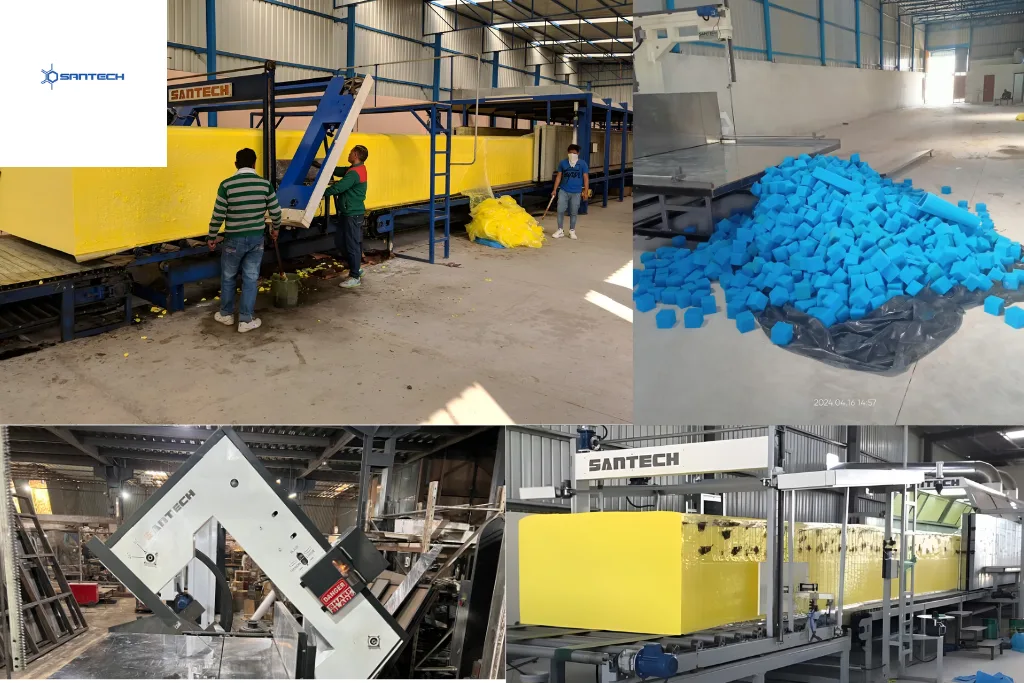
Once the ingredients have been mixed, they are transferred to a mould where they expand and solidify into foam. During the course of the continuous slab foaming process, the foam is poured into a moving conveyor, thereby ensuring the production of a continuous foam sheet.
This is an important step as it helps in determining the density and the texture of a foam. For different applications, foam should be allowed to expand more or less, depending on whether it is used for soft cushions, hard insulation, or any other use.
Step 4: Curing and Cutting
After the foam has expanded, it should undergo curing to ensure that it reaches its final form. This stage also includes allowing the foam to cool and harden, thereby ensuring its stability and durability.
Post this, the foam sheets are cut into the required sizes using specialised cutting tools and advanced foam cutting machines, which are tailored according to the specific requirements of the customer.
Common Foam Types Produced in the Manufacturing Process
There are different types of foam made during the manufacturing process, each with unique characteristics that are based on its intended use. Some of the common types are:
-
Polyurethane Foam
One of the most common types of foam, it is used in a wide range of applications, including mattresses, furniture, and insulation. PU foam is created by the reaction of polyols and isocyanates, which in turn helps in forming a durable and flexible foam structure.
-
Memory Foam
Memory foam is mainly used in mattresses and pillows; it is a type of PU foam that reacts to body heat and pressure. In fact, a foam of this type can easily adjust to the shape of the body, offering comfort and support.
-
Latex Foam
It is made from natural rubber latex, providing excellent durability and elasticity. It is commonly used in mattress manufacturing due to its comfortable and supportive properties.
Wrapping Up
The foam manufacturing process is complex and a multi-step operation that can easily transform raw materials into useful and versatile foam products. Whether it is about selecting the right ingredients or planning for the curing process, foam is crafted carefully to meet the industrial standards and consumer needs.
Developing an understanding of how a foam is made will help the user to appreciate its role in different industries, including furniture and automotive. So, whether you’re in the market for a new foam product or looking to work with leading foam machine manufacturers in India like Santech Foam Machines, knowing the process behind foam production will add value to the product you choose.