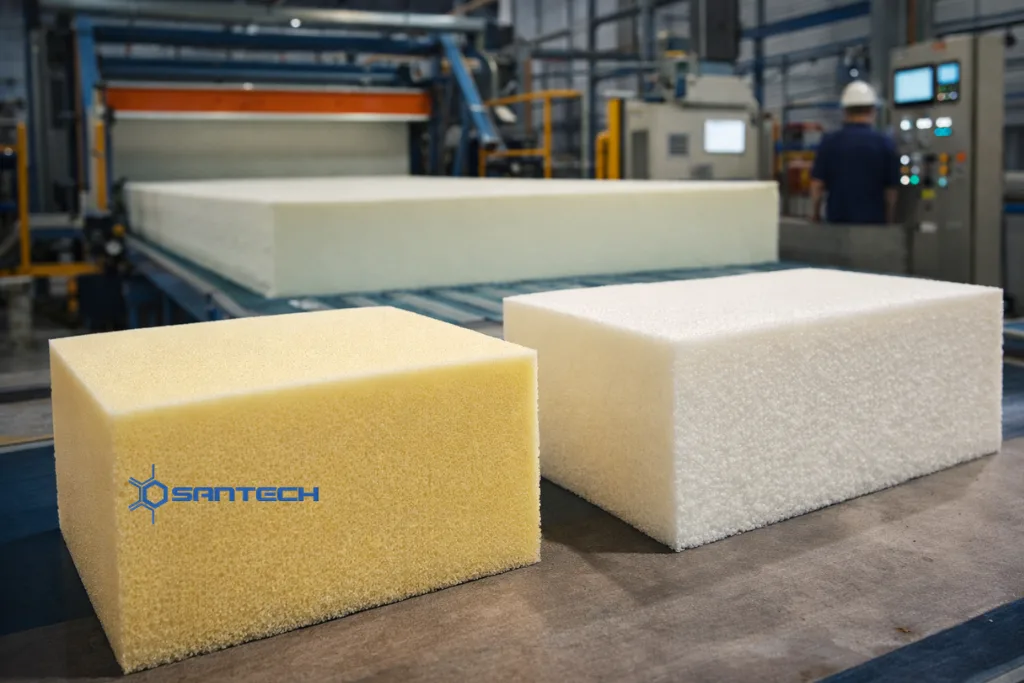
In foam manufacturing, small changes can lead to major differences in the quality of a product. From mattresses and furniture to insulation material and automotive, every sector relies on foam that performs reliably over the course of time. Well, even minor fluctuations in density or texture will affect the overall comfort, durability, and safety.
As consumer expectations and industrial trends continue to increase, manufacturers are under a lot of pressure to deliver consistent results across every production batch.
Achieving this level of precision is based on technical expertise as well as advanced production systems. Various types of technologies, including slab stock foam machine and batch foaming machine, will help manufacturers maintain process stability, reduce variations, and deliver consistent output.
This blog highlights the importance of uniform foam density and texture and clearly explains how modern manufacturing practices support long-term quality, efficiency, and competitive edge.
Understanding Foam Density and Texture
Foam density refers to the total weight per unit volume. It is used to determine how firm, supportive, and durable a product will be. A foam of high-density will not only last longer but also offer better support, while lower-density foam is softer and more flexible.
On the other hand, texture describes the surface feel and the internal structure of the foam. In addition, it also influences comfort, airflow, and visual appeal. While a smooth texture indicates stable production conditions, an irregular texture, on the other hand, may indicate processing issues.
When texture and density vary from batch to batch, manufacturers may encounter higher rejection rates, frequent customer complaints, and increased costs.
The Role of Modern Foam Production Equipment
Advanced machinery serves as the foundation stone for consistent foam manufacturing. Various equipment, like a slab stock foam machine, helps in the continuous production of large foam blocks with uniform properties. These machines help in maintaining precise control over chemical ratios, temperature, and mixing speed.
Similarly, a batch foaming machine enables the manufacturers to produce foam in controlled quantities. This method is suitable for specialised products, custom formulations, and small production runs. With precise dosing systems and programmable controls, batch foaming delivers consistent results across multiple production cycles.
Therefore, by investing in reliable equipment, manufacturers can gain better control over production variables, minimising the scope for inconsistencies.
Impact of Consistency on Product Performance
Consistent foam density and texture directly affect how products perform in the real world applications. For mattress manufacturers, uniform density ensures even body support and prevents sagging. In furniture applications, on the other hand, consistent texture helps in improving comfort and durability. But the automotive and industrial foam products are dependent on accurate density levels for safety and insulation purposes.
But when foam lacks uniformity, it can degrade faster and even fail to meet the regulatory standards. Over the course of time, this can lead to brand damage and loss of potential business opportunities. Consistent quality that is well-supported by a calibrated slab stock foam machine and batch foaming machine will enable the manufacturers to easily meet performance expectations.
Enhancing Customer Satisfaction and Building Brand Trust
In today’s time, a customer is well-informed and is more conscious about quality than ever. They expect products to deliver the same experience irrespective of purchase date and location. Any type of changes or variations in foam firmness, appearance, or feel will lead to negative reviews and reduced loyalty.
Consistency helps in building trust. When a customer knows that they can rely on a brand for quality, they will not only make repeat purchases but also recommend the company to others.
It is seen that manufacturers who prioritise stable production processes and invest in advanced foam machinery showcase their commitment to excellence.
Reducing Waste and Operational Costs
Poor and inconsistent foam production practices result in material waste, reprocessing and increased energy consumption. Defective batches often require disposal or downgrading, and this directly affects profit margins. But with precise control systems in slab stock foam machine, manufacturers can reduce raw material variations and properly optimise resource usage.
On the other hand, a batch foaming machine reduces waste by producing only the required quantities with precise formulations. By ensuring uniform density and texture, companies will not only lower rejection rates but also streamline workflows and enhance overall operational efficiency.
Quality Control and Process Optimisation
Achieving consistent foam quality requires more than just advanced equipment. It also depends upon strong quality control practices and process optimisation.
Key measures consist of:
- Regular calibration of dosing and mixing systems
- Carefully monitoring temperature and humidity
- Maintaining detailed records of production
- Training operators on best practices.
When it’s combined with modern slab stock and batch foaming technologies, these measures help in creating a stable manufacturing environment where variations are reduced.
Supporting Innovation and Product Development
Well, consistency in foam production helps in creating a strong foundation for innovation. When manufacturers can easily control texture and density, they can easily experiment with new formulations, eco-friendly materials, and specialised applications.
While a batch foaming machine is especially valuable for research and development, it further paves the way for precise testing of new chemical blends. A slab stock foam machine, on the other hand, provides support for large-scale commercialisation once the formulation is finalised.
This perfect balance between experimentation and mass production enables the companies to stay ahead in the competition.
Best Practices for Maintaining Consistency
To achieve long-term growth and stability in foam density and texture, manufacturers should follow these practices:
- Invest in high-quality slab stock and a batch foaming machine.
- Use automated dosing and monitoring systems.
- Implement preventive maintenance schedules.
- Train staff on process control.
- Thoroughly analyse production data for continuous improvement.
These are the top practices that you can easily create a culture that supports sustainable growth and operational excellence.
Wrapping Up
Consistency in foam density and texture is important for successful foam manufacturing, as it directly impacts product performance, customer satisfaction, cost efficiency, and regulatory compliance. Well, without stable and controlled production processes, even the most advanced designs will fail to meet the market expectations. Various modern equipment, including slab stock foam machine and batch foaming machine, offers manufacturers the appropriate tools that are needed for achieving reliable and repeatable results, which is why many foam machine manufacturers India focus on delivering advanced and efficient solutions. When supported by strong quality-control systems and skilled operators, these technological advancements will help the companies to deliver superior-quality products everytime. By prioritising consistency, foam manufacturers will not only improve their current operations but also build a strong foundation for long-term success.