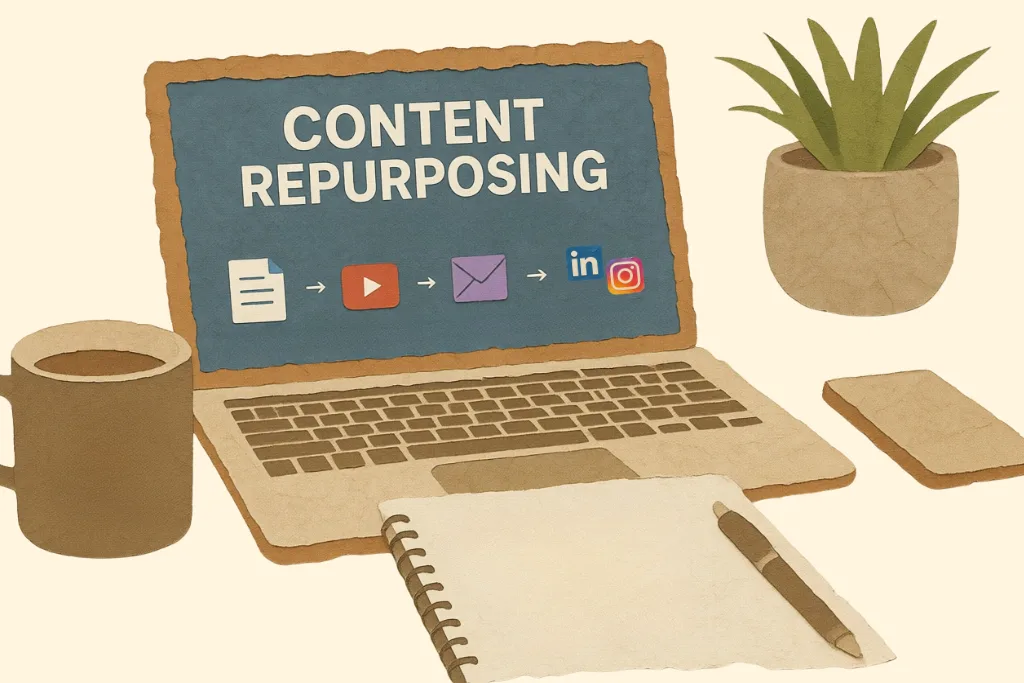
If you want to repurpose blog content but have no idea where to begin, you are not alone. Most bloggers spend hours writing a post, share it once, and then move on to the next one. The post disappears within days.
The smartest bloggers do not just move on. They use a content repurposing strategy to turn one post into multiple pieces of content across multiple platforms. Same research. Same insights. Far greater reach.
This guide walks you through exactly how to repurpose blog content step by step, which formats work best, and how to build a blog content distribution system that works consistently.
What Is Content Repurposing?
Content repurposing means taking an existing blog post and adapting it into a new format for a different platform. When you repurpose blog content, you are not creating something from scratch. You are taking the research, structure, and insight you already invested in and presenting it in a way that reaches a new audience.
A blog post becomes a YouTube script. A guide becomes a LinkedIn carousel. A listicle becomes an email newsletter. A how-to post becomes a podcast episode.
According to HubSpot, the most expensive part of content creation is not the writing but the research and thinking behind it. A content repurposing strategy lets you get far more value from that investment without starting over every time.
Why You Should Repurpose Blog Content
Most bloggers treat content creation as a one-way street. Publish, share, forget. This approach leads to burnout and inconsistent growth.
When you repurpose blog content regularly, you get a much better return on every post you write. Here is why it matters:
It extends content lifespan. A blog post from two years ago can reach a completely new audience today when turned into a video or newsletter.
It improves blog content distribution. Different people consume content in different ways. Some prefer reading. Others prefer watching or listening. Repurposing puts your content in front of all of them.
It builds topical authority faster. When Google sees your brand covering a topic consistently across formats and platforms, it strengthens your credibility. This supports a strong content cluster strategy around your core topics.
It solves the consistency problem. Publishing consistently is one of the hardest parts of blogging. A content repurposing strategy gives you more to publish without requiring new research every single time.
Step 1: Choose the Right Posts to Repurpose
A good content repurposing strategy does not mean repurposing everything. It means being selective. Before you learn how to repurpose content, you need to know which content deserves to be repurposed.
Focus on posts that meet one or more of these criteria:
High organic traffic. If a post is already ranking and bringing in visitors, repurposing it amplifies something that is already proven.
Evergreen topics. Posts on topics that stay relevant over time are ideal because the repurposed content will not become outdated quickly.
High engagement. Posts that generated comments, shares, or email replies have already proven they resonate with your audience.
Comprehensive guides. Long posts with multiple sections are natural candidates because each section can become its own repurposed piece.
Run a quick SEO content audit to find your best-performing posts before you decide what to repurpose first.
Step 2: How to Repurpose Blog Content Across Platforms
This is the core of any content repurposing strategy. Different platforms need different formats. Here is exactly how to repurpose blog content for each major channel.
Blog Post to YouTube Video
Use your blog post structure as a video script. Each H2 becomes a section. The introduction becomes your hook. The conclusion becomes your call to action.
YouTube is the second largest search engine in the world. Repurposing a well-ranking blog post into a video doubles your chances of appearing in search results for the same topic.
Blog Post to Email Newsletter
Pull the three to five most valuable points from your post and write them as a short, scannable newsletter. Link back to the full post for readers who want to go deeper.
This is one of the most efficient forms of blog content distribution because your email list is already warm and engaged.
Blog Post to Social Media Carousel
Instagram and LinkedIn both reward carousel posts. Take a listicle or checklist post and turn each item into one slide. Add a cover slide with the main topic and a final slide with a call to action linking back to the blog post.
Blog Post to Infographic
Data-heavy posts, step-by-step guides, and checklist posts translate naturally into infographics. Infographics get shared far more than plain text on social media and can earn backlinks when other sites embed them.
Blog Post to Podcast Episode
Your blog posts are ready-made podcast scripts. Read through the post conversationally, add personal commentary, and you have a full episode with minimal extra preparation.
Blog Post to Twitter or LinkedIn Thread
Break your post into a numbered thread. The introduction becomes the opening post. Each major section becomes one entry in the thread. The conclusion becomes your closing with a link to the full article.
Threads consistently outperform single posts on both platforms because they hold attention across multiple touchpoints.
Step 3: Update the Post Before You Repurpose It
Before you repurpose blog content, check whether the original post needs updating. Outdated statistics or old tool recommendations will undermine the credibility of everything you create from it.
This is also a good opportunity to strengthen the original. Update internal links, refresh any outdated sections, and check that the on-page SEO is still correctly optimised. A refreshed post ranks better and produces stronger repurposed content.
Step 4: Build a Blog Content Distribution Workflow
Knowing how to repurpose content is one thing. Doing it consistently requires a system. Here is a simple workflow to make blog content distribution repeatable:
Publish the blog post first. Get the original live and indexed before repurposing begins.
Wait two to four weeks. This gives the post time to gather real performance data before you decide how to repurpose it.
Select two to three repurposing formats. Based on your platforms and audience, choose the formats that suit that specific post best.
Create a repurposing calendar. Spread repurposed content over two to four weeks so you are not flooding all platforms at once.
Link every repurposed piece back to the original post. Every format in your blog content distribution plan should drive traffic back to the original. This builds authority and increases time on site.
This kind of system is what separates content-led growth from random publishing. You are building an asset, not just producing content.
Step 5: Adapt Each Piece for Its Platform
The biggest mistake people make when they repurpose blog content is treating it as copy-paste work. Each format must be adapted for the platform where it will appear, not just reformatted.
A YouTube video needs a strong hook in the first fifteen seconds. A LinkedIn post needs a bold opening line since most text is hidden behind a see more button. An email newsletter needs a subject line that earns the open before anything else matters.
The core content stays the same. The presentation changes to match how people consume content on each channel.
How to Repurpose Old Blog Content
Your existing archive is part of your content repurposing strategy too. You do not have to wait for new posts.
Go back to your best posts from the past one to two years and assess them for repurposing potential. Posts that ranked well but have dropped can be refreshed and put back into your blog content distribution plan.
Even a post that failed to rank on Google can reach a new audience through YouTube, LinkedIn, or email if the content itself is genuinely useful.
Tools to Repurpose Blog Content Faster
You do not need a large budget to repurpose blog content effectively. These tools handle the core tasks:
| Tool | Use Case |
| Canva | Turn blog posts into carousels, infographics, and social graphics |
| Descript | Edit and produce podcast episodes and videos from scripts |
| Notion or Trello | Manage your repurposing calendar and workflow |
| Mailchimp or ConvertKit | Turn posts into email newsletters |
| ChatGPT or Claude | Rewrite blog content in a different format or tone quickly |
Start with one or two tools and build from there as your content repurposing strategy matures.
Frequently Asked Questions
Does repurposing blog content hurt SEO? No. When you repurpose blog content across external platforms like YouTube, LinkedIn, or email, there is no duplicate content issue. Problems only arise if you publish the same article twice on your own website. That is a separate issue called keyword cannibalization.
How many formats should I use in my content repurposing strategy? Start with two. One social format and one email or video format. Repurposing two formats consistently beats repurposing five formats sporadically every time.
Do I need to repurpose every blog post? No. A smart content repurposing strategy focuses on your best-performing and most evergreen content. Time-sensitive or very niche posts may not translate well to other formats.
How long does it take to repurpose blog content? Once your workflow is set up, most repurposing tasks take one to two hours per format. A carousel in Canva might take thirty minutes. A newsletter adaptation might take forty-five minutes. It is significantly faster than writing new content from scratch.
Final Thoughts
Every time you publish a blog post, you are not creating one piece of content. You are creating the raw material for a video, a newsletter, a carousel, a thread, and a podcast episode.
A consistent content repurposing strategy is what separates bloggers who struggle with reach from those who build authority across multiple platforms without burning out.
Start with your best existing post. Pick two formats. Build your blog content distribution workflow. Then make it a habit.
That is how you stop publishing and hoping, and start publishing and growing.