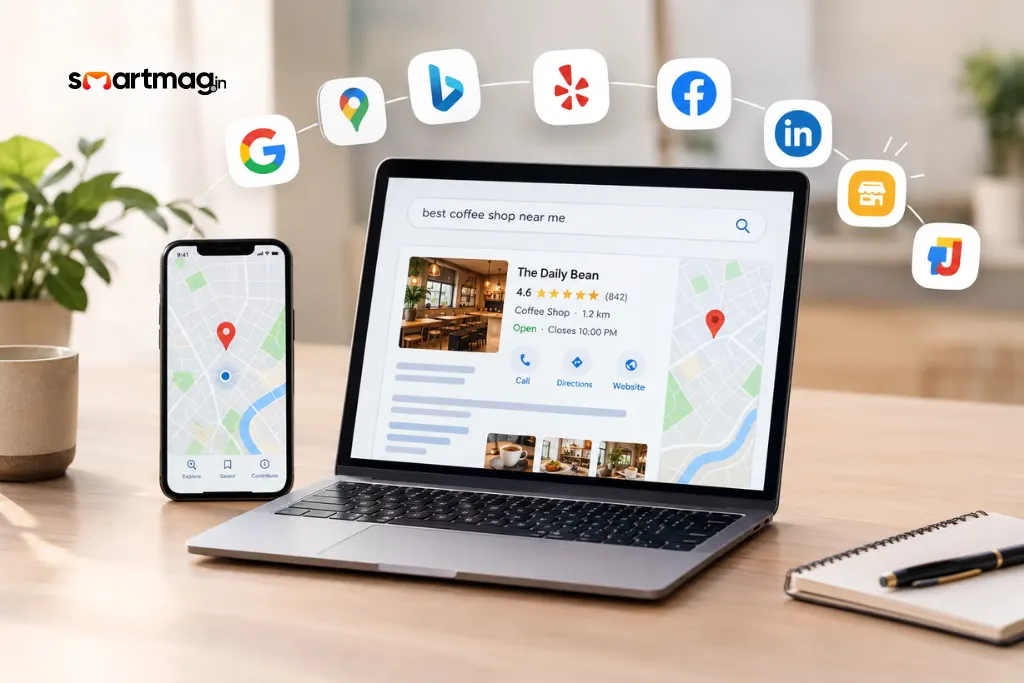
Even a highly rated local business could be overlooked by an AI assistant when queried for a good option nearby. That’s because the issue does not lie with service quality, but with insufficient, vague, or inaccurate data.
Appearing in AI search results depends upon the platform’s ability to recognise what the business offers, its location, availability, and reasons for customer confidence.
Here is how those pieces work together.
What Are Local AI Search Results?
Local AI answers are generated recommendations or comparisons shaped by a user’s location and specific need.
An AI-assisted query may combine service, urgency, distance and opening hours. Responses can appear through Google AI features, ChatGPT Search, Microsoft Copilot or map-supported recommendations.
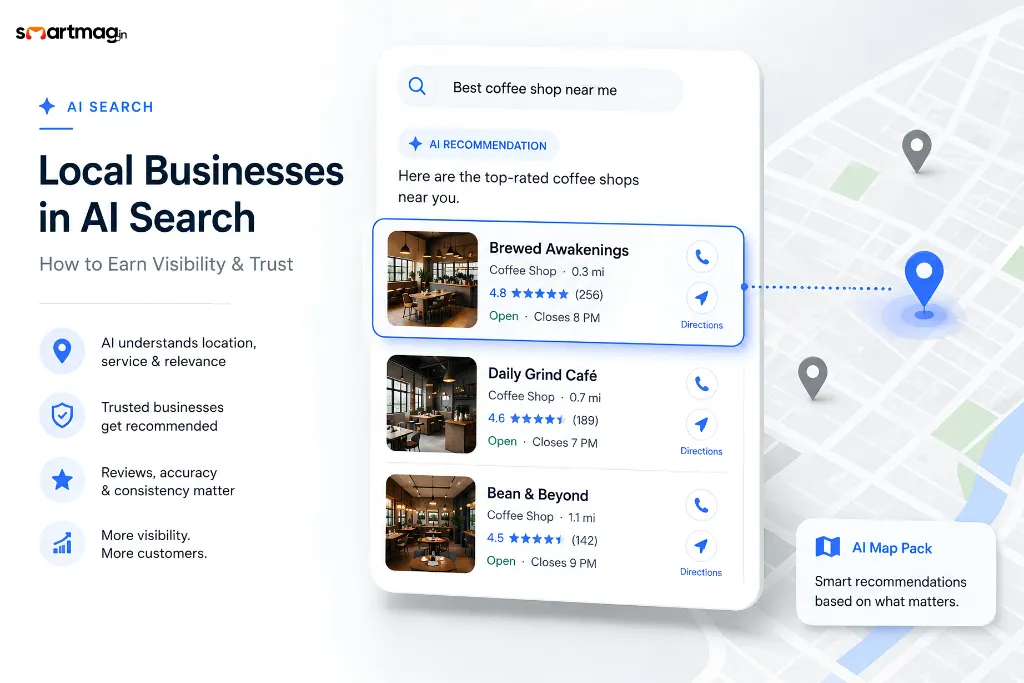
When an answer combines a map with selected nearby businesses, it can function like an AI map pack.
How Do AI Systems Find Local Businesses?
AI systems rely on business profiles, indexed websites, maps, directories and reviews.
Business Profiles can help local services appear in generative responses. Its AI features may use query fan-out to run related searches before answering.
A local query may trigger checks for:
- Service and specialisation
- Distance and service area
- Hours and availability
- Reviews, credentials and pricing
- Contact and booking options
This is why local AI SEO must connect these facts clearly. A vague homepage rarely answers every part of a detailed local request.
How Local Businesses Can Appear in AI Search Results
Local businesses can improve visibility by making their information accurate, detailed, accessible and independently supported.
The following actions form a complete local AI SEO foundation. None guarantees inclusion, but each removes uncertainty that can stop a business from being selected.
1. Complete and Maintain Your Business Profiles
Accurate profiles give search platforms a dependable record of the business.
Start with Google Business Profile and Bing Places for Business. Keep these fields current:
- Real business name and categories
- Address or genuine service area
- Phone number, website and booking link
- Regular and holiday hours
- Services, attributes, and recent photographs
Local discovery is influenced by relevance, distance and prominence. Complete information improves the match between the business and the query.
This matters when an AI map pack compares nearby choices. A wrong category or closing time can remove a suitable result.
2. Keep Business Information Consistent
Consistent details help platforms recognise that different listings refer to the same business.
Check the name, address, phone number, website, hours and service area across major profiles. Use only relevant review sites, directories and associations.
Avoid mass directory submissions. A smaller set of accurate sources is more useful than abandoned listings.
In practical audits, inconsistent contact details deserve an early check because they weaken confidence across local search and AI search results.
3. Create Dedicated Service and Location Pages
A dedicated page connects one service with a real place, customer need and next step.
A homepage rarely answers a complex local question. Create distinct pages for priority services and genuine locations. Do not copy one template and only change the city name.
Include:
- The service and area covered
- Hours, response times and booking steps
- Staff, qualifications and licences
- Pricing guidance or cost factors
- Original photographs and local examples
- Directions or accessibility details
Link service pages to location pages, proof and enquiry forms. This strengthens local AI SEO by connecting the service, evidence and place.
4. Publish Local Proof
Original evidence makes a business easier to verify than generic marketing claims do.
Publish local case studies, original images, staff profiles, licences, customer outcomes and service processes. Prioritise unique, non-commodity information that competitors cannot simply copy.
Avoid unsupported claims such as “best in the city”. For local AI SEO, proof should be specific. Show the qualifications or outcomes behind them.
For example, a clinic can explain practitioner qualifications, while a contractor can document a completed project and the problem it solved.
This evidence can strengthen an AI map pack recommendation by giving the system more context than a rating alone.
5. Answer Conversational Local Questions
Content should answer the complete questions people ask, not only short location keywords.
A customer may ask whether the business is open today, serves a neighbourhood or supports a specific requirement.
Create direct answers around prices, availability, service limits, accessibility, delivery areas and what customers should expect.
The question of how to rank in ChatGPT for a local business is often treated as a technical puzzle. A better starting point is factual content that answers the local need more clearly than a vague landing page.
Lead with the answer, then add supporting detail.
6. Use LocalBusiness Structured Data
Structured data helps search engines classify business information, but it does not create automatic visibility.
Use ‘LocalBusiness’ or the most accurate subtype for each real location. Mark up the visible name, address, phone number, hours and URL.
The markup must match the visible page. Test it with the Rich Results Test and Search Console.
Structured data supports local AI SEO by reducing ambiguity. It should clarify genuine information, not introduce claims or locations users cannot see.
7. Make Important Pages Crawlable
A page cannot be quoted or cited reliably when the relevant crawler cannot access it.
Check robots.txt, noindex directives, canonical tags, XML sitemaps, firewall rules and mobile rendering. Important service and location details should appear as visible text.
For marketing teams researching how to rank in ChatGPT for local businesses, OAI-SearchBot is the relevant crawler for ChatGPT Search discovery. GPTBot relates to model-training controls, so the two are not interchangeable.
8. Build Reviews and Reputation Ethically
Genuine reviews and credible third-party mentions provide independent evidence of real customer experience.
Request honest feedback through a direct link or QR code, and reply professionally. Never offer incentives for reviews. Local media coverage and relevant associations can also strengthen prominence.
These signals may help an AI map pack distinguish an established provider from an unverified listing.
9. Make Contact and Booking Simple
Visibility matters only when the user can take the next step quickly. Use clear call buttons, booking links and short forms. Display phone numbers, hours and availability as text.
This is an overlooked part of how to rank in ChatGPT for local businesses because the commercial goal is not a mention. It is a qualified call, booking or visit.
How to Measure Local AI Visibility
Measure mentions and citations alongside calls, bookings, enquiries and sales.
Use profile reports, Search Console, Bing Webmaster Tools and analytics.
Test realistic prompts and record whether:
- The business appears
- Details are accurate
- Sources are cited
- An AI map pack is displayed
- Visits become enquiries
This turns local AI SEO into measurable work rather than screenshot collecting.
What Local Businesses Should Avoid
Avoid shortcuts that create false, duplicated or unverifiable information.
Do not:
- Create fake offices or service areas
- Stuff keywords into the business name
- Publish near-identical city pages
- Buy reviews or artificial mentions
- Block OAI-SearchBot accidentally
- Add a schema that contradicts visible content
- Expect llms.txt to improve Google visibility
Businesses asking how to rank in ChatGPT for local businesses should avoid chasing one fixed answer. Recommendations change by prompt, location and evidence.
A Practical 30-Day Plan To Appear in AI Search Results
Fix accuracy first, then improve proof and measurement.
- Week 1: Audit profiles, listings, crawler access and current AI visibility.
- Week 2: Correct categories, hours, contact details and service areas.
- Week 3: Improve priority pages, local proof and internal links.
- Week 4: Request genuine reviews, test prompts and track enquiries.
This sequence supports an AI map pack and other local recommendations. It also gives teams a practical response to how to make local businesses appear in AI search results without relying on unsupported tricks.
Final Takeaway
The businesses most likely to earn AI visibility are those that are easiest to understand, verify and contact. Strong local AI SEO connects accurate profiles, useful pages, technical accessibility and independent reputation signals.
There is no guaranteed switch for inclusion in AI search results. Consistent proof of services, location and trust gives search systems a stronger reason to include the business.