You have the vision, the perfect brand name, and a Pinterest board full of aesthetic packaging ideas. But then reality hits: the cost of setting up a licensed factory in India can easily run into crores. Between the high-tech machinery, the strict CDSCO licensing, and the endless monthly overheads, most dreams die before the first bottle is even filled.
However, the Indian beauty and personal care market is currently an unstoppable force. In fact, one major report puts the Indian cosmetics market at about USD 22.92 billion in 2026, and expects it to grow to USD 43.85 billion by 2033, implying a CAGR of about 9.3% from 2026 onward.
Here’s something that people don’t really know: The tons of brands you see blowing up on Instagram? They don’t really have their own factories! Big D2C brands, indie luxury brands, you name it! They’re all going “asset-light,” creating hype for their brand while leaving it to the pros to handle production.
Curious to know how they manage to do it? This guide will walk you through the process. Stay tuned, and you’ll be able to start your own cosmetic company without the need for a manufacturing unit.
Start with a brand idea that people actually want
The first thing you need to do is to establish the importance of your brand. Just being natural is no longer enough. In fact, everyone’s natural nowadays.
The people in India today need something that works, something that will actually solve a problem. So, dig a little deeper. Where are the big guys failing? Where are the opportunities? That’s where you should go after. Here are some high-demand niches you should consider:
- Climate adaptive products: Skincare designed for the humidity of India or the pollution of a city like Mumbai.
- Concern-based product lines: Focus on barrier repair products instead of “glow.”
- The Male Grooming Boom: Designing sophisticated skincare products for men, endorsed by dermatologists.
- Multipurpose Products: It is trending these days. You can get into launching a product that works as makeup and treatment, together, for example. You must have seen ads for tinted sunscreens or 3-in-1 compact.
Your brand story is the only way to protect your business from imitation by your competitors. Your robust brand story will allow you to sell a liquid product as a result. The cosmetics manufacturer will trust you for a long time because they understand your business model.
Choose the right manufacturing model for your brand
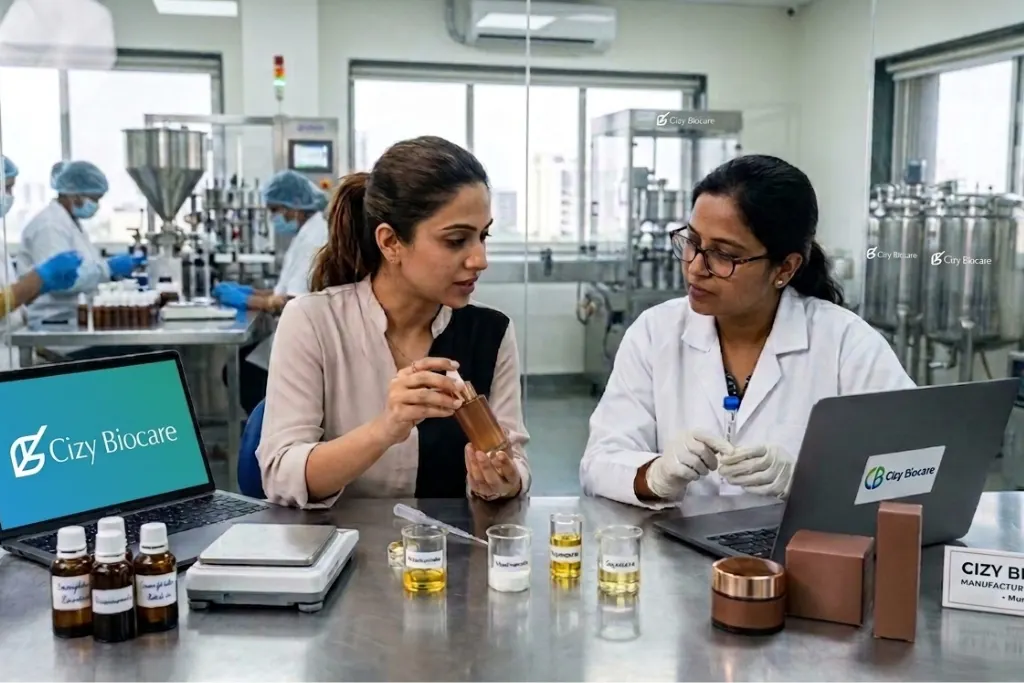
Having completed the design of your concept, you now need to choose the manufacturing model that will bring your product to life. You don’t need a PhD in chemistry or a warehouse the size of a football field to do this; you need to choose the right professional partnership.
Most successful entrepreneurs follow a strategic path that leads them to one of these two professional manufacturing models:
-
Private Label Manufacturing
Experts opine that this is the most efficient way of entering the Indian beauty market without the high failure rate associated with new research.
Instead of developing a formula from scratch, you’re basically choosing a high-quality product that a manufacturer has already perfected, tested, and stabilized. This is a huge advantage because you’re bypassing the costly and time-consuming process of conducting lab tests and safety tests.
You can start with a formula that is already successful, like a Vitamin C serum or a moisturizing cleanser, and then add your own clean beauty ingredients to make it unique to your brand. This is probably the smartest thing you can do if you’re a private label cosmetic brand looking to test this market trend. It will ensure you’re launching a dermatologist-backed skincare product that works.
-
Third-Party Custom Manufacturing
When your brand is based on a unique vision that doesn’t exist anywhere else in the world, you need a customized approach.
This is not about choosing from a selection; it’s about hiring a professional laboratory to create your “Signature Formula” from scratch. You work directly with their chemists to determine everything from the percentage of actives in the formula to the texture of the skin.
In this framework, many founders prefer to go with “Turnkey” options, whereby the cosmetics manufacturer takes care of the entire supply chain. This involves everything from raw material sourcing to taking care of eco-friendly packaging to printing the labels.
This approach is much more capital-intensive and time-consuming, yet it guarantees that you have an exclusive “product DNA” that no competitor can ever replicate or acquire.
Building the hype before your first sale
Marketing in 2026 is no longer about shouting at an audience, but inviting them into the lab. Since you saved a fortune by not building a factory, you can re-allocate that capital into high-impact digital storytelling that builds “pre-launch equity.”
Instead of polished celebrity ads, today’s “skin-smart” Indian consumers demand transparency and proof. Use this phase to turn your cosmetic brand startup guide into a living documentary.
- Partner with “Skin-fluencers”
You should collaborate or work with micro-creators who prioritize clean beauty ingredients and scientific efficacy over aesthetic filters.
- The “Behind-the-Science” Hook
It is one of the best ways to catch attention. You can share raw footage of your third party cosmetic manufacturer testing the stability of your barrier repair formulations.
- Tiered Video UGC
You can send early product samples to a small group of creators so they can show their followers what the texture and packaging actually look like in real life. Do this before you officially launch the product.
Executing a launch that turns viewers into customers
A successful launch is where your brand promise meets operational reality. In the Indian market, the “unboxing” experience and delivery speed are the ultimate trust-builders. Your logistics strategy must be as refined as your formula to prevent early-stage churn.
In fact, you should know that “logistics is the new marketing,” and failing to deliver a pristine product can kill a startup’s reputation overnight in 2026.
- India-Proof Fulfillment: Utilize micro-fulfillment centers in Tier-2 cities to ensure 24-hour delivery and protect products from 40°C transit heat.
- Reduce COD Losses: Implement AI-driven RTO prediction tools at checkout to incentivize UPI payments and lower non-delivery rates.
- Eco-Friendly Durability: Use plastic-free, eco-friendly packaging that is reinforced to survive the “last-mile” journey without leaks or cracks.
- Dermatologist Validation: Launch with a “Founding 100” campaign featuring reviews from dermatologist-backed skincare experts to provide instant social proof.
These are a few things that will help you launch big in the market. And the best part is you do not own a manufacturing unit, but still launch like a pro.
Final Thoughts
Success in the Indian beauty market today requires businesses to possess their own brand stories rather than their equipment. Your business can avoid both major operational costs and technical difficulties by using a third party cosmetic manufacturer.
The asset-light business model enables your company to maintain operational flexibility while achieving rapid growth and dedicating all resources to community development. The most powerful tool for you in this booming market is the partnership that brings your vision to life.