Your search rankings seem good enough. Your content is well-written. Yet, your organic traffic just keeps decreasing. Does it sound like you? What if we told you that the problem might not lie in your SEO strategy, but in the new search landscape itself?
Yes. As concerning as it is, over half of all search requests today do not involve clicking at all. People get their questions answered by summaries generated via AI that appear at the top of a search result page. As a result, there are zero-click searches which never even reach the website.
That is why the topic of GEO vs SEO is becoming extremely urgent for brands and marketers right now. It is no longer an option but a survival necessity to understand both terms and how they work together.
So, let’s do that.
What Is SEO?
SEO (Search Engine Optimisation) refers to enhancing the visibility of your site on platforms like Google, Bing, and Yahoo Search. It was first introduced back in 1997 and has been the backbone of digital marketing for more than two decades, till today.
SEO works across four core pillars:
- Keyword research and content: Building web pages relevant to users’ searches and queries.
- On-page optimisation: Structuring title tags, headings, links, and metadata for visibility.
- Technical performance: Optimal loading speeds, mobile responsiveness, and crawlable structure. These are what search engines use as the foundations.
- Authority signals: Backlinks, domain trust, and brand credibility that signal expertise to algorithms.
SEO’s scale argument is undeniably true. Google handles more than 14 billion searches per day, which no AI-based chatbot can match. For transactional search, local search, and product discovery, SEO is still the best ROI channel available for brands to invest in.
However, SEO has real blind spots in 2026.
What Is GEO?
Introduced in late 2023, GEO (Generative Engine Optimisation) is the practice of optimising your content to be found, cited, and referenced inside AI-generated answers and not simply indexed in a list of links.
AI platforms like ChatGPT, Perplexity, Google AI Overviews, and Bing Copilot don’t show ten blue links like traditional search engines. They provide a single, direct answer sourced from multiple channels. In other words, if your content doesn’t fit into an answer generated by an AI, you don’t even exist for that query, even if you rank on Google.
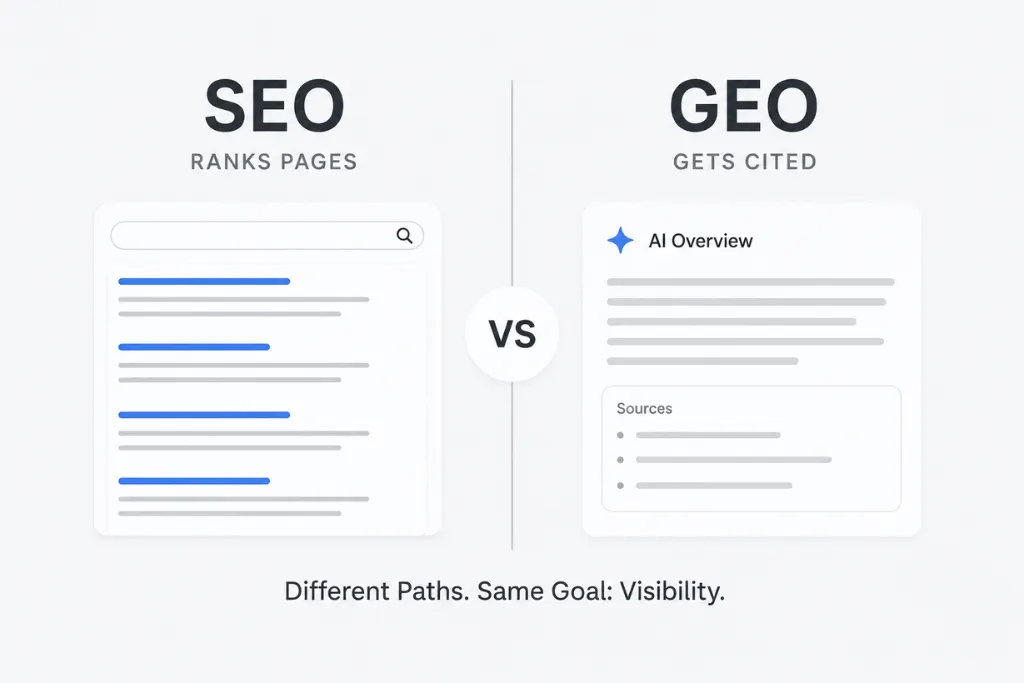
GEO vs SEO is basically the transition from a click-based economy to a citation-based economy. Today, brands are not competing for position on search engines anymore. They are competing to be the source that AI trusts to be credible and useful for users.
What generative engine optimisation works for:
- Being quoted or cited within an AI-generated response.
- Structured, schema-enabled content that AI search engines can parse quickly.
- Conversational relevance. Content written the way people actually ask questions.
- E-E-A-T signals (Experience, Expertise, Authoritativeness, Trust) that LLMs are trained to favour.
- Brand mentions, even without a direct link, as a visibility signal.
GEO vs SEO: The Core Differences at a Glance
| Dimension | SEO (Search Engine Optimisation) | GEO (Generative Engine Optimisation) | Why It Matters |
|---|---|---|---|
| Target platform | Google, Microsoft Bing, Yahoo, Yandex, DuckDuckGo, Baidu, Naver, etc. | ChatGPT Search, Grok, Brave AI Search, Andi Search, Perplexity AI, Google AI Overviews, Bing Copilot, etc. | SEO targets search engines that return links. GEO targets AI search platforms that generate direct answers. It’s a fundamentally different interface and user behaviour. |
| Result format | Gives a ranked list of links for the user to click through. | Generates one synthesised answer pulling from multiple sources. | With SEO, your page competes for a spot in a list. With GEO, your content either contributes to the answer or doesn’t appear at all. |
| Primary goal | To drive clicks to your website. | To be cited or referenced inside an AI-generated response. | SEO success is mainly measured by traffic, while the success of generative engine optimisation is measured by influence. You may never get a click via GEO but still shape what a user believes and decides. |
| Key ranking factors | Keywords, backlinks, page speed, technical SEO, E-E-A-T, user experience, etc. | Content clarity, structured data, topical authority, source credibility, conversational relevance, etc. | SEO rewards technical precision and link equity. GEO rewards content that AI systems can easily extract, trust, and accurately summarise. |
| Traffic type | Click-based organic traffic where users visit your site. | Users see your content summarised as citations without visiting your website. This gives zero-click visibility. | Over 60% of searches now end without a click. GEO keeps your website visible even when users never land on your page. |
| Content format | Long-form blogs, landing pages, keyword-optimised copy. | Direct Q&A structure, concise paragraphs, schema markup, clear headings. | AI engines scan for extractable answers. Dense or keyword-heavy content gets ignored, while concise, structured, question-first content is more likely to be cited. |
| User intent served | Navigational, transactional, and informational queries. | Primarily informational and research-driven queries. | SEO covers the full funnel. GEO is strongest at the awareness and consideration stage when buyers are exploring, not yet ready to click. |
| Success metrics | Rankings, organic traffic, CTR, conversions. | AI citation frequency, brand share of voice in AI responses, pipeline quality from AI-exposed prospects. | You can’t track generative engine optimisation in Google Search Console. It requires manual audits and new tooling to measure where and how your brand appears in AI answers. |
| Main risk | Visibility drops from Google core algorithm updates. | Unpredictable citation patterns. Many AI models are black boxes with no guaranteed sourcing logic. | Both carry volatility. SEO risk is well documented and recoverable. GEO risk is newer and harder to diagnose, making diversification across both even more important. |
The key takeaway: SEO gets you found. GEO builds credibility as part of the answer. Each serves a unique stage in the user journey of discovery and validation. Where GEO stands today is where SEO was a decade ago: new, underutilised, and full of opportunity for early movers.
How to Optimise Content For AI Search Engines
The smartest brands aren’t choosing between GEO vs SEO; they’re utilising both. Here’s how to optimise content for AI search engines:
- State the answer in the opening sentence and then explain it.
- Structure your content with concise paragraphs, headers (H2 and H3), bullet points and schema markup.
- Be specific. Data points, statistics, and named examples make your content look credible to LLMs.
- Strengthen author profiles with credentials and case studies. AI models favour credible, documented expertise.
- Match how people actually phrase questions in AI tools.
- Audit key pages for question-answer structure clarity. If the answer is not in the first few sentences, then restructure it.
- Add FAQs and HowTo schema on high-authority pages so AI engines can parse and cite them easily.
- Use question-based headings, and embed at least one data point per section.
- Distribute beyond your blog posts and publish on sites that get actively crawled by AI search optimisation platforms such as Reddit, Quora, and LinkedIn.
The Bottom Line
Marketing experts make the GEO vs SEO comparison and take it as the next stage of evolution. SEO continues to be your bedrock for discovery and attracting quality traffic from billions of searches. Generative engine optimisation expands your reach to AI-powered search results and guarantees that your brand stays seen and recognised even as user search behaviour moves to zero-click search experiences.
Winning brands will be the ones that understand that both disciplines work towards the same goal, since they strive to become the authority for information that users can count on.
Start by reviewing what you already have. Then build for where search is already going.