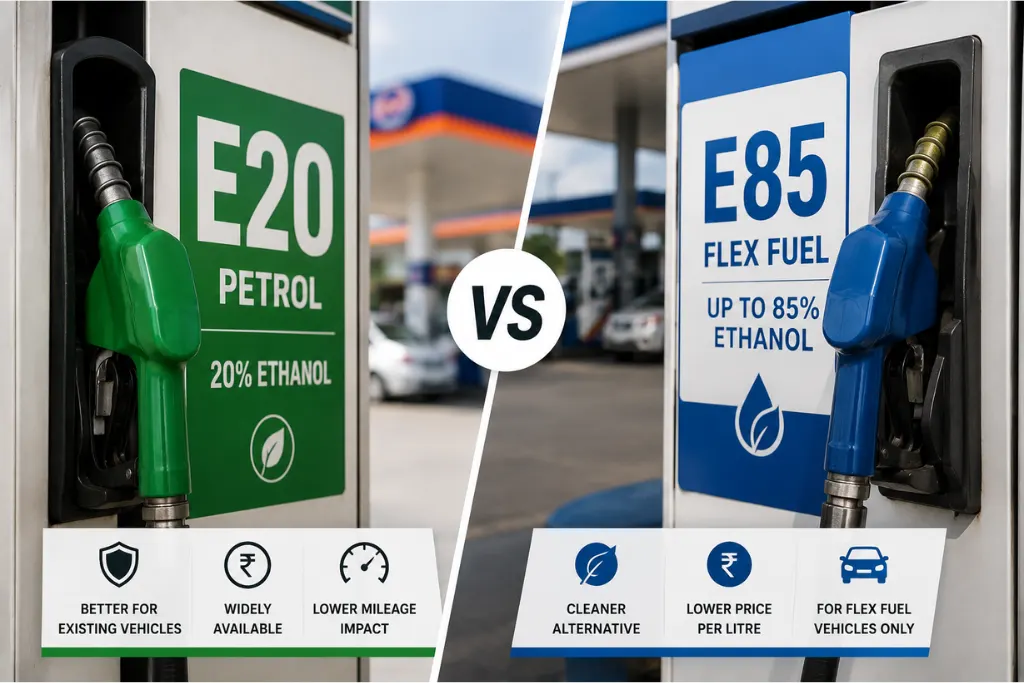
E20 vs E85 petrol is the fuel conversation India can’t avoid in June 2026. E20 became the only petrol available at all 90,000 fuel stations nationwide from April 1. Then, just yesterday on World Environment Day, the government officially launched E85 at 48 outlets across the country with Maruti’s WagonR Flex Fuel becoming India’s first flex-fuel passenger car on the same day. Two new fuels. Two very different stories. And millions of ordinary car and bike owners caught somewhere in the middle, genuinely unsure what any of this means for them.
Let’s break it down properly.
what actually are these fuels?
E20 petrol is 80% regular petrol mixed with 20% ethanol. It’s been rolling out gradually since 2023, but from April 1, 2026, it became the only petrol you can buy anywhere in India. There’s no E5 or E10 left at pumps. E20 is it. The minimum octane rating is 95 RON, slightly higher than what most Indians were used to.
E85 is a completely different animal. It’s 80 to 85% ethanol and just 14 to 19% petrol. It launched officially on June 5, 2026 and is currently available at only 48 fuel stations. And here’s the catch most people haven’t realized yet: you can’t use E85 in your existing car or bike. Only flex-fuel vehicles (FFVs) can handle it, vehicles built to run on anything from E20 to E100.
Breaking: June 5, 2026
On World Environment Day, Union Petroleum Minister Hardeep Singh Puri launched E85 fuel at an IndianOil outlet in New Delhi. E85 is priced approximately Rs 20 per litre cheaper than regular petrol. Currently available at 48 PSU outlets. The government plans to expand to 500 outlets by December 2026 and 5,000 outlets by December 2027. Maruti Suzuki’s WagonR Flex Fuel was simultaneously launched as India’s first flex-fuel passenger car.
The mileage question everyone is asking
This is the one that’s been driving people crazy on social media since April. And honestly, the anger is valid.
Ethanol contains less energy per litre than petrol. That’s just chemistry. So when you blend more ethanol in, your car works a little harder to travel the same distance. For E20 petrol India 2026, the Society of Indian Automobile Manufacturers (SIAM) admitted a 2 to 4% drop in fuel efficiency. But an ARAI study funded by the Ministry of Heavy Industries found up to a 6% decline depending on vehicle type.
People on the ground are reporting worse. Scroll through any Indian car forum in May 2026 and you’ll find owners claiming 8 to 12% drops, especially on older bikes and two-wheelers not designed for higher ethanol content. The E20 mileage impact has been the single biggest pain point for ordinary consumers since the rollout.
Public reaction, Indian car forums and social media, May 2026
“My Activa’s mileage dropped from 52 kmpl to 46 kmpl overnight. Nobody warned me, nobody asked me, they just changed the fuel and said it’s fine.”
Owner complaint, viral thread on X (India), April 2026
For E85, the ethanol blended petrol mileage situation is even more stark. With 85% ethanol, expect a 25 to 30% drop in fuel economy compared to regular petrol. The government’s argument is that E85 price in India, roughly Rs 20 cheaper per litre, compensates for this. On paper that math can work. In reality, it depends entirely on your driving pattern, the vehicle model, and whether you’re doing city or highway driving.
What does E85 mileage actually look like in numbers?
Say your flex-fuel vehicle gets 18 km per litre on regular petrol at Rs 105 per litre. Your cost per km is Rs 5.83.
On E85 at Rs 85 per litre, mileage drops to around 13 km per litre. Your cost per km is Rs 6.54. You’re actually spending more per kilometre, not less at current pricing estimates. The government’s cost parity argument only holds if E85 is priced aggressively below Rs 75 per litre or if mileage drops less than expected for that specific vehicle.
This is exactly the kind of thing the public needs to calculate before buying a flex-fuel vehicle and almost nobody is talking about it clearly. Fuel prices in India have always been more complicated than the pump sticker tells you.
Mileage impact: ARAI and SIAM verified data
E20 mileage impact: 2 to 6% drop vs E10 petrol (ARAI study, Ministry of Heavy Industries). SIAM confirmed 2 to 4% for modern vehicles. Older vehicles and two-wheelers may see higher drops. E85 mileage impact: estimated 25 to 30% drop vs regular petrol, based on ethanol energy density. Government says Rs 20 per litre price advantage on E85 is designed to offset this. Whether it actually does depends on your car model.
“E20 arrived with no choice. E85 arrives with a price tag attached to it, a new car. The public has every right to ask harder questions.”
Which vehicles can use which fuel?
This is where a lot of people are getting confused and with good reason, because carmakers weren’t exactly clear about this when E20 petrol India 2026 rolled out in April.
E20 can technically be used in almost any petrol vehicle made after 2010, but “can be used” and “optimised for” are different things. Modern vehicles from Maruti, Hyundai, Tata, and Honda sold after 2023 are E20 compatible. Older vehicles, particularly two-wheelers and cars from before 2015, may experience rubber seal degradation, fuel injector issues, and cold-start problems over time.
E85 is a different story entirely. Only flex-fuel vehicles India can use it, vehicles specifically engineered to handle ethanol blends from E20 all the way up to E100. As of June 6, 2026, the only flex-fuel vehicles available in India are the Maruti WagonR Flex Fuel (launched June 4) and Hero MotoCorp’s Splendor Plus and HF Deluxe flex-fuel variants.
June 2026: flex fuel vehicles India
Maruti WagonR Flex Fuel launched June 4, 2026 as India’s first flex-fuel passenger car. Hero MotoCorp launched flex-fuel Splendor Plus and HF Deluxe at the same event. Royal Enfield has introduced E20 conversion kits for select older motorcycles. Other manufacturers have not confirmed timelines. If your current vehicle is not a designated FFV, you cannot use E85. Period.
E20 vs E85 Petrol: the honest comparison
| Factor | E20 Petrol | E85 Fuel |
|---|---|---|
| Ethanol content | 20% | 80 to 85% |
| Available at pumps | All 90,000 stations | 48 stations (June 2026) |
| Price vs regular petrol | Similar (slight variation) | ~Rs 20/litre cheaper |
| Mileage impact | 2 to 6% drop | 25 to 30% drop |
| Vehicle compatibility | Most petrol vehicles post-2010 | Flex-fuel vehicles only |
| CO₂ emissions reduction | ~20% lower | Up to 61% lower |
| Cold-start performance | Minor issues on older vehicles | Needs FFV engineering |
| Farmer income benefit | Moderate | Higher ethanol demand |
| Choice for consumers | Mandatory, no alternative | Optional (if you have FFV) |
| India’s forex savings | Already Rs 1.84 lakh crore saved | Higher savings expected |
The government’s side and the public’s frustration
To be fair to the government, the numbers on ethanol blending are genuinely impressive. India went from 1.53% ethanol blending in 2014 to 20% in 2025, five years ahead of the original 2030 target. The programme saved over Rs 1.84 lakh crore in foreign exchange, cut 698 lakh tonnes of CO2 emissions, and paid Rs 1.18 lakh crore directly to farmers.
These aren’t small numbers. They matter.
But public frustration is real too, and it shouldn’t be dismissed. E20 was made mandatory at every pump on April 1, 2026. Older vehicle owners had no choice. Carmakers first said E20 hadn’t been tested for older vehicles, then backtracked and said it was safe. Nobody offered a clear answer on long-term engine wear. And now E85 arrives with an Rs 20 per litre price cut, but only if you buy a brand-new flex-fuel car. For the average Indian who’s already watching every rupee at the pump, that offer feels distant.
Public reaction: social media, June 2026
“E85 is Rs 20 cheaper but only if I buy a new WagonR? So the discount is for people who can afford a new car. What about the rest of us on 10-year-old bikes?”
Comment on BusinessToday’s E85 article, June 5, 2026
So what should you actually do?
If you drive a modern petrol car made after 2020: don’t panic about E20. Your vehicle was engineered for it. Expect a slight mileage drop plan for 3 to 5% and move on.
If you ride an older two-wheeler or drive a pre-2015 car: keep an eye on rubber seals, fuel lines, and cold-start behaviour over the next few months. The fuel is declared safe, but long-term data on older vehicles is still thin. Don’t ignore unusual engine behaviour.
If you’re buying a new vehicle in late 2026 or 2027: flex-fuel vehicles India is a real conversation worth having. If E85 availability reaches 500 pumps by December 2026 as promised, and pricing stays around Rs 20 cheaper per litre, the economics get interesting, especially on high-mileage vehicles. Run the per-kilometre cost calculation for your specific use case before deciding.
And if you’re waiting for pure petrol to come back: it won’t. The government has been explicit. There’s no plan to return to E0. This is the direction India has chosen, and it’s not changing.
Frequently Asked Questions:
Can I use E85 fuel in my regular petrol car?
No. E85 fuel India is designed exclusively for flex-fuel vehicles (FFVs) built to handle ethanol blends ranging from E20 to E100. Using E85 in a regular petrol car can damage fuel system components including seals, injectors, and rubber lines. As of June 2026, only the Maruti WagonR Flex Fuel and Hero MotoCorp’s Splendor Plus and HF Deluxe flex-fuel variants are available as FFVs in India.
What is the E20 mileage impact on older vehicles?
For modern post-2020 vehicles, the E20 mileage impact is 2 to 4% according to SIAM. An ARAI government study found up to 6% drop depending on vehicle type. Older two-wheelers and pre-2015 cars are reporting higher drops of 8 to 12% in real-world use, though manufacturers have declared E20 petrol India safe for all petrol vehicles. Long-term engine wear data on older vehicles is still limited.
What is E85 price in India and is it worth it?
E85 price in India is expected to be approximately Rs 20 per litre cheaper than regular petrol. However, E85 fuel’s 25 to 30% lower energy density means mileage drops significantly in flex-fuel vehicles. Whether the price advantage compensates depends on your vehicle model and driving pattern. At Rs 20 cheaper per litre with a 28% mileage drop, the per-kilometre cost is actually slightly higher than petrol for many users. The economics improve if E85 is priced more aggressively or if your FFV is optimised for ethanol combustion.