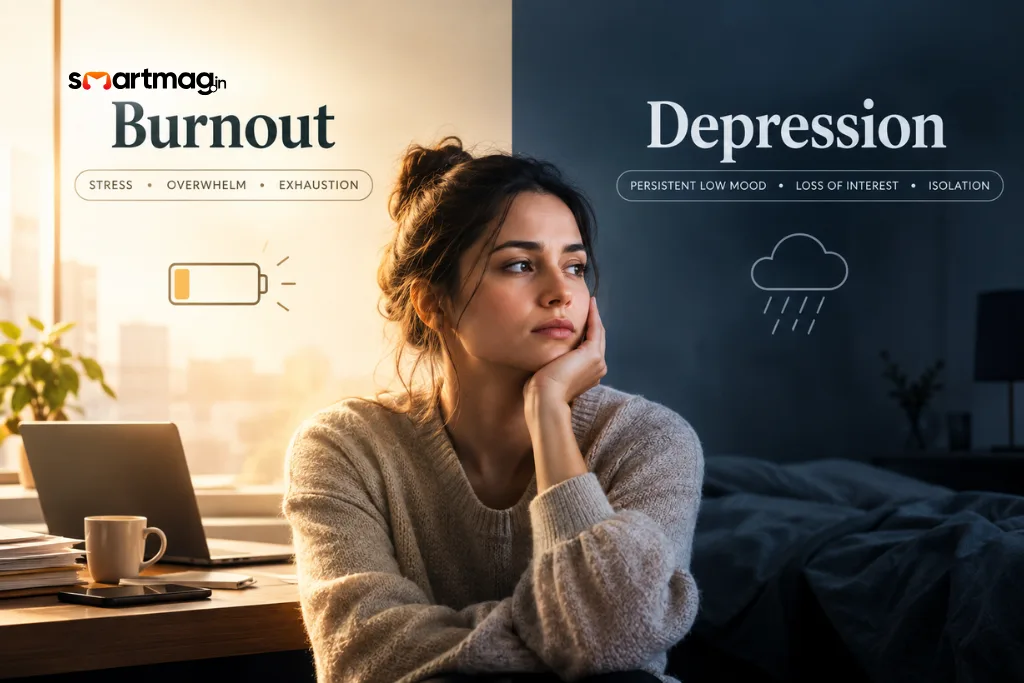
You’re exhausted. You dread Monday before Sunday even ends. You’ve stopped caring about things you used to love.
Is that burnout? Or is it depression?
Most people can’t tell. And the confusion isn’t your fault. The two conditions share a lot of the same territory.
Burnout vs depression: why they get mixed up
Both drain your energy. Both mess with your sleep. Both make you want to cancel plans and stare at a wall instead.
Burnout comes from Christina Maslach’s research in the 1970s, built around three things: exhaustion, cynicism, and a drop in how effective you feel at work. Depression is a clinical diagnosis, listed in the DSM-5, with its own specific criteria.
One is a response to your environment. The other is a mental health condition. That distinction matters more than it sounds like it should.
Burnout vs depression: what actually causes each one
Burnout is situational. It shows up after months (sometimes years) of chronic stress, usually tied to work, caregiving, or some other role you can’t easily walk away from.
Take away the stressor, and burnout usually improves. A vacation helps. A new job helps. A boundary you finally set helps.
Depression doesn’t work that way. It can show up with no external trigger at all. Genetics, brain chemistry, past trauma, even a vitamin D deficiency can play a role. You can quit the job that was crushing you and still wake up depressed three months later.
Burnout vs depression: the symptoms that overlap
Here’s where it gets messy. Both conditions can bring:
- Constant fatigue, even after sleep
- Trouble concentrating
- Irritability
- Withdrawing from people
- Changes in appetite
That last one is worth paying attention to. Some people stress-eat their way through burnout. Others lose interest in food entirely. If your eating patterns have shifted and you want to actually see the change instead of guessing, tracking your intake for a week with a Calorie Counter can show you whether you’re under-eating, overeating, or just eating differently than usual. Small data point. Sometimes it’s the first honest signal that something’s off.
Burnout vs depression: the signs that don’t overlap
This is the part that actually helps you tell them apart.
Burnout tends to stay tied to the source. You’re wrecked about work, but you can still laugh at dinner with friends. You still feel a flicker of interest in your hobbies on the weekend.
Depression doesn’t stay in its lane. It follows you into the parts of life that used to feel good. The hobby stops feeling like a break. The friends stop feeling like a relief. Guilt and worthlessness creep in, and they’re rarely proportional to anything real.
Depression can also carry a persistent low mood that lasts most of the day, nearly every day, for two weeks or more. Burnout tends to lift, even briefly, when you’re away from the stressor.
When burnout turns into depression
Untreated burnout doesn’t just sit still. Give it enough time and it can turn into something clinical.
A 2023 review in the journal Frontiers in Psychology found meaningful overlap between severe burnout and depressive symptoms, especially in high-stress professions like healthcare. The line between “worn down” and “depressed” gets blurry fast when the exhaustion has been going on for a year instead of a month.
What to actually do about it
If it’s burnout: change the conditions. Set a boundary. Take real time off, not a laptop-on-the-beach version of time off. Talk to your manager if you can. Rest that isn’t just sleep, actual disengagement, matters here.
If it’s depression: rest alone won’t fix it. This needs a professional, whether that’s therapy, medication, or both. There’s no shame in that. Brain chemistry isn’t a willpower problem.
If you’re not sure which one you’re dealing with, that uncertainty is itself a reason to talk to a doctor or therapist. They can screen for depression in about 15 minutes. Guessing on your own for six more months isn’t a great plan.
And if things ever get bad enough that you’re thinking about hurting yourself, don’t wait this out alone. Call or text 988 in the US, or reach out to a crisis line in your country, right away.
Getting this right matters more than most health topics people brush off. For more research-backed breakdowns like this one, sourced from primary research rather than aggregator blogs,is
Health Coach JP worth a look.
Explore more health-related informational blogs on SmartMag.