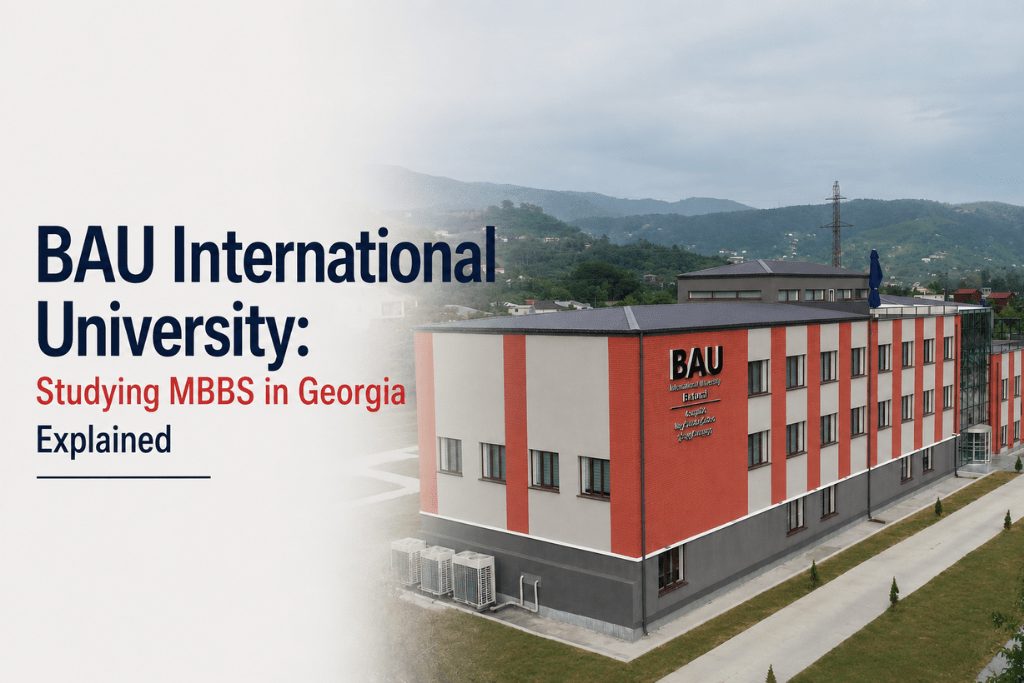
BAU International University has become one of the names that keeps coming up whenever students start researching MBBS in Georgia. Part of a wider international education network, its Batumi campus runs medicine and dentistry programs taught entirely in English, with an accreditation profile that’s worth understanding properly before you add it to your shortlist.
Why Georgia, and why this university specifically
Georgia has positioned itself as a genuine alternative for international medical education over the last decade, alongside more established destinations like the Philippines, Russia, and parts of Eastern Europe. The country’s medical schools generally teach in English and follow structured 6-year MD/MBBS-equivalent programs, but accreditation status varies a lot between institutions.
This is where BAU International University stands out from a lot of the competition. Its medicine program holds WFME (World Federation for Medical Education) accreditation and is listed in the WHO World Directory of Medical Schools with Canada sponsorship. The university is also ISO 9001:2015 certified for its medical education processes, and its dentistry program follows ADEE (Association for Dental Education in Europe) standards. These credentials matter because they connect directly to licensing pathways like the USMLE in the US.
What the campus and student experience actually look like
BAU International University’s Batumi campus sits on Georgia’s Black Sea coast and hosts close to 200 international students from more than 25 countries, including Egypt, Turkey, the UK, Iran, Canada, and Jordan, alongside Georgian nationals. That’s a genuinely multicultural environment for a relatively small university.
The program structure includes clinical exposure starting from the first year, anatomical training using real specimens rather than only models, and USMLE preparation support built into the curriculum. Current students describe the appeal in fairly consistent terms: an international peer group, earlier hands-on clinical exposure than many home-country programs offer, and a coastal city setting that’s a genuine change of pace from a typical university town.
What the admission process looks like
For international applicants, the requirements are fairly standard across most Georgian medical universities: a high school diploma or equivalent (A-levels), academic transcripts, a passport copy, and an English proficiency certificate at B2 level or above (commonly IELTS 6.5 academic or TOEFL iBT 79). Indian applicants generally need NEET scores, and Turkish applicants are assessed against national exam rankings.
Applications go through the university’s online portal. After submission, applicants typically receive a conditional acceptance letter within a couple of days, and the Georgian Ministry of Education then processes recognition of foreign qualifications, which usually takes 2 to 3 weeks before enrollment is finalised.
“The accreditation check is what actually determines whether a degree means anything once you graduate. Everything else, including the campus and the city, is secondary to that.”
Things worth knowing before you commit
A few practical points that don’t always show up in prospectus materials. The university doesn’t provide accommodation directly, so factor in time to arrange housing in Batumi before the semester starts. Scholarship structures at BAU International University are merit-based and reassessed every semester according to academic performance, which is different from a one-time entry scholarship model used elsewhere, so it’s worth understanding how that works if cost is a major factor in your decision.
Beyond academics, the university maintains an active campus calendar: sports leagues, student participation in international medical conferences, clinical traineeships abroad (a recent cohort completed a placement at the University of Florence, Italy), and community initiatives like blood donation drives run jointly with the Georgian Red Cross.
Is it the right fit?
If you’re seriously exploring MBBS in Georgia, BAU International University is a reasonable name to have on your shortlist, particularly because of its WFME accreditation and WHO listing, which removes a lot of the uncertainty that comes with overseas medical degrees generally. As with any university abroad, the homework that matters most is confirming your home country’s recognition pathway directly with your national medical board, rather than relying on marketing claims alone.
Frequently Asked Questions:
Is BAU International University a recognised medical university?
Yes. BAU International University’s medicine program holds WFME (World Federation for Medical Education) accreditation and is listed in the WHO World Directory of Medical Schools with Canada sponsorship. It’s also ISO 9001:2015 certified for its medical education processes. These credentials are recognised by medical licensing bodies in most countries, including pathways like the USMLE in the US.
How long does the MBBS program at BAU International University take?
The medicine program follows a 6-year structure, similar to the MD/MBBS-equivalent format used widely across Europe and Asia. The program includes clinical exposure beginning in the first year, rather than delaying hands-on training until later years, alongside anatomical training using real specimens and structured USMLE preparation support.
What documents do I need to apply to BAU International University?
International applicants typically need a high school diploma or equivalent (A-levels), academic transcripts, a passport copy, and an English proficiency certificate at B2 level or higher (IELTS 6.5 academic or TOEFL iBT 79 are common minimums). Indian applicants need NEET exam results. After submission, a Ministry of Education recognition process generally takes 2 to 3 weeks before final enrollment is confirmed.