Search visibility no longer begins and ends with ten blue links on Google result pages. Thanks to zero-click search made possible with AI, a user can now ask a detailed question, receive an answer and compare providers. These AI search results comprise AI citations that can place a brand directly inside the answer.
So, what exactly are these AI citations, how do they work, and why do AI platforms choose some sources over others?
Let’s find out.
What Are AI Citations?
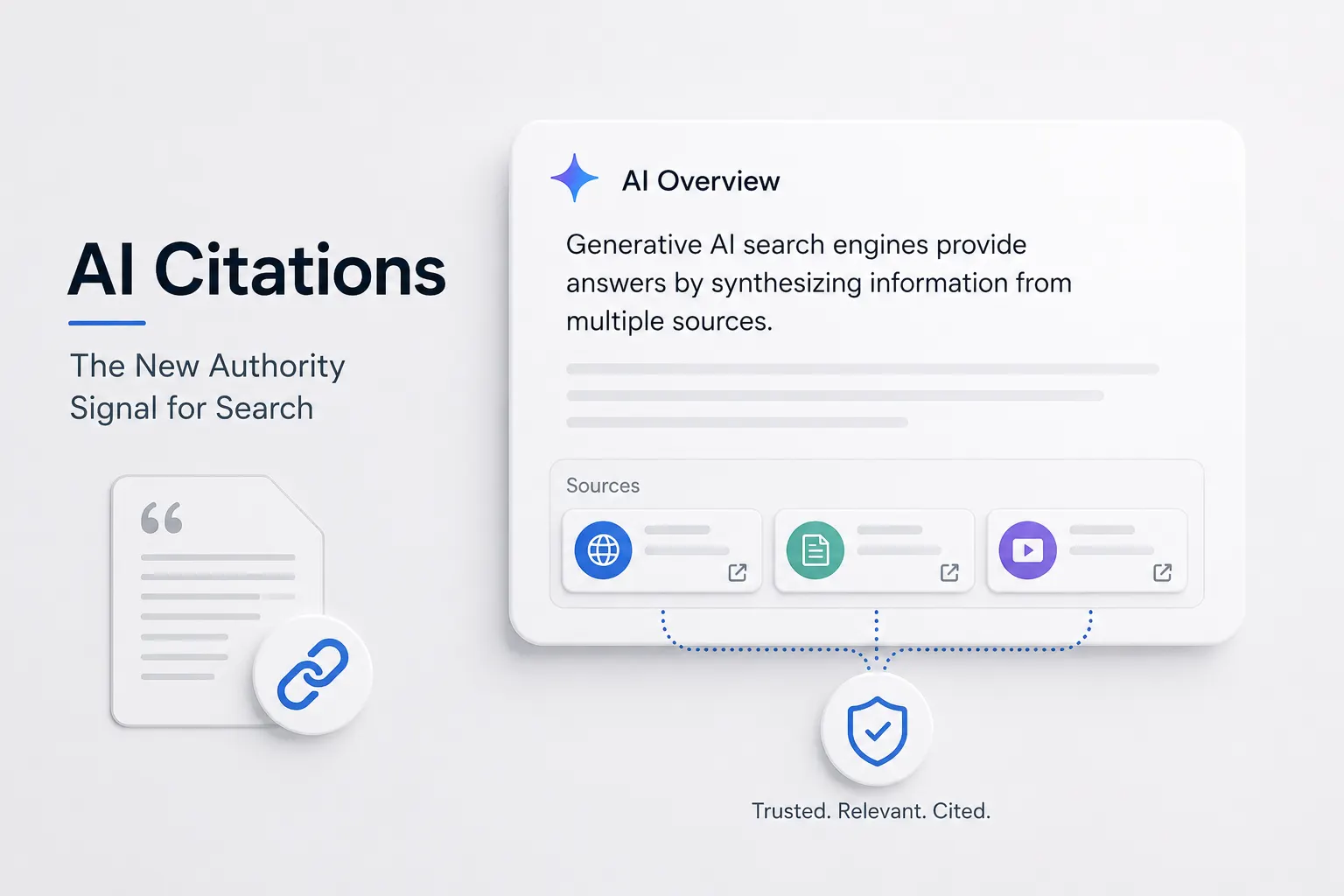
AI citations are links or references attached to an AI-generated response to a user query. These citations show the links of the source pages that were referenced by the AI system to generate the response.
You may find AI citations in Google’s AI overviews, ChatGPT Search, Microsoft Copilot, Bing and Perplexity.
These citations are of three main types:
- Information citations (references to informative sources that provide verified information to users)
- Product citations (references to product pages from e-commerce sources)
- Multimedia citations (multimedia content sources like images, videos, etc).
Formats vary, but the purpose is similar: letting users inspect the evidence behind an answer.
How AI Search Finds Sources
Now, the question comes: how are these sources selected? Generative AI search engines discover relevant pages, retrieve useful information and combine it into a response.
Google explains that its AI experiences may use “query fan-out”, where one complex question triggers related searches.
For example, someone researching payroll software may trigger searches about pricing, compliance, integrations and support. A page may be selected because one section answers one supporting question.
So, the basic process involves:
- Discovery: Finding accessible pages.
- Retrieval: Identifying relevant information.
- Grounding: Supporting the response with external sources.
- Synthesis: Combining information.
- Referencing: Linking claims to sources.
It is now clear that generative engine optimisation involves so much more than keyword placement, like traditional SEO. A page needs useful sections that work independently while supporting a complete explanation.
Are Citations a Confirmed Ranking Signal?
No major platform has publicly confirmed that AI citations directly improve rankings or automatically indicate authority, importance, and placement.
Instead, they are better treated as an emerging visibility indicator.
A citation suggests that a system considered a source relevant enough to support an answer. It may improve discovery, but it is not a permanent endorsement.
Note: Visibility can change with prompt wording, location, freshness, available results, retrieval methods and the model used. Businesses should track recurring patterns rather than one screenshot. Context and intent shape every answer.
Why AI Citation Visibility Matters
As per a Semrush study, by the year 2028, AI search traffic and conversions could surpass traditional search results.
Generative AI search engines can influence customers before making the click. A direct answer may introduce brands, define buying criteria and shape a shortlist.
For a startup, appearing as a source can build awareness during research.
For an enterprise, repeated visibility around subjects can reinforce expertise.
For marketers, citation data can show whether content is recognised as useful evidence
Potential benefits are as follows:
- Visibility during research
- Brand recognition before a visit
- Inclusion in comparisons
- Relevant referral traffic
- Increased branded searches
- Better insight into customer questions
It is noteworthy that these are opportunities, not guarantees. It is possible for a citation to influence a decision without producing measurable traffic.
What Makes Content Worth Citing?
Good generative engine optimisation starts with the quality of information. A human reader and AI should be able to understand the claim made in the source, its relevance and the supporting evidence.
Citation-worthy content exhibits some clear features, such as:
- Original information based on new verified findings to unanswered questions
- Large language model-friendly natural language
- A direct opening answer
- Descriptive, question-led headings
- Statistics linked to primary sources
- Clear definitions and dates
- Named, qualified authors
- Helpful comparison tables
- Internal links to related resources
Generative AI search engines rely very little on recycled overviews. Businesses create stronger opportunities by publishing evidence, real insight and practical detail that competitors have not repeated.
Technical SEO Still Matters
It brings us to the importance of technical SEO. No matter how excellent the information is, it cannot be picked up if systems cannot access or interpret it. Pages need to be indexed and eligible for a search snippet before appearing in its AI features.
A robust generative engine optimisation programme should:
- Follow SEO best practices
- Keep important pages crawlable
- Maintain accurate canonical tags
- Submit XML sitemaps
- Fix broken internal links
- Provide usable mobile pages
- Keep key information visible
- Match structured data to page content
- Maintain consistent company details
Note: No special schema guarantees AI visibility. As per Google, an llms.txt file is not required for its search experiences.
Authority Beyond Your Website
Generative engine optimisation is not only limited to on-site content. Search systems can encounter a business through publications, reviews, directories, research, partners and professional communities.
Brands need two forms of authority: owned and earned authority:
- Owned authority comes from the website, documentation, case studies, expert profiles and original reports.
- Earned authority comes from credible third parties that mention, quote, review or reference the organisation.
Startups can build this through founder expertise and market data. Enterprises can use transparent documentation and expert participation. The goal is to confirm credibility, not mere volume.
How to Measure AI Visibility
Measurement parameters are still developing, but businesses can combine platform data, analytics and prompt testing to stay ahead.
Bing Webmaster Tools reports total AI citations, cited pages, grounding queries and trends. ChatGPT Search lets users inspect source links, while Google now reports AI-feature visibility through Search Console.
When evaluating AI citations, what to track?
- Pages receiving references
- Topics and prompts creating visibility
- Referral visits from AI platforms
- Engagement and conversions
- Changes in branded search demand
- Accuracy of generated descriptions
- Competing sources used for the same questions
Generative engine optimisation should be judged through business relevance, not volume alone. One high-intent reference may be worth more than many related appearances.
From Ranking Authority to Answer Authority
Search authority is no longer expressed only through rankings and backlinks. Businesses must also consider whether their information can be found, understood, trusted and referenced inside generated answers.
The strongest approach combines technical SEO, original insight, third-party recognition and readable content. That is the purpose of generative engine optimisation: becoming a dependable source, not manipulating an answer box.
For businesses, the direction is clear. Solve customer problems, support claims and keep information easy to verify. As generative AI search engines evolve, AI citations should be treated as evidence of answer visibility rather than a guaranteed badge of authority.