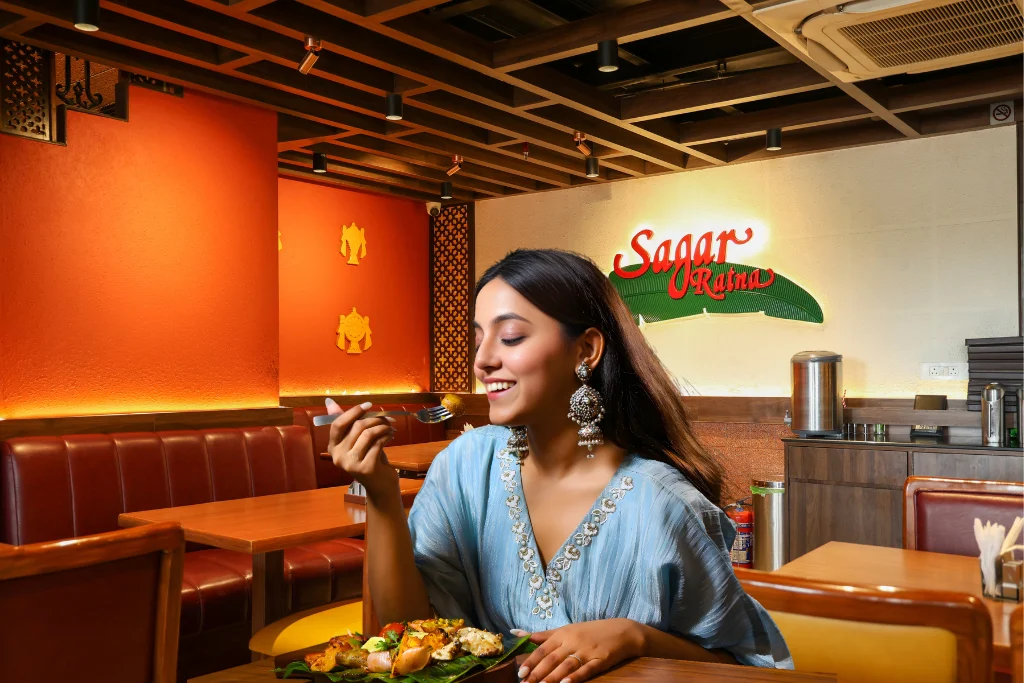
The food industry today operates at lightning speed, where trends change just as quickly as the social media newsfeed. Today, for a restaurant, it’s not about a one-time visit. It’s about creating customer loyalty over a lifetime. Therefore, the answer to how restaurant brands build long-term loyalty is that brands that survive this highly competitive environment (with both global giants as well as emerging local names) are those which can effectively balance tradition and innovation.
One of the most shining examples of this success is the Sagar Ratna restaurant. It is a brand that is an established symbol of the authentic South Indian flavours in North India. By taking a closer look at their journey, we could derive the model for how restaurant brands build and retain customer loyalty over a long time.
From 40 Seats to a National Icon: The Sagar Ratna Story
The success and longevity of any brand come from the ground. The Sagar Ratna restaurant story began in 1986, when the founder, Mr Jayaram Banan, opened an outlet of 40 seats in Defence Colony, New Delhi. South Indian cuisine, which, up until that point, was exclusively found in roadside kiosks or luxurious 5-star hotels in North India, was now redefined as a mid-range offering of superior-quality, affordable food, all thanks to Mr Jayaram Banan’s vision.
His journey, famously known widely (running away from home as a young boy to working as a dishwasher and rising through the ranks to become a manager and restaurant owner), infused the brand with a culture of service.
This “founder’s story” is what a lot of modern Indian restaurant brands aspire to inculcate. Staying grounded while having built the brand over a hundred outlets, this shows that by retaining its soul, restaurant brands can remain loyal over generations, even while turning into corporations.
The Foundation of Trust: Consistency and Quality
The first pillar of how restaurant brands build long-term loyalty is unwavering consistency. The signature dish of a vegetarian restaurant should taste the same at its different locations if it wants to last for years. This is the exact case with Sagar Ratna. When a customer eats at any of its outlets, they are eating to experience not necessarily food but trust.
Another thing is that the one problem which made many Indian restaurant brands fail in scaling in the early stages was that they were unable to replicate the magic of the original chef. However, Sagar Ratna restaurant takes care of this issue by providing rigorous standard operating procedures (SOPs). It ranges from how many hours to ferment dosa batter to the spice mix for sambhar, etc.; every detail is well documented and strictly followed.
This level of care and precision is the main reason why it is still a top-class vegetarian restaurant destination for families who want a quality, pure vegetarian meal.
Adapting to the Modern Palate
One big error that has plagued old Indian restaurant brands is becoming stagnant. But the answer to how restaurant brands create lasting loyalty lies in “dynamic tradition”, which essentially means sticking to your roots but moving with the times as your audience does.
When urban India increasingly began to eat healthy, Sagar Ratna restaurant didn’t just stick to deep-fried vadas. By coming up with alternative, healthier options like ragi dosas or dishes that are high on vegetables, it managed to remain a choice vegetarian restaurant even for health-conscious millennials and Gen-Z.
This flexibility is a vital contributor to its uniqueness among Indian restaurant brands that just could not adapt.
The Role of Technology in Customer Retention
Today, in the digital world, customer loyalty in restaurant brands has more to do with data. Smart Indian restaurant brands are now implementing a highly evolved POS system and a CRM program that monitors customer behaviour.
Using high-tech retail management software, a vegetarian restaurant chain can tell which cuisine is more popular in which geographical location. These brands use this information to tailor their marketing efforts and loyalty rewards. For example, sending a regular customer a personal “Coffee on Us” birthday voucher on his birthday (because he always orders filter coffee) would create a much stronger connection than a generic discount offer.
Creating an Emotional Connection
While the food contributes greatly, restaurant brands build long-term loyalty by creating an atmosphere of belonging. For many Indian families, going to a vegetarian restaurant on a Sunday afternoon is like a family tradition.
The service culture of Sagar Ratna restaurant is based on the principle of ‘Atithi Devo Bhava’ (the guest is God). The staff’s knowledge of their regulars, knowing them by name, offering their preferred table, and remembering their preferences (say, spice levels), transforms a restaurant into their extension. And that’s when it stops being a business and starts being home.
This ’emotional connect’ is a restaurant brand’s strongest armour against competitors. Even with a new vegetarian restaurant coming up across the street, the loyal customers will stay because they feel recognised and valued at their trusted restaurant.
Strategic Expansion and Visibility
You just cannot create loyalty if you are not present in the customer’s space. The presence at the right time and place constitutes a major factor where restaurant brands build long-term loyalty.
Sagar Ratna strategically set up outlets in places that are commonly frequented by their target customers, including shopping malls, airports and highway pit stops. By making their well-known logo appear to the customers while they travel in their car during a road trip with family or during their wait at the airport, they establish their position as an accessible vegetarian restaurant option.
This is a hallmark of all the successful vegetarian restaurant brands.
The Power of the "Anchor Product"
Every brand needs an anchor, which is a product good enough that it becomes the primary reason for a visit. For Sagar Ratna, this anchor product is its authentic South Indian thali and dosas. Restaurant brands build long-term loyalty only when they master one type of meal category before branching out.
While they have also added some North Indian and Chinese dishes to attract groups, Sagar Ratna remains predominantly a South Indian vegetarian restaurant. This well-defined brand proposition allows them to rival other Indian restaurant brands that aim to be “everything to everyone” and be average in all areas.
The Long Journey of Loyalty
The success of a decades-old brand cannot be attributed to a one-time achievement; rather, the long-term loyalty of a restaurant brand relies on the careful concoction of consistent quality, emotional storytelling, integration of technology, and respect for the evolving needs of its customers.
Sagar Ratna has proved to have learned this formula to perfection, from its 40-seat start to its status as a giant among the Indian restaurant brands. Sagar Ratna truly exemplifies the concept that if you take care of your customers like your family and your food like a piece of art, loyalty will inherently grow. For every business owner or restaurateur aspiring to succeed or every diner seeking a delectable dish, there is a treasure of lessons to be learned from this legendary vegetarian restaurant.