
Growing Up Online: Transition vs Immersion
To understand these differences clearly, we begin with widely accepted generational definitions: Millennials are typically classified as those born between 1981 and 1996, while Generation Z begins in 1997. This distinction matters because it marks two very different technological childhoods.
Technology influenced both generations, but the depth and timing of exposure created fundamentally different developmental environments.
For Millennials, the internet was an evolution. Many remember dial up connections, offline weekends, and the gradual rise of social media platforms. Smartphones arrived later in adolescence or early adulthood. Their relationship with technology was transitional. They logged on and logged off.
For Gen Z, connectivity was not an upgrade. It was the baseline. Many came of age during a period dominated by algorithm driven platforms, constant notifications, and uninterrupted digital feedback loops. Social identity developed alongside social media. Visibility was not optional. It was embedded.
The difference is subtle but powerful.
Millennials adapted to a digital world.
Gen Z was socialized within one.
How the Digital Environment Shifted
Technology played a big role for both generations, although the timing of the influence gives us significant insight.
For the Millennials, the internet has been an evolutionary experience. Many people remember the days when the internet was inaccessible, and users can trace the development of the initial social platforms and the gradual extension of smartphone usage.
Gen Z, especially the younger members of the group, came of age in their teenage years, a period in which algorithmic platforms and connectivity
Psychological Implications
Increased immersion influences:
- Attention regulation
- Social comparison frequency
- Information processing speed
- Identity experimentation
Millennials logged in.
Gen Z never really logs off.
Constant exposure to algorithmic feeds reshapes attention patterns and behavioral loops, reinforcing how digital habits influence identity formation.
Career Identity: Endurance vs Sustainability

While work defines adulthood for both generations, the concept of success in a career is distinctive.
The millennial generation entered the job market at a time when the financial crisis of 2008 occurred. Scarcity of jobs and competition propelled the attitude of resilience and loyalty.
Professional endurance became a survival mechanism.
Why Millennials Internalized Hustle
Long hours showed commitment. Corporate loyalty was equated with stability. Burnout was normalized because economic recovery felt like an uncertainty.
Climbing the ladder was the strategy.
Why Gen Z Redefines Success
Generation Z grew into adulthood during the pandemic and a period of visible organizational instability. Remote work and layoffs became early realities.
Rather than associating tenure with success, Gen Z often places a greater value on:
- Flexibility
- How to set boundaries for better mental health
- Role mobility
- Work-life balance
When it comes to work ethic, the great Gen Z vs. The Millennials debate is not about ambition; it is about sustainability.
Micro takeaway: Millennials climbed for security. Gen Z adjusts for protection.
Financial Outlook: Deferred Stability vs Expected Volatility
Money anxiety affects the two generations differently.
Millennials have been made to believe that there is security for higher education. This has encouraged them to incur debt in the hopes of stability. The housing crisis disrupted that expectation
Financial pressure became prolonged.
The Millennial Financial Burden
Delayed developmental milestones like home ownership and savings formation considerably influenced adulthood timelines. Stability waited longer than expected to arrive.
The Gen Z Financial Mindset
Observing these patterns has helped shape Gen Z’s point of view. For them, questioning the degree and exploring other sources of income comes first.
The financial differences between Gen Z and Millennials are nuanced but important. Millennials expect a recovery, and Gen Z expects a fluctuation.
That expectation influences risk responses and career explorations
Relationships: Structure vs Fluidity
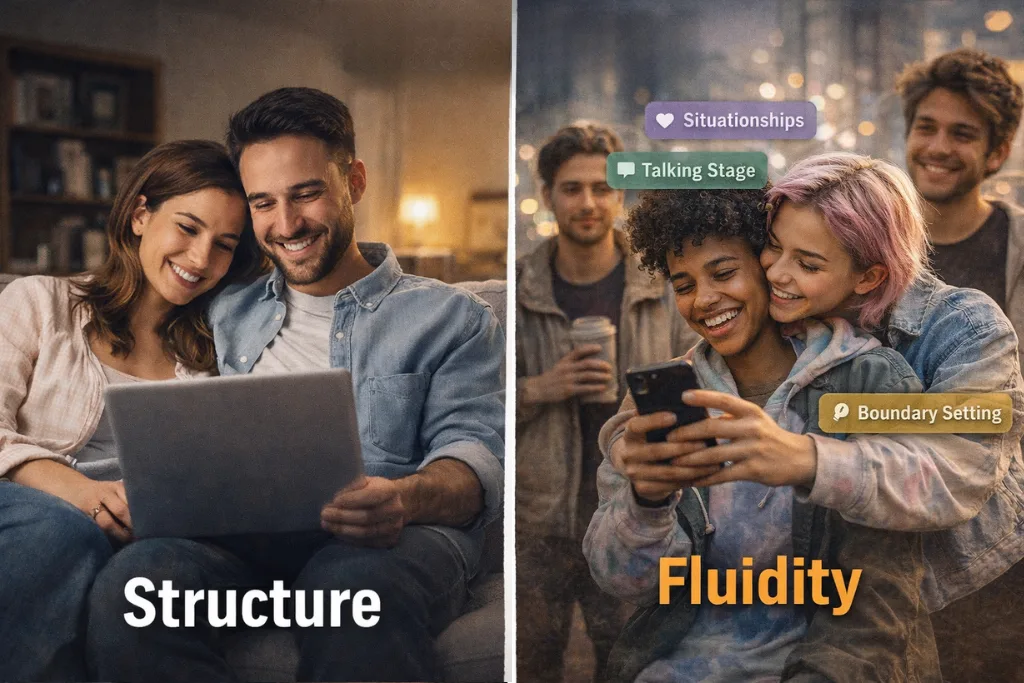
Another cultural domain that shows interesting divergences between Gen Z and Millennials is that of romance.
The millennials pioneered a culture of online dating but carried forward a linear progression of relationships with designated labels.
Relational Norms Among Gen Z
The Emergence of Emotional Ambiguity
Situationship and talking stage are terms that demonstrate illustrative dating expectations. Constant connectivity has ambiguities.
Emotional Literacy Expansion
Gen Z displays increased public fluency with the following:
- Attachment styles
- Therapy concepts
- Boundaries
- Trauma responses
This shift in emotional expression is also visible in how humor is used as a coping mechanism, particularly in Gen Z’s dark humor culture.
Nevertheless, emotional vocabulary removes the uncertainty.
Micro takeaway: Awareness increased. Stability remains complex.
Mental Health: Stigma Reduction vs Visibility Expansion
The dialogue with regard to mental health vastly changed between the generations.
Millennials helped normalize therapy and anxiety discussions. Such topics became acceptable in the workplace and social circles.
The Gen Z age group made an impact on visibility in digital media.
The Strength of Public Dialogue
Mental health stories are very common and produce a sense of validation.
The Risk of Constant Exposure
At the same time, exposure to continuous crisis news and comparative content enhances stress.
It is important to note that notwithstanding the present comparison between Gen Z and Millennials on mental health trends, the primary variation to expect in the Gen Z vs. Millennials mental health pattern will be in the expression of such trends. In respect
Both experience pressure. The style of communication differs.
FOMO vs Burnout Anxiety

Comparison culture affects both groups.
The fear of missing out was common among millennials. Visible milestones led to competition.
Gen Z continues to face comparison, but burnout anxiety is the new core issue.
The Shift in Productivity Culture
Millennials may have reacted to pressure by increasing their efforts.
In a hyper-optimized digital economy, productivity tools often amplify busyness rather than effectiveness, intensifying burnout anxiety.
The question of whether productivity can be maintained is being increasingly posed by the Gen Z generation.
The difference is not ambition. The difference is pacing.
Micro takeaway: The fear changed from missing time to managing energy.
Conclusion: Context Explains the Contrast
The debate between Gen Z and Millennials should not be about who is superior. It should be about when.
Millennials faced the recession and the emergence of digital technology.
Gen Z experiences hyperconnectivity and structural uncertainty since they are adolescents.
The differences between Gen Z and Millennials are influenced by the economy, the intensity of technology, and social demands.
Various environments foster the development of unique coping styles.
Understanding these mechanisms will result in stronger work environments, clearer communications, and healthier generational collaboration.
FAQs;
A – What is Gen Z and Millennials?
Millennials are those born between 1981 and 1996. Gen Z, on the other hand, are those born between 1997 and 2012.
B – What makes Gen Z unique?
Gen Z is unique because they were born and raised in a completely digital world with constant connectivity, early introduction to social media, and an uncertain economy.
C – When does Gen Z start and end?
Gen Z starts in 1997 and ends in 2012, according to the most widely accepted demographic definitions.
D – What is the difference between Gen Z and Gen Alpha?
The generation that is included in the category of Gen Z is made up of people born between 1997 and 2012, while the people in the category of Gen Alpha are born from 2013 and later.
E – What does the “Z” in Gen Z mean?
The “Z” in Gen Z stands for Generation Z and follows the alphabetical sequence after Generation X and Generation Y. The name simply continues the generational naming pattern, and members are sometimes informally called “Zoomers.”







Social & Political Identity: Participation vs Integration
Political awareness influences generational identity.
Millennials are a generation of people who witnessed significant changes in the world and took part in organized movements. Their engagement was event-driven.
Gen Z incorporates political values into daily identity.
Digital Acceleration
Social justice issues are trending worldwide within hours. Silence for brands often equates to an endorsement.
Among the key differences between Gen Z and Millennials is how activism is incorporated into personal identity.
Participation is no longer an occasional phenomenon. It is constant.