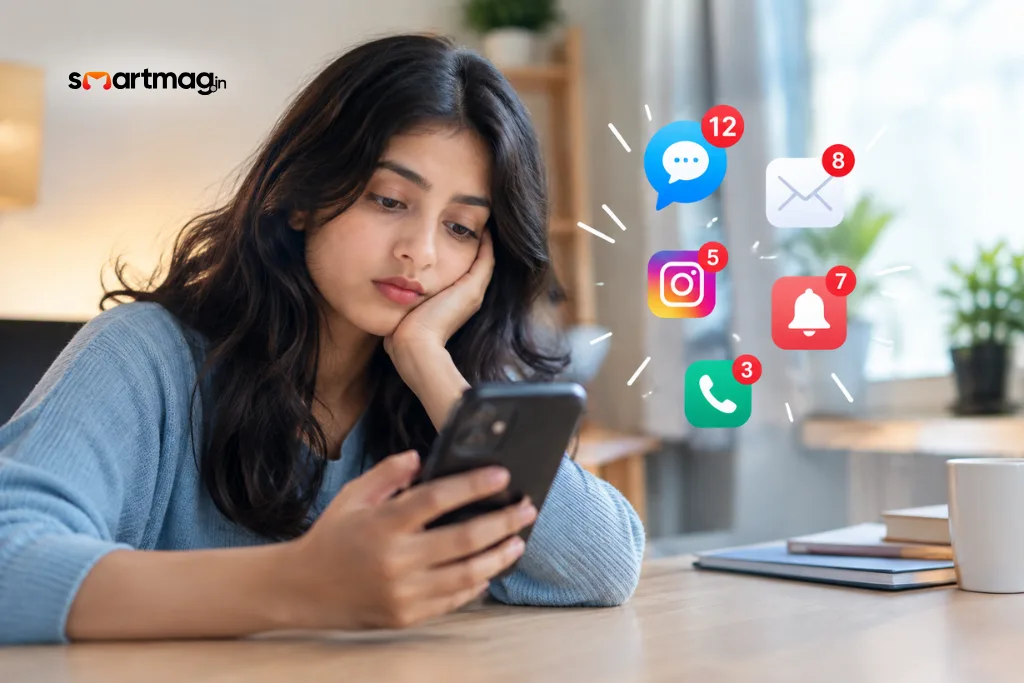
Your phone starts buzzing. You grab your phone, despite knowing you might not have to. After a few minutes, you find yourself immersed in messages, reading updates and using an application that you never meant to.
Ringing any bells?
This is not merely a case of poor self-regulation. Brain Craves Notifications because notifications tap into anticipation, ambiguity, and social relevance in ways that automatically draw your attention. Every notification implies that there might be something new waiting for you: a message, a reaction, an update, or even a reward.
In the end, your phone-checking becomes involuntary. You even start grabbing your phone even when it does not buzz at all. Knowing how the brain seeks continuous notifications is the first step towards modifying this habit.
Why the Brain Craves Constant Notifications
The brain constantly looks for information that could be useful, rewarding, or socially important. A notification creates a small gap between knowing that something has happened and discovering what it is. That uncertainty makes the alert difficult to ignore.
Reward is also unpredictable. While one notification might bring an important piece of information, another notification could be a discount, a social response, or anything not rewarding at all. This variability in outcome makes the urge to check very powerful.
This behavior can be described by psychologists as “variable reinforcement”. People tend to act more consistently when the result is unpredictable than when it is predictable.
The notification becomes the stimulus, the act of checking becomes the ritual, and new information becomes the possible reward.
| Habit Stage | What Happens | Common Example |
|---|---|---|
| Cue | The brain notices a trigger. | Buzz, badge, vibration, or screen light. |
| Anticipation | Curiosity or urgency appears. | “Who messaged me?” |
| Action | The phone is checked. | Opening the notification. |
| Reward | New information is revealed. | A reply, reaction, update, or offer. |
| Reinforcement | The pattern becomes easier to repeat. | Checking automatically next time. |
It explains why the brain is always craving alerts, despite the fact that most of them are inconsequential.
Is It Really Dopamine Addiction?
Dopamine is frequently described as the brain’s “pleasure chemical”, but that explanation is incomplete. It plays an important role in motivation, learning, and anticipating potentially rewarding outcomes. It is not simply released whenever someone feels happy.
Notifications can cause anticipation due to the unknown nature of the notification content. This can induce the tendency to check notifications.
However, labelling all phone addictions as dopamine addiction might oversimplify neurobiology and addiction studies.
The correct way to comprehend this behaviour is that the brain develops a connection between:
Alert → check phone → discover something new
Repeated often enough, this sequence can become automatic. The person may then check the device in response to boredom, stress, or a pause in conversation, even without receiving an alert.
Phone Notifications Interrupt More Than Your Screen
A notification does not have to be opened to affect concentration. The sound or vibration itself can pull attention away from the current task.
This study, conducted at the University of Texas at Austin, was published in the journal “Neuropsychologia”. The findings show that smartphone alerts might hinder performance while adding to the workload associated with managing multiple stimuli. More details about this study are available at the United States National Library of Medicine.
Usually, the process takes place rapidly as follows:
- There is an interruption that catches your attention.
- It is thought out by the brain, which considers whether to check it or not.
- The primary task you were handling becomes less important.
- It takes some effort of your mind to refocus on that task.
- There are some lingering thoughts related to that interruption.
This constant switching causes digital distraction. Small disturbances can also make concentrating more difficult since the brain is always having to rebuild its train of thought.
Why Silence Does Not Always End the Urge
Muting the sound may assist, yet visual notifications, lock screen notifications, and vibrations will all serve as signals. After the routine is developed, the mere existence of the phone may serve as an alerting cue.
It may happen that a person experiences phantom alerts. He/She feels vibration or sound even though no alert appeared on the phone. This does not mean that the phone has affected the brain in any physical way.
A calm period may also serve as a trigger. Waiting for a ride, queuing, or taking a pause while doing something may produce boredom. The phone serves as the perfect tool to use up that period of time.
This is the reason why people experience such difficulty with notification addiction. It is not necessarily related only to the incoming notifications. It may be associated with particular locations, feelings, and inactive periods of time.
How Constant Alerts Affect Everyday Life
The impact differs from person to person. Some individuals handle notifications easily without much problem, while for others the notifications affect their concentration or well-being.
According to research conducted in translational psychiatry, there were differences in attentional control between individuals with problematic smartphone use. The research does not necessarily imply that all those who have regular phone usage have a problem, but rather, it illustrates the reasons why regular checking should be taken seriously. The study is available through Nature.
| Area | Possible Effect of Frequent Alerts |
|---|---|
| Work | More interruptions and slower progress |
| Learning | Difficulty maintaining attention while reading |
| Conversations | Reduced presence and weaker listening |
| Sleep | Delayed bedtime or disrupted rest |
| Mood | Pressure to respond and fear of missing out |
| Leisure | Difficulty relaxing without checking a device |
| Memory | Less continuous attention when processing information |
The Reuters Institute Digital News Report from 2025 also noted that alert fatigue was on the rise. According to its findings, people had turned off news notifications because of receiving excessive alerts or finding them irrelevant.
It is not about social media only; news, shopping, gaming, work apps, delivery apps – everything is in the race for our limited attention.
Signs That Phone Notifications Are Controlling Your Attention
Regular use of mobile phones doesn’t necessarily imply there is an issue. Context is important. For instance, one may be required to be contacted all the time due to work, caregiving, or other reasons.
The habit may demand attention when you:
- Check your phone right after waking up
- Unlock your phone for no reason at all
- Disturb conversations to check small notifications
- Be anxious when you can’t find your device
- Be unable to complete things until checking
- Continue checking even though there are no notifications
- Stay awake till late hours because of scrolling
- Feel compelled to reply right away to each message
Such symptoms do not indicate a diagnosis of clinical notification addiction; rather, they indicate that the act of checking might have gone from being deliberate to automatic.
How to Break the Notification Habit
Relying solely on willpower will prove to be very challenging since the phone stays right there and the cues keep coming. A better way would be to change the environment.
1. Audit Your Notifications
Go to your notification settings and check all apps. See if the notification requires immediate action or simply benefits the app.
Save important phone calls, direct messages, and security notifications. Block promotional notifications, engagement notifications, shopping notifications, and useless news notifications.
Eliminating non-essential phone notifications removes distractions before self-control kicks in.
2. Eliminate Visual Clues
Red dots make you feel like you have outstanding to-dos. Likewise, lock screen previews tempt users to check notifications right away.
Deactivate badge features for applications you don’t use and remove notifications from the lock screen. Place those apps far away from your home screen.
3. Set Up a Schedule For Message Checks
Pick exact periods for reading messages, emails, and social media accounts. This can be once every hour when working or after completing any task.
It does not involve ignoring communication but making it a purposeful activity rather than an instinctive one.
Let your close people know how they can contact you in case of any emergency. This will help to alleviate their worries.
4. Activate Focus and Do Not Disturb Mode
There are modes that enable you to block your phone from certain people or applications while in Focus mode. You can activate this mode during times when you are working, eating, exercising, or sleeping.
Start with something shorter, like 25 or 30 minutes, and after you get used to it, move to longer periods of time.
5. Maintain Physical Distance
Put the phone inside a drawer or bag when you need to concentrate, since putting it face down next to you may not be sufficient.
The use of an old-fashioned alarm clock is yet another option to maintain distance from the phone.
6. Add Friction to Distracting Apps
Log out after each session, remove shortcuts, or switch the display to greyscale. These small barriers interrupt automatic behaviour and create a moment to reconsider the action.
The aim is not to make technology impossible to use. It is to reduce effortless digital distraction.
7. Change the Behavior
The simple act of abstaining from using your phone leaves a gap in time that can be difficult. Choose an appropriate reaction.
In those moments where the impulse arises, take a walk, stretch, have some water, jot down what you’re thinking of doing, or take three deep breaths.
Wrapping Up
The brain’s craving for continuous notifications arises due to the fact that these notifications offer novelty, uncertainty, and a chance for social and information rewards. Checking therefore becomes a habit associated with boredom and stress.
Breaking this cycle does not mean giving up on your phone. It means limiting unnecessary triggers, setting times to check it, distancing yourself physically, and finding better solutions to handle idle time.
Breaking this habit does not mean giving up your phone. Simply reduce unnecessary alerts, check it at set times, keep it out of reach, and find other ways to use your free time.
Discover practical insights on digital habits, phone use, and healthier ways to manage technology with SmartMag.