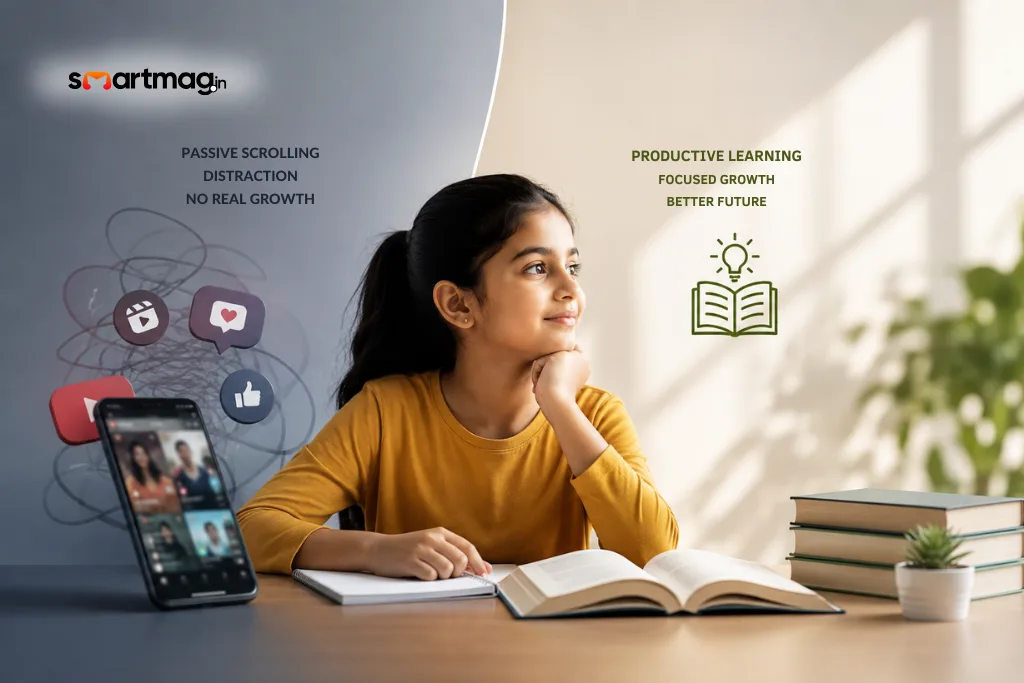
Today most parents are caught in the same daily tug-of-war: digital devices on one side, homework and books on the other. It’s no wonder that the debate of screen time vs productive learning has become one of the most talked-about issues in modern parenthood.
Technology isn’t going anywhere, but how children use it can make all the difference between wasted hours and real growth.
This blog looks at how to distinguish between passively scrolling through social media and productive use of smart devices and also offers some tips on how to foster healthy digital habits in your child.
Screen Time Vs Productive Learning: The Importance Of This Debate
Children nowadays are exposed to screens from a very early age. Like, tablets accompany babies in prams, smartphones become instruments for homework, and even class lessons take place on digital screens. It makes it much harder to separate the two by just switching off devices.
A few reasons this topic deserves attention:
- Excessive and unregulated screen use is associated with decreased attention span and disturbed sleeping patterns in children.
- Not all kinds of screen use are equally harmful. There is a difference between educational apps and endless watching of short videos.
- Parents tend to struggle with decision-making on how to use devices wisely because of guilt and ambiguity, as well as the necessity of their use for homework.
- Since moving to hybrid and online lessons, screens have become a must, so a total ban is almost impossible.
Understanding this difference helps parents make better, calmer choices instead of acting out of frustration.
What the Research Tells Us
Paediatricians’ guidelines generally recommend limiting screen time to one hour per day of high-quality programming for children 2 to 5 years of age and no screen time at all for children under 18 months, except for video chatting with family members. For older children, the advice shifts away from strict hour limits to mindful, purposeful use.
Studies of digital learning also distinguish between active, guided screen use, where a child is solving problems or creating, which supports concentration and understanding, and passive viewing, which does the opposite. And here is the crux of the matter. It is rarely about the clock, and almost always about what is happening on the other side of the screen.
Passive Screen Time vs Productive Learning
The real issue here is not the number of hours but the quality of engagement.
Signs of passive screen time
- Scrolling through videos or social media with no clear goal
- Switching between apps out of boredom rather than interest
- Watching content that requires no thinking, response, or creativity
- Using screens simply to fill silence or avoid boredom
Signs of productive learning-focused screen time
- Apps to aid problem-solving, reading or skills-building
- Watching content related to schoolwork, hobbies or curiosity
- Making something (writing, coding, digital art, etc.) instead of just consuming
- Joining a live class, tutoring session, or study group where a response is anticipated
Many educators now recommend a useful rule: put creation before consumption. Generally, writing, designing, coding, or editing are seen as high-value screen time, whereas endlessly scrolling is seldom seen that way, even if the app itself is labelled educational.
Once parents see which category their child’s screen time falls into, the conversation gets much easier to manage.
Practical Ways to Balance Screen Time and Learning
Here are some approaches that genuinely help families strike a healthier balance:
1. Set clear and suitable age limits : Instead of banning screens completely, set reasonable daily limits with your child. This fosters cooperation rather than resistance, and children are far more likely to follow through on a plan they have helped to create.
2. Go for quality, not quantity: Not all screen time is bad. Educational platforms and skill-building apps and documentaries can also be genuinely useful for learning if chosen with intention rather than used as a default distraction.
3. Designate screen-free spaces and times: Simple rules such as no devices at meals or an hour before sleep protect sleep and family conversation.
4. Try structured study-break cycles: A simple technique such as studying for around forty-five minutes and taking a short break afterwards can help children associate screens with rest rather than constant background noise. This keeps study sessions focused and prevents screens from bleeding into every part of the day.
5. Encourage offline hobbies: Reading, sport, art and outdoor play give children a natural break from screens while building skills that devices cannot replicate.
6. Stay involved in what they use:Ask what an app or website actually does, rather than only monitoring how long it was open. A short conversation such as “What did you learn today?” keeps parents informed and helps children feel proud of their progress.
7. Model healthy habits yourself:Children notice how adults use their own devices. Demonstrating balanced screen use at home reinforces the message far more than instructions alone.
Digital Discipline: The Importance of Structured Environments
Home routines are very important, but they are not everything. Children often develop far more consistent habits when an entire day (and not just a few hours) is intentionally structured around learning, activity and rest.
That’s why some parents bypass day schools altogether and look to a boarding school for girls where the daily rhythm itself is designed to reduce idle screen dependency.
- Academic periods, sport, meals, prep time and lights-out are all built into a fixed schedule, so there is a lot less unstructured time for aimless scrolling than a typical evening at home.
- In a boarding school for girls, access to screens is generally supervised and not left to the individual student, especially when it comes to younger boarders.
- Devices tend to be used for specific, purposeful tasks such as research, assignments or approved communication with family, rather than being freely available throughout the day.
- Over time, this consistent structure can help students internalise the difference between passive and purposeful screen use far more naturally than repeated reminders at home might achieve.
It is worth noting that boarding is not a fix in itself; the same principles of intentional, purposeful screen use still apply.
What a well-run boarding school for girls offers is simply a more consistent environment in which those habits are reinforced daily by routine rather than by willpower alone.
Bedford School Mohali is one model example of an institution built around this kind of structured daily rhythm, pairing academic rigour with clear boundaries around personal device use.
Helping Children Build Their Own Awareness
Ultimately, the goal is not to control every minute of screen use but to help children understand the difference for themselves. A few gentle habits can support this:
- Instead of asking how much time they were on a device, ask what they learned or enjoyed after screen time.
- Take short breaks between sessions to refocus.
- Acknowledge occasions when screens are used for creativity or learning so that children also learn to distinguish the difference.
- Get kids involved in making a schedule around their screen time so limits don’t feel like a penalty but a compact.
Kids who understand this difference tend to make better choices on their own later on, even without being monitored all the time.
Final Thoughts
The debate around screen time vs productive learning is not about cutting out technology but about guiding children towards more intentional use. Whether the structure is from home routines or a more formal setting, parents can help children reap the benefits of technology without sacrificing real learning and growth by setting clear limits, providing good content, and creating a supportive setting.
The biggest difference is often made in small, consistent steps. With patience, most families find a healthy rhythm that works for them.
Enjoyed the blog? Explore more on SmartMag.