Establishing authority online sounds simple until a brand formally decides how to do it.
Should it publish articles on relevant websites through guest posting, or should it create stories, research, and expert insights that the journalists want to cover?
Well, both methods can support visibility and link building, but they work in very different ways. One offers greater control, while the other helps in creating broader recognition and stronger third-party credibility.
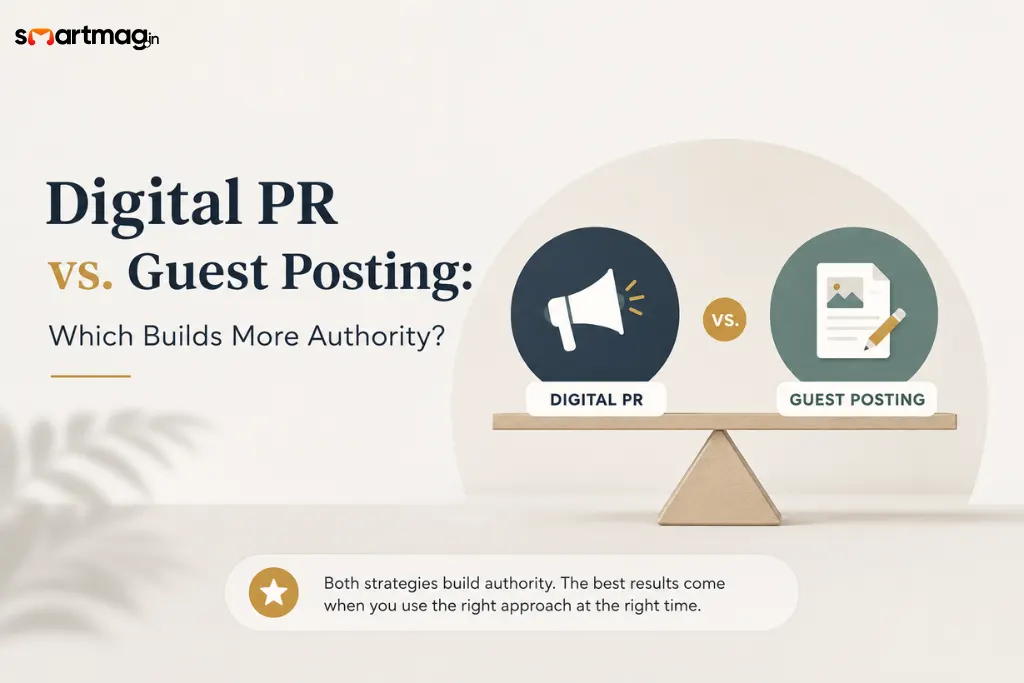
The debate around digital PR vs. guest posting is not about choosing a better method. But it is more about understanding what type of authority a business wants to build, how quickly it needs results, and what resources it can invest.
What is Digital PR?
Digital PR is an online public relations approach that is used for earning media coverage, brand mentions, and backlinks.
Rather than directly requesting space for an article, a business creates something newsworthy. This might include original research, expert commentary, industry reports, useful data, and a strong opinion on the current topics.
The idea is then presented to the journalists, publishers, bloggers, and industrial platforms. When they find it relevant, they may mention the brand, quote its experts, or link it to the website.
A successful campaign can also place the brand in front of a much larger section of the audience. Moreover, it can also create brand authority as an independent business that has chosen to feature the business.
But you need to remember that coverage is never guaranteed. The story should be relevant, timely, and valuable enough to earn attention.
What is Guest Posting?
Guest posting is a process that involves writing an article or a blog for another website that is generally within the same industry or a closely related field.
The article may include an author biography, a brand mention, or a link to a useful page on the writer’s website. In return, the publisher will receive original content, and the author will gain access to a new audience.
Compared to digital PR, this approach offers more control, as a business can easily choose relevant websites, suggest suitable topics, and decide on which expertise it wishes to highlight.
Guest articles are commonly used to
- Showcase subject knowledge
- Reach a relevant audience
- Build professional relationships
- Earn referral traffic
But at the same time, quality matters. Publishing generic blogs across unrelated or low-value websites will add only a little authority and can also make the activity look purely link-driven.
Digital PR vs. Guest Posting: The Main Difference
The clearest difference between digital PR and guest posting is how the actual placement is earned.
When it comes to guest posting, the business usually offers a complete article to the publisher. As a result, the content is planned specifically for that website, and the brand gets reasonable control over the topic and message.
However, with digital PR, the business provides a story, an insight, or a source. It’s on the journalist or the publisher to decide whether they want to cover it, how to present it, and whether to include a link or not.
This creates 2 broad types of authority.
Guest articles build authority by allowing the brand to share its knowledge directly. Digital PR builds authority by showing that independent media outlets consider the brand worth mentioning.
One is an authored credibility, while the other is an earned credibility.
Which One Produces Better Backlinks?
The answer lies in the quality of placement.
A guest blog on a respected and relevant industry website can provide a useful backlink, targeted referral traffic, and greater visibility among potential customers.
But make sure that the links are not treated as the only purpose of the article. A guest post should first provide useful information to the reader. If its purpose is to only place the keyword-rich links, its long-term value will become limited.
Digital PR can earn backlinks from news websites, trade publications, and specialist media platforms. These links might be harder to secure, but they have the potential to carry a stronger editorial value as the publication decided to reference the brand independently.
Here, the limitation is that the media mentions do not always include a backlink. For instance, a journalist may name the company without linking to its website.
Which Builds Greater Authority?
Digital PR has the advantage when the main goal is wider recognition and third-party credibility.
Being mentioned in a reputable publication can position a founder or a business as a reliable voice in the industry. Moreover, original research may also be used as references by many publishers, thereby helping one campaign gain attention across multiple platforms.
This can easily strengthen the brand authority beyond search performance. You can also share media coverage on the company websites, sales presentations, social channels, and investor materials.
Guest-posting creates authority in a more controlled and gradual manner. A series of useful blogs on a respected industry platform will not only demonstrate expertise but also help the readers become familiar with the brand.
It is mainly effective for specialist or business-to-business (B2B) companies whose customers regularly read niche articles.
Hence, digital PR may provide wider authority, while guest posting can build a deeper authority within a focused section of the audience.
Which Approach Offers More Control?
Compared to digital PR, guest posting offers more control.
The writer or the contributor can choose the topic, structure the discussion, and explain the subject in depth. Though the publisher may edit the article, the brand can still shape most of the message.
Digital PR, on the other hand, offers more control to the publication. A business can provide accurate information and a strong pitch, but it is the journalist who plays the masterstroke by deciding the angle, headline, and final coverage.
This lack of control can make digital PR more demanding. Businesses need strong ideas, authentic data, a responsive spokesperson, and realistic expectations.
Therefore, guest blogs are easier to plan as a part of a regular content calendar compared to digital PR, which is often more unpredictable, but a successful campaign can deliver a much larger impact.
The Risks of Poor Guest Posting
Guest posting is not harmful, but the actual problem starts when it becomes a large-scale backlink exercise and not a genuine publishing strategy.
Warning signs mainly include:
- Publishing on unrelated websites
- Reusing similar content across different platforms
- Filling content with unnatural anchor text
- Paying for links without proper disclosure
- Choosing websites only because they offer followed links
- Producing thin content with little reader value
Perhaps a strong guest-posting strategy should mainly focus on relevance, quality, and audience value.
In fact, one well-curated article on a respected publication can be more useful than numerous placements on weak websites.
Ethical link building can help readers discover relevant information rather than attempting to change the rankings.
Can Brands Use Both Approaches?
For the majority of businesses, the best answer to digital PR vs. guest posting is not about choosing one and rejecting the other.
Both methods can support different stages of authority building.
A brand can use guest blogs to explain complex topics, demonstrate knowledge, and establish a consistent presence on specialist websites. At the same time, digital PR can promote original research, respond to industry news, and earn wider media recognition.
For instance, a company might publish a detailed guest post explaining industrial problems. It could then survey the same issue and present the findings to the journalists through a digital PR campaign.
The guest blog offers depth. While the media coverage provides a wider reach and independent validation.
Together, they can create a balanced linking strategy.
How to Choose the Right Method?
The right approach will depend on the brand’s current goals.
You should choose digital PR when the business wants the following:
- Wider media coverage
- Third-party credibility
- Stronger public recognition
- Coverage around original research and news
Choose guest posting when businesses want the following:
- Greater control over its message
- Access to a specific industry audience
- Regular content on thought leadership
- Referral traffic from relevant websites
Businesses should also consider their resources. Digital PR requires extensive research, storytelling abilities, and media outreach. On the other hand, guest posting requires topic development, strong writing, and good relations with suitable publishers.
Wrapping Up
When judged based on wider recognition and independent credibility, digital PR generally helps in building greater authority.
A media mention clearly means that another publication considers the brand, its data, and its expertise valuable. One independent endorsement can easily influence how customers, journalists, and other businesses view the company.
But guest-posting remains valuable when it is selective and genuinely useful. It enables businesses to explain their ideas clearly and build trust within the relevant communities.
The strongest strategy will combine both. Digital PR will help in earning attention, while guest posting will demonstrate expertise. One creates the spotlight, and the other gives the brand something more meaningful to say that people are watching.