A degree can help you enter the job market, but it will not automatically make employers choose you.
This is the harsh truth students in 2026 must confront.
The in-demand skills employers value are changing faster than ever. The World Economic Forum predicts that by 2030, 39% of employees’ skill sets will need to be updated. This is already being reflected in recruitment practices.
According to a LinkedIn survey, nearly one out of five people feels that their lack of skill set is making things tougher for them in finding employment. More precisely, 74% of Indian recruiters have difficulty finding the required talent, whereas 38% of job seekers feel underprepared. Globally, 46% of recruiters consider skills data while recruiting.
For a student, the real question is not whether to learn new skills. The question is, which skills will make you indispensable in 2026?
The Biggest Skills Transformation Yet
The answer lies in understanding what employers actually want. Degrees alone are no longer enough. The top skills to learn in 2026 for students are the ones that make their capabilities visible and useful.
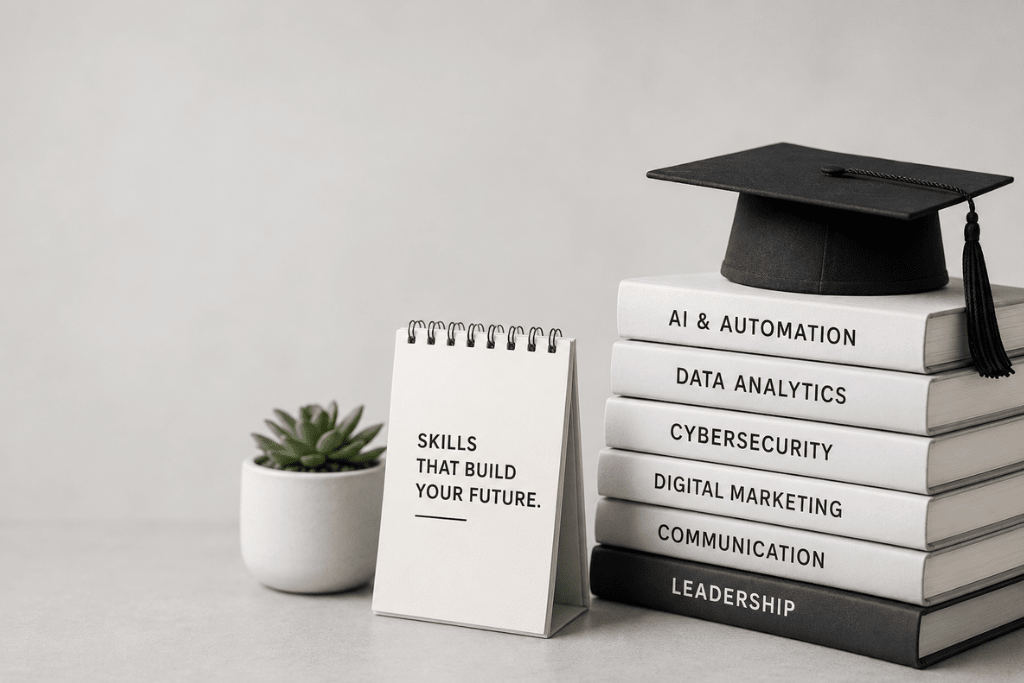
2026 is the year of skill stacking. Being proficient in more than one skill will always favour your chances to become more valuable. The top skills to learn in 2026 need complementary strengths across:
- AI and automation
- Data and analytics
- IT and cybersecurity
- Business growth
- Communication and leadership
- Risk management
- Sustainability and green skills
The most in-demand skills employers value now combine technical ability, commercial understanding, and human judgement.
Let’s delve into these skills next.
Technical In-Demand Skills That Will Define 2026
Technical in-demand skills are the foundation of future-ready careers. Mastering these skills can help you stay competitive and meet evolving employer expectations in 2026.
Generative AI and Prompt Engineering
As per a report, prompt engineering is one of India’s fastest-rising capabilities. Key components include:
- Prompt structure, context, constraints, and output formats
- AI agents and workflow automation
- Large language models and basic LLMOps
- Model testing, iteration, deployment, and responsible use
- Human review for accuracy, tone, bias, and risk
Among the top skills to learn in 2026, AI ranks first since it influences marketing, human resources, operations, product development, and customer service management.
What does this mean for you? You need to master turning fuzzy briefs into clear, repeatable instructions for AI systems. This creates higher-quality content, faster approvals, and less rework.
Action plan: Create an AI-assisted process for research and writing that includes obligatory proofreading by a human before publication.
Data Analysis and Analytics
Businesses rely on data for every major decision. Companies look for employees who are capable of interpreting numbers and implementing data-driven decision-making processes.
Technical components you need to have proficiency in:
- SQL, database schemas, normalisation, indexes, and query optimisation.
- Python with Pandas and NumPy.
- Data cleaning and preprocessing.
- Tableau, Power BI, Matplotlib, Seaborn, and Plotly.
Analytical components:
- Descriptive and inferential statistics.
- Correlation, regression, and time-series analysis.
- Hypothesis testing, A/B testing, and fundamentals of machine learning.
- Key performance indicators, forecasting, customer segmentation, and market trends.
- Data ethics, privacy, bias detection, NoSQL, and APIs.
These are practical skills for students because public datasets can become credible portfolio projects.
Apply it: Build a Power BI dashboard that identifies trends and recommends three business actions.
Cybersecurity and IT Security
One of the highest-paying in-demand skills in India is cybersecurity. As digital threats increase exponentially, it is crucial to protect digital infrastructure. Every organisation needs cybersecurity professionals to protect against data breaches, ransomware, and cyber attacks. Without it, companies will not be able to expand safely.
Its main components include:
- AWS, Azure, and Google Cloud security.
- Identity and access management.
- Firewalls, VPNs, DNS security, and network configuration.
- Intrusion detection, SIEM, and log analysis.
- Incident containment, recovery, and review.
- Vulnerability scanning, CVE assessment, patching, and penetration testing.
- Secure coding, OWASP, API security, DevSecOps, and automation.
- ISO 27001, NIST, SOC 2, HIPAA, PCI-DSS, audits, and risk assessment.
Why it matters: With 46% of recruiters globally relying on skills data to hire, having cybersecurity expertise will position you as a vital asset and not optional support.
Cloud Computing and Programming
Cloud computing supports digital systems, while programming helps you build them. It’s the foundation for modern infrastructure.
Cloud components:
- AWS EC2, S3, VPC, and Lambda
- Azure virtual machines, Active Directory, DevOps, and hybrid cloud
- GCP Kubernetes Engine, Cloud Run, and BigQuery
- Scalability, fault tolerance, disaster recovery, cost control, and security
- IaaS, PaaS, SaaS, containers, and microservices
- Git, Docker, Kubernetes, CI/CD, Terraform, and CloudFormation
Programming components:
- Python for automation, analytics, APIs, Django, and Flask
- JavaScript for React, Vue, Angular, and Node.js
- Java, C#, SQL, and TypeScript
- HTML, CSS, REST, GraphQL, authentication, deployment, and technical SEO
These skills for students become valuable when they lead to a working product.
Apply it: Build a web application, connect it to a database, and deploy it on a cloud platform.
Strategic Skills for Career Growth
Project Management
The top skills to learn in 2026 must help organisations deliver measurable results, not simply create plans. Project management is one of India’s highest-paying capabilities, with an average annual salary of about ₹8 lac to ₹20 lac. It coordinates cross-functional work and is essential for delivering results.
Key components:
- Scope, timelines, budgets, resources, and risk
- Task coordination, progress monitoring, and quality control
- Project closure, documentation, and lessons learned
- Waterfall, Agile, Scrum, Lean, and hybrid methods
- Asana, Monday.com, Jira, and Gantt charts
Digital Marketing with AI
A digital marketing manager earns around ₹5 lac to ₹10 lac annually in India. The role combines content, analytics, search, and automation.
Key components:
- AI-assisted content research and production
- SEO and Generative Engine Optimisation
- Keyword strategy, link building, and content distribution
- Analytics, conversion tracking, and ROI measurement
- Social media storytelling and community management
- Paid advertising, email automation, influencer marketing, and video
- CRM and customer-journey optimisation
Sustainability and Green Skills
Sustainability now affects operations, reporting, finance, and supply chains. Green capability is becoming mainstream. Demand has risen 11.6%, more than twice the 5.6% supply growth. One in eight workers has a green skill, and nearly one-quarter of job postings ask for green expertise. Based on level of experience, the average annual salary of a sustainability specialist ranges from around ₹15 lac to ₹19 lac.
Key components:
- Carbon accounting, footprint measurement, and reduction plans
- Carbon offsets and climate-risk assessment
- ESG reporting using the SASB and GRI frameworks
- Sustainable procurement and supplier assessment
- Renewable energy, efficiency, waste, and water management
- Environmental compliance, circular design, and product lifecycles
- Green finance, sustainability marketing, and corporate responsibility
These in-demand skills help organisations meet regulations, reduce waste, and make stronger long-term decisions.
Human In-Demand Skills AI Cannot Replace
While technical skills are foundational, they cannot fully replace human judgement, empathy, communication, or accountability. People skills matter more than ever as technology becomes a bigger part of everyday work.
Analytical Thinking and Problem-Solving
This is among the most sought-after core skills amongst employers. Analytical thinking helps you evaluate evidence, detect bias, and break complex problems into manageable parts.
Key components:
- Testing credibility and assumptions
- Identifying logical fallacies and root causes
- Comparing options and assessing risk
- Generating and testing solutions
- Planning resources, timelines, and implementation
- Monitoring results and adjusting the approach
Apply it: When a campaign fails, analyse the audience, message, channel, timing, and conversion data before proposing changes.
Resilience, Adaptability, and Lifelong Learning
In 2026, with rapid technological changes, adaptability is essential for survival. You need the capacity to adapt to change, recover from setbacks, and maintain performance when conditions shift. These skills for students matter because job requirements will keep changing.
Key components:
- Stress management and emotional resilience
- Flexibility with new tools and processes
- Learning agility and feedback acceptance
- Self-directed study, mentorship, and peer learning
- Reading, experimentation, and progress tracking
Apply it: Set one monthly learning goal, use it in a project, and record what improved.
Communication and Professional Presence
Communication remains one of the most important skills because recruiters must understand your value before they can trust it. Strong ideas achieve little when you cannot explain them clearly.
Communication components:
- Professional writing, email etiquette, reports, and presentations
- Public speaking, virtual meetings, and digital etiquette
- Cross-functional, client, executive, board, and crisis communication
- Clear articulation and active listening
Professional-presence components:
- Posture, eye contact, and body language
- Professional appearance and personal branding
- Networking and LinkedIn optimisation
- Stakeholder communication and strategic messaging
Self-Awareness, Motivation, and Empathy
Self-awareness reveals your emotions, strengths, limitations, and working patterns. Empathy helps you respond constructively to others.
Key components:
- Recognising emotions and triggers
- Identifying strengths and development gaps
- Using feedback and self-assessment
- Setting SMART goals and milestones
- Managing energy and tracking progress
- Listening without interrupting
- Paraphrasing, asking useful questions, and confirming understanding
- Reading tone, expressions, and body language
These capabilities improve teamwork, leadership, customer service, and conflict resolution.
Key Takeaways
The biggest gap between college and corporate work is exposure, not knowledge. The best in-demand skills for students are built through practice, industry contact, and visible proof.
- Combine complementary capabilities. Pair AI with business judgement, data with communication, or cybersecurity with risk management.
- Build complete systems. Create a working dashboard, a deployed application, an automated report, or a repeatable marketing workflow instead of collecting certificates.
- Get industry exposure. Pursue internships, freelance assignments, volunteer work, open-source contributions, and conversations with professionals.
- Create proof of work. Publish case studies, dashboards, campaign reports, security labs, applications, or project plans.
- Make a learning routine. Define monthly objectives, seek comments, evaluate your progress, and then use all the knowledge gained before moving on to another course.
- Make use of YouTube, open-source documents, government programmes, Coursera, or eligible LinkedIn Learning access. You can also consider paid options like Udemy, PMP, AWS, Google certifications, and industry training.
The Bottom Line
The most in-demand skills for students by the year 2026 reflect an impressive combination of technological know-how and human innovation. Success depends not just on what you learn but also on how confidently you apply and adapt it.
The top skills to learn in 2026 include a connected skill stack, which is built around pillars like AI proficiency, business acumen, and human judgement. The future belongs to professionals who are able to combine these skills. Students who will be mastering them will be sure to thrive in the evolving job market.
Take the lead right now! The skills gap exists, but it is also your opportunity. While 38% of job seekers feel unprepared, you can put yourself ahead of the game and become the 74% of talent that recruiters actively seek.
Because your career beyond 2026 depends on the skills you build today. Make it count.