I used to laugh when people said your phone knows everything and it listens to you. Until the coincidences became impossible to ignore.
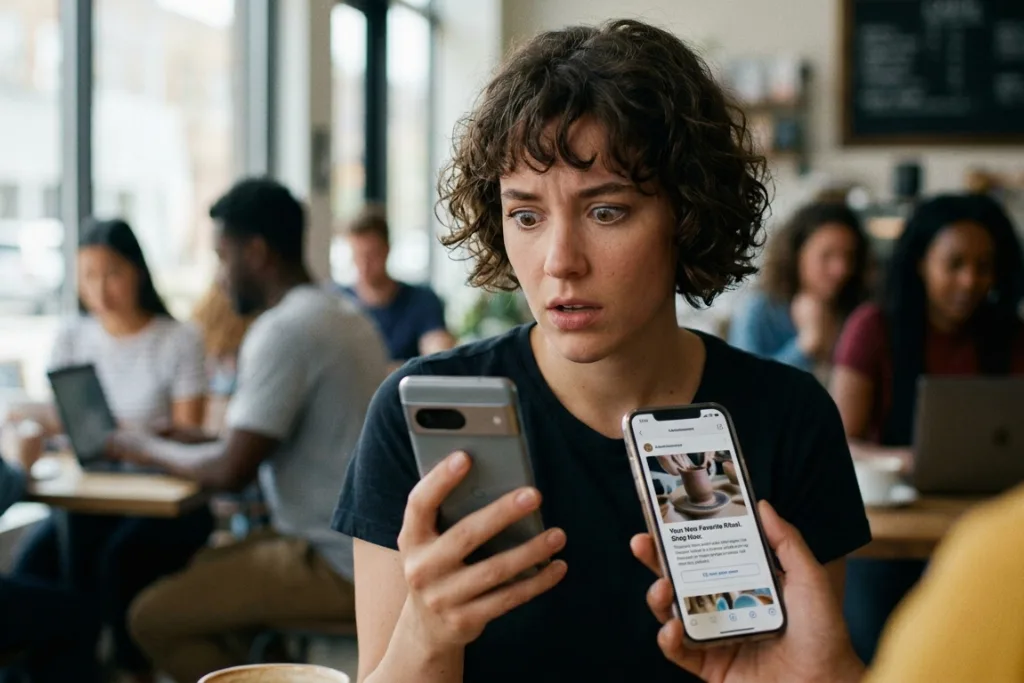
You’re having a conversation with your friend about something completely out of left field. It could be something as mundane as sneakers, or a spontaneous travel itinerary, or even a specific brand of protein powder you’ve never Googled.
You pick up your phone.
Boom.
Ads, videos, suggestions, all about what you were just talking about.
It’s weird at first, sure. Then it keeps happening, though, and you start to feel like your phone knows everything. Which, to be fair, is kind of where things get weird.
When Coincidence Turns Into a Pattern
It starts with an event, something that can be dismissed as unimportant. It can be ignored, but eventually, the event repeats itself enough to become a pattern. It becomes clear that it is not just one platform, but several apps that are displaying this pattern. It becomes apparent that social media, search engines, video sites, and shopping apps are all showing this pattern, all aligned in a way that is just too specific to be a coincidence.
This is where the transition occurs. It is no longer dismissed, but recognized for what it is.
A system that is constantly watching, learning, and adapting.
The issue is not with the advertisements themselves, but with the timing and specificity of them. It is not just that the advertisements are relevant, but they are relevant at the exact time they feel most personal. It is as though they knew what you would be doing next before you did.
And this leads to a deeper issue.
Not “Why am I seeing this?”
But “How did it know in the first place?”
What Is Actually Happening Behind the Screen
In order to comprehend the phenomenon of why it seems that your phone knows everything, all about your activities and interests, it is important to shift the paradigm beyond the surveillance phenomenon and enter the domain of data interpretation.
The phone does not function in isolation. It is part of a digital ecosystem that is driven by the power of smart algorithms and Predictive Analytics.
The phone does not depend on one source of data. Rather, it functions on multiple layers of data that are generated over time.
This includes your browsing habits, your search behavior, the time spent on specific content, your likes and shares, your location data, your movements, your purchasing behavior, and your interactions with similar users.
When all these data sources are aggregated and analyzed, they generate a highly precise behavioral pattern.
But this is not all. The data generated is predictive in nature.
The data uses the power of probabilities and pattern recognition to predict what you are most likely to be interested in the coming moments.
When we say that your phone knows everything, all about your interests and activities, it is because your conversation is merely aligning with the prediction that was already made.
Why It Feels More Personal Than It Actually Is
What makes this experience feel unsettling is how personal it is.
However, the reality is that these systems are not always geared towards you as an individual.
Rather, you are categorized with other users who exhibit similar behavioral patterns to yours.
When other people in your category start interacting with certain pieces of content, those pieces of content will also appear in your feed.
This is not individual-level understanding. This is large-scale pattern grouping.
However, the illusion of personalization is strong.
Because the accuracy is strong.
Why Your Brain Notices the “Hits” More Than the Misses
People cannot recall all those irrelevant ads and recommendations they are scrolling through week by week. They can remember the occasions when ads were particularly on point, following a conversation that just occurred, or recommending a product exactly when it was needed. People tend to remember the occasions that were especially accurate and relevant.
Humans’ nature leads them to perceive emotions as a signal of relevance and importance. This explains why predictive algorithms seem to be incredibly efficient and omnipresent even though they aren’t always correct.
What makes the algorithm work is not its accuracy but the pattern recognition people can develop because of it. The algorithm does not have to be always correct to make users believe it has become a reliable prediction source. The moment the user starts seeing a pattern, each additional recommendation serves as evidence for the idea that the phone can predict what its owner needs.
In a similar way, people start noticing repeated behavioral patterns online without understanding the extent of their influence on the process. This approach is used by most modern social media platforms to sustain user attention and engagement for longer periods of time
After I Did Some Research
However, there was a point in time when it really mattered to me. So, I decided to look into it.
In my quest for answers, I went on google and there was a research on it by Science x discussing about Your smartphone knows everything about you,
The fact of the matter is, your phone is not listening to your conversations. It is constantly making predictions based on existing data signals.
This is an important point.
The fact of the matter is, we are moving from being “watched” to being “analyzed.”
The Role of Predictive Systems in Daily Digital Life
Predictive systems have become an integral part of almost all digital platforms. They affect what you see in your feed, what advertisements you see, what products they recommend to you, what videos you see next, and even what order you see that information in.
But none of that is random. It is all optimized for engagement.
When a system is able to predict your interests, you obviously spend more time on that system. And the more time you spend on that system, the more data that system collects.
And that is when it feels like your phone knows everything. And before you even know it, you lose your ability to think independently.
So, from a technical point of view, that is not mind-reading. But from a user point of view, that is pretty close.
The thing that is not being collected is not your data. It is your influence.
When predictive systems get good at predicting your interests, they also get good at influencing your behavior. But at the same time, they also make your digital life smoother. They make it easier for you.
So, in conclusion, the state of affairs is not at either extreme.
It is not entirely harmful. And it is not entirely harmless.
It exists somewhere in between.
How Predictive Algorithms Slowly Shape Your Decisions
The bigger shift is that predictive systems understand behavior.” The bigger change is that behavior begins to slowly adapt to the system itself.
The suggestions at first seem helpful. They save you time. They make it easier. They make decisions less hard. But over time, the steady stream of recommendations begins to shape what people consume, what they buy, what they believe and even what they notice.The modern digital experience is not about discovery anymore. Its basis is increasingly prediction. Platforms attempt to reduce uncertainty by continually narrowing content down to what users are most likely to engage with.
It’s handy, but it can also slowly diminish the need for independent exploration. People start to react rather than to actively seek. Instead of deciding, they start choosing from pre-optimized options that are given to them.
That’s one reason digital exhaustion feels so different now. People are always interacting with systems that predict attention before attention is consciously paid. The result isn’t always obvious burnout, but often a subtle sense of mental fatigue and overstimulation.
Control Still Exists
While we are not completely powerless in the face of such advanced systems, the way in which we interact with them directly influences what they learn.
While your phone may feel like it knows you inside and out, it is still learning from the information you give it, both directly and indirectly. The truth is, your habits are what are shaping the algorithm, though it feels like the reverse is true.
How to Reduce the Effect Without Disconnecting
You don’t necessarily have to disconnect from digital platforms completely. You can, however, reduce the predictability of your actions to some of these platforms.
For instance, you can review your app permissions, remove any unnecessary access to background data, clean your browsing history, and avoid repetitive engagement with particular content.
Making deliberate use of digital platforms, instead of using them reactively, can also make a significant difference.
This may not completely stop the tracking of your data, but it can break your pattern, which reduces the accuracy of prediction.
The Difference Between Convenience and Control
Most people do not voluntarily choose to trade privacy for surveillance. They trade it for convenience.”
Faster recommendations, personalized feeds, smarter searches, automatic suggestions, endless convenience are gradually woven into the fabric of everyday life. Over time, people stop caring how much of their digital behavior is being manipulated. Everything just feels so nice and smooth and frictionless.
That is why predictive systems cannot be completely dismissed. They really make digital platforms a lot more user friendly. They make life easier. They make buying easier. They make things more efficient in many ways.
But when convenience is 24/7, it can subtly rewire behavior.
The better platforms understand what grabs attention, the better they can keep users engaged for longer periods of time. This creates a virtuous cycle where prediction improves engagement, and engagement improves prediction.
And before long, a lot of people start confusing personalized experiences with personal control.
And that’s also why modern technology seems more silent and invisible than people expected. The greatest technological shifts are no longer loud or obvious. They operate quietly in the background, influencing habits without requiring direct attention.
The Strange Part Is How Quickly We Adapt to It
It is at some point that people stop finding it surprising.
This might be the most strange thing about it all.
During the first few instances of seeing something unexpectedly accurate pop up on a screen, the feeling was almost intrusive. People talked about their phones listening to them, jokingly. They mentioned it casually to their friends. They found modern technology to be increasingly odd.
As time passed, however, the response began to change.
The suggestions continued and the predictions became expected. Little by little, people began subconsciously adapting their behavior to the system without even noticing.
Some people find themselves hesitant to search for something private. Other people would refrain from saying anything in front of their gadgets, even when they knew it might be an absurd notion that their phones were really listening to them.
It is precisely this behavioral change that enables the predictive system to work.
Not by exerting any direct control on people.
Rather, people adapt to the environment that such a system creates.
And as people become accustomed to doing so, they start experiencing their online journey as a space rather than a utility.
This is also why disengaging from the digital platform can feel quite awkward nowadays. Silence feels alien. Discovery at a slow pace feels irritating. Recommendations, which seem to be missing constantly, feel incomplete.
The technology did not advance alone.
Behavior did too.
Final Thought
Perhaps you might believe your device has knowledge of everything around it.
However, on a closer inspection, it will be discovered that the phone has the ability to recognize patterns.
The clearer the pattern, the better its predictions get.
This, in essence, explains why many of today’s systems are personalized without having to understand users as individuals.
Human behavior becomes predictable after some time due to consistent habits.
While such systems remain focused on acquiring more knowledge on a constant basis, many users are unaware of how routine they have become with respect to how they interact with technology.
Patterns tend to evolve into something else eventually.
Once humans learn to recognize how these systems function, their perceptions about the relationship they maintain change dramatically.
Recommendations are perceived differently, algorithms take another form, and online habits become intentional rather than automatic.
Perhaps that is the actual transformation that takes place.
Instead of disconnecting people from technology, they start recognizing the extent to which it shapes them.
After all, technology observes the user.
The user also plays a role in the observation process.