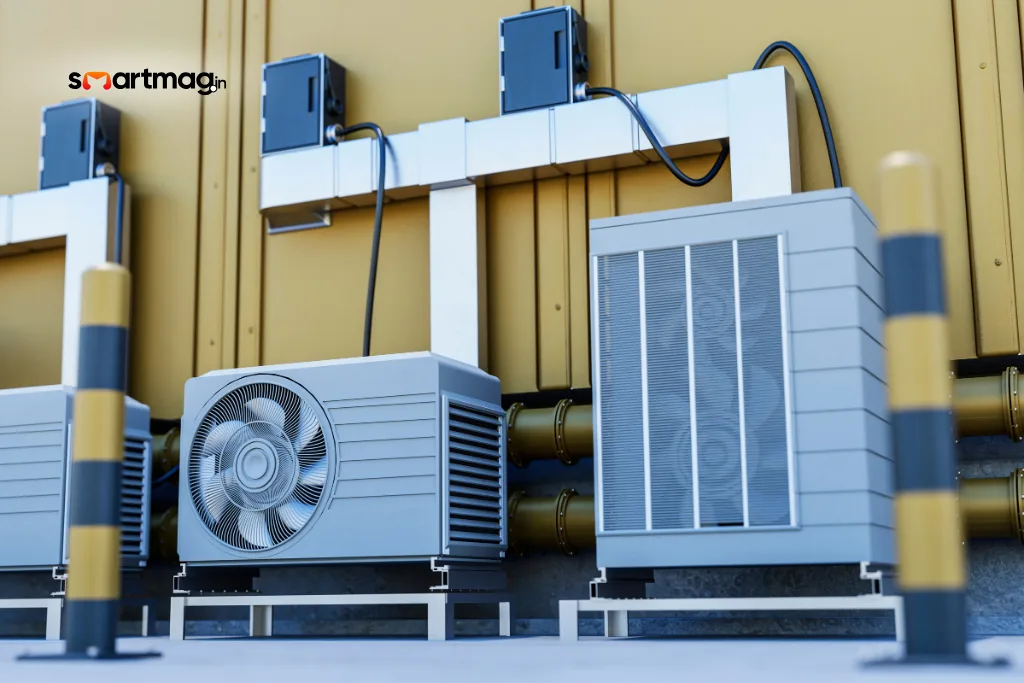
A few years back, in most commercial installations, heating in India used to relate to boilers, electricity-based heaters, or fuels, which tended to be cost-prohibitive and maintenance-intensive. This trend is gradually being turned around. Today, in most hotels, hospitals, factories, educational institutions, and residential societies, commercial heat pumps have become the preferred choice.
This evolution is not based on the trend. Rather, it is influenced by growing costs, increased demands for efficiency, and a call for applications that will not increase long-term costs of operation, no matter how large they are. As this is seen in the commercial sectors of India, heat pumps go from being considered “alternative” to “mainstream.”
How do Commercial Heat Pumps Operate?
In a commercial heat pump, the heat is transported from one environment to another rather than being produced. In a conventional system, the fuel is burnt, or the electricity directly passes through the resistor to produce heat, but in a heat pump, the heat present in the air or even the earth is utilised.
A commercial air source heat pump is one of the variants that has been widely adopted by the modern world. The device draws heat energy from the ambient air and upgrades it to a usable temperature for applications like space heating, hot water generation, and process heating.
What makes these systems appealing is not just the technology, but the way they fit into real operating environments.
Why Commercial Heat Pumps Work in India
The climate conditions in India are also a defining factor in the increasing use of heat pumps.
Climate Advantage
The major parts of India have moderate to warmer climates all round the year. This enables air-source conditioning systems to operate perfectly well, as they would not be subjected to extreme conditions as in colder nations.
Energy Cost Pressure
Business electricity prices are escalating every year, while fuel heating systems are prone to fluctuating operating costs. Heat pumps lower energy demand by exploiting free heating from the atmosphere.
Infrastructure Compatibility
Today, commercial buildings are designed sustainably. Heat pumps can be combined effectively with traditional HVAC systems, solar thermal systems, as well as energy management systems.
Applications Fueling Adoption
Commercial heat pumps are not restricted to one sector. Application domains for commercial heat pumps are expanding.
Hospitality and Healthcare
Hotels and hospitals require a significant amount of hot water. Heat pumps can supply this water while being energy-efficient, especially when compared to diesel or gas-fired boilers.
Manufacturing and Processing Units
Industrial heat pumps are employed in industrial applications for low to medium-temperature process heating. Food processing, pharmaceutical, and textile plant applications require a strict temperature control system and have a small carbon footprint.
Commercial Complexes and Campuses
Schools, corporate parks, and residential townships are embracing the need for centralised heating solutions. Large-scale industrial heat pumps are used to satisfy these requirements without adding complexity to the infrastructure.
Industrial Heat Pumps and Large-Scale Systems
Commercial systems are designed to serve buildings and service sectors, whereas Large scale industrial heat pumps address process demands.
These systems are intended to:
- Handle continuous operation
- Provide increased thermal output
- Integrate the system with ongoing industrial processes
- Cut dependence on fossil fuels
The rise of industrial heat pump manufacturers in the Indian market depicts the demand for the technology. With improved technology, it can now be easily manufactured in the country.
Efficiencies Beyond Numbers
The efficiencies of heat pumps are more often discussed in terms of performance ratios, but real-world value extends beyond technical metrics.
Commercial users seek systems that:
- Perform reliably when demand peaks.
- Require least human intervention
- Maintain steady output over a wide range of loads
This is where the best commercial heat pumps make the difference. They are designed not only for laboratory efficiency but for Indian operating conditions, power fluctuations, and usage patterns.
Cost Considerations and Market Reality
One of the bigger fears about adoption is the cost. Commercial heat pumps’ prices in India vary with capacity, application, and system design. Though the initial investment seems to be higher compared to conventional heaters, the operating savings change the equation.
Eventually, reduced consumption of electricity, lower fuel dependency, and fewer mechanical failures make up for the upfront costs. As energy prices escalate, payback periods shorten for many commercial users.
Role of Manufacturers and System Designs
The increased presence of commercial heat pump suppliers in the Indian market has led to more systems being available for customisation and support services. Additionally, local manufacturing provides improved component and know-how availability.
Nevertheless, the performance of a system relies to some degree on its design as well as the technology used. This explains the importance of cooperation between designers, installation specialists, and users.
Heat Pumps and Sustainable Living
The commercial sector in India faces growing pressure to cut greenhouse gas emissions and enhance energy efficiency. Heat pumps can easily match these requirements.
Heat pumps’ benefits in:
- Producing less greenhouse gases than fuel-based systems
- Pairing well with alternative energy sources
- Promoting green building certifications
In long-term sustainability, heat pumps represent more than equipment for businesses. They represent infrastructure decisions.
Bottom Line
The growth of commercial heat pumps in India is a manifestation of the change in energy consumption patterns and management. This is because, with increased knowledge and advancements in technology, growth will speed up.
Due to advancements in local production capabilities and a deeper system knowledge and favourable operating conditions, heat pumps will find a common position in Indian commercial and industrial heating.
The discussion is no longer about the efficacy of heat pumps in India, but about the effectiveness of designing, implementing, and maintaining these installations based on the conditions they operate in.