The skincare industry in India is expanding at an unparalleled rate. It reached USD 9.06 billion in 2025 and is expected to grow up to USD 18.38 billion by 2034, at a CAGR of 7.49% from 2026 to 2034.
Each month, fresh faces emerge in the form of new brands, products, and categories. However, along with this expansion, there exists a query that doesn’t receive enough attention.
How do we actually know these products are safe to use? If you have ever wondered what happens inside a manufacturing facility before a skincare product reaches your hands, you are not alone.
All the cosmetic manufacturers in Punjab or any other region in India always carry out rigorous testing of all their formulations at different levels that include the safety of use on the skin, as well as the stability of microorganisms and the compatibility of the product with the formula used.
Read on to know how testing goes on before the products hit the market.
Why Testing Skincare Products Before Launch Matters
Any skin-care product without the necessary tests done on it is an accident waiting to happen any time soon. This includes adverse reactions, contamination issues, deterioration of the formula, and even misinformation about its effectiveness.
Here is why every serious private label skincare manufacturer treats testing as non-negotiable:
- Compliance with regulations: According to CDSCO guidelines, all cosmetic products must have a test report before becoming available in India
- Market access through retail and distribution channels: The majority of distributors and retailers request documentation of testing before stocking up on products
- Safety issues with untested cosmetics: Skin irritations and potential hazards from contaminants make testing imperative
- Brand protection: A single product failure or recall can permanently damage a brand and the cosmetic manufacturers associated with it
The testing process is never-ending; it begins right from the start, when formulas are drafted, until the final batch is approved.
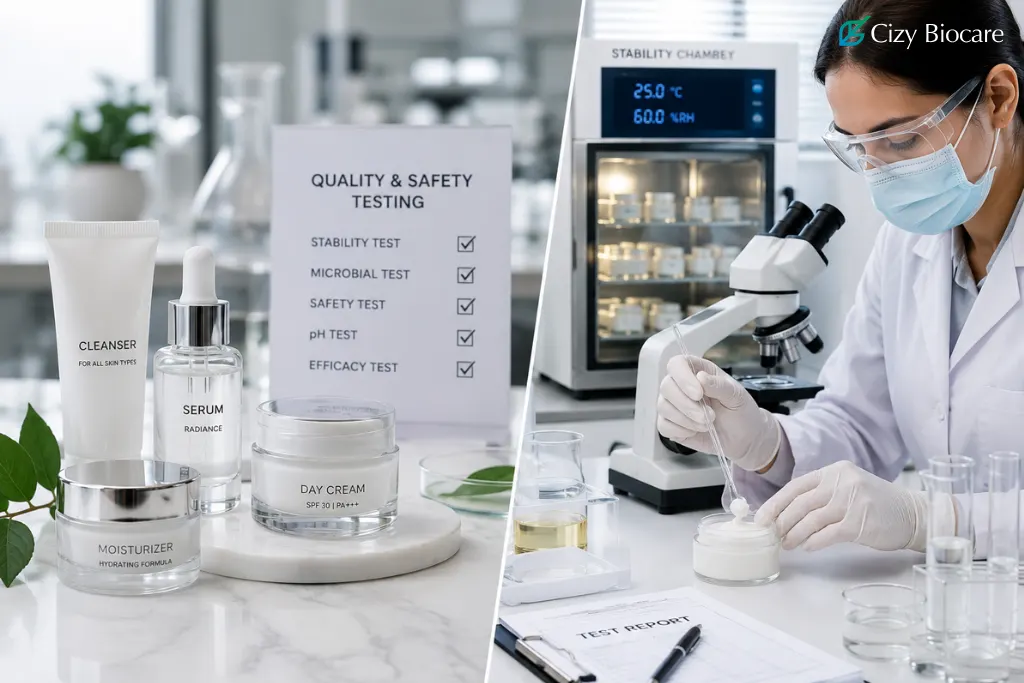
Types of Tests Skincare Products Go Through
Testing is not one process. It is a series of evaluations that each check something specific. Here is how manufacturers run each one.
Safety and Dermatological Testing
The safety test is where the whole process starts. It is crucial that the manufacturer verifies that the product formula will be safe on the intended skin type.
These safety checks are done by:
- Human patch tests on volunteers to assess irritations, redness, and allergies
- Tests in a laboratory environment to study how the formula works on skin cells
- An evaluation by a dermatologist and an approval letter
A private label skincare manufacturer must have this safety assessment on file before production begins. Without it, the product cannot legally enter most regulated markets.
Stability Testing
The stability test helps answer an important question. Can this product remain safe and effective six months later?
Manufacturers conduct stability tests on their products through various types of stresses:
- Subjecting them to elevated temperature and humidity to age them quickly
- Monitoring real-time reactions during normal storage conditions throughout their shelf life
- Testing how well they withstand freeze-thaw cycles by changing their temperatures
- Evaluating their light sensitivity by exposing them to light
This data confirms shelf life, finalizes preservative levels, and ensures packaging compatibility with the formula inside.
Microbial and Preservative Testing
Any water-containing cosmetic is a medium where microbes can grow. The development of bacteria, yeasts, or molds in any formula occurs when the preservative system does not work effectively.
The Preservative Efficacy Test is used by cosmetics makers to assess this problem. It includes placing certain amounts of specified microbes into a test product.
The results indicate whether the preservation system is adequate, requires modification, or simply does not work at all. If a product passes this test, then it will be considered for manufacturing.
Efficacy Testing
A skincare product claiming to hydrate, brighten, or reduce signs of aging needs evidence behind that claim. Every private label skincare manufacturer handling claim-heavy formulations runs efficacy testing to verify the product does what its label says.
- Hydration claims are tested using corneometer readings measuring moisture levels before and after application
- Brightening claims are evaluated through skin tone analysis tools, measuring changes in radiance
- Anti-ageing claims require clinical assessments measuring changes in fine lines and elasticity over several weeks
Without documented efficacy data, claims on packaging are not just misleading. They are a regulatory violation.
Packaging Compatibility Testing
The choice of packaging and formula is directly related. The formula that is safe in one package could be totally different when placed in another.
The cosmetic companies conduct tests for product-package compatibility to make sure there is no reaction between the two. It is because:
- Certain ingredients can react with plastic packaging and leach chemicals into the product
- Actives like Vitamin C or retinol can degrade faster in packaging that is not airtight or UV-protected
- Pump mechanisms and tube seals are tested for leakage and dispensing consistency
A private label skincare manufacturer tests the package material to ensure that the product remains stable for its full shelf life before packaging can be finalized.
In-House Testing vs. Third-Party Testing
Cosmetic manufacturers use two routes for product testing, and many serious facilities use both.
| In-House Testing | Third-Party Testing | |
|---|---|---|
| Where | Inside the facility’s own lab | Independent certified laboratory |
| Speed | Faster turnaround | Takes longer but carries external credibility |
| Best for | Routine checks and batch approvals | Regulatory submissions and export markets |
| Credibility | Internal documentation | Independently verified report |
Most private label skincare manufacturers run in-house testing throughout production for speed and consistency and use third-party labs when regulatory submissions or export market entry requires independently verified results.
What Happens After Testing Is Complete
After the successful completion of all phases of testing, the next step for the manufacturer is to move forward with the process of approval:
- Approval by the quality control department on the basis of all the test results and approval of the formula
- Production of the pilot batch and its verification according to the specified standard
- Final packaging assessment, including checking labels and dispensing
- All relevant documents for formulations, test results, and batches should be compiled.
It is no less significant to every serious cosmetic manufacturer than the process of testing itself. The documentation prepared at this stage will secure both the company and the brand in case an inspection or inquiry occurs following the release.
Final Thoughts
Each and every skincare product found in stores has undergone a long process of testing before becoming available for sale.
The reason why cosmetic companies perform such tests lies in the fact that an untested product carries significant risks, which no manufacturer would be prepared to accept.
These characteristics represent the backbone of any reputable skincare product.