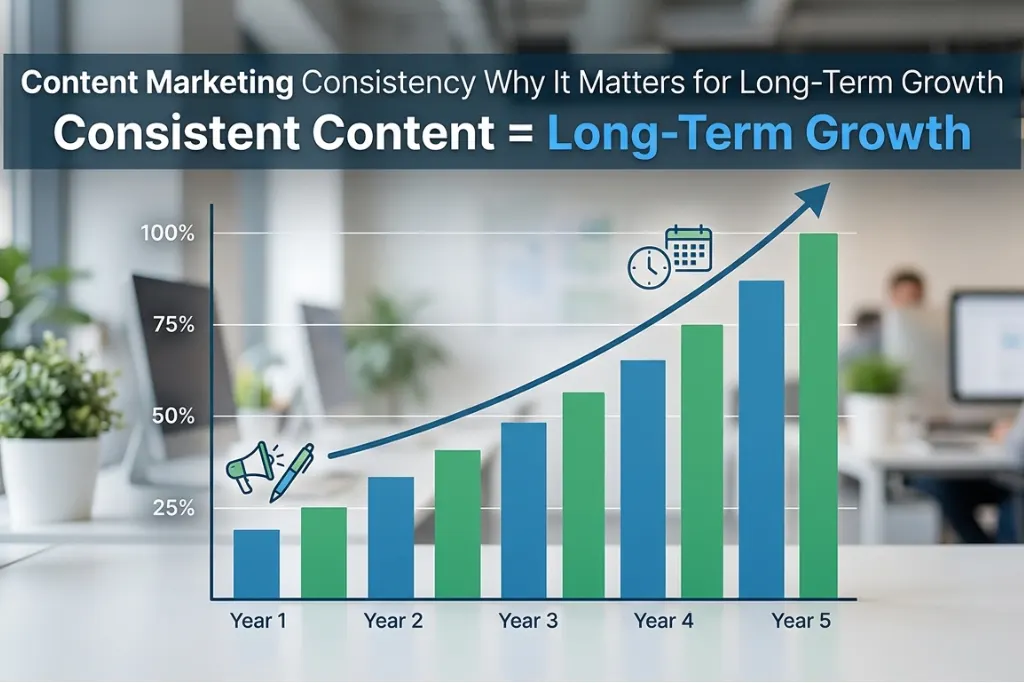
Companies often abandon content marketing efforts prematurely.
They write some blog posts and promote them on social media, expecting immediate traffic or leads. Once there are no results fast enough, they cease publishing content and conclude that content marketing is ineffective for their business.
The actual issue, however, is not content marketing but inconsistency.
Content marketing operates by earning trust, establishing topical expertise, and maintaining visibility. Companies that produce valuable and interrelated content on a consistent basis have a higher probability of achieving sustainable organic growth than companies that produce content sporadically and disappear shortly thereafter.
That is why consistency is so critical in content marketing.
Content Marketing Takes Time to Build Results
Content marketing has many myths associated with it, but one such myth is the assumption that content marketing yields immediate results.
Contrary to the paid model, content marketing requires some time before any substantial growth can be seen. Search engine algorithms require sufficient time to digest the content and make sense of it. The same is the case with new sites, which also require some time to build their credibility.
Sometimes even well-written articles require several weeks and months to attract any impressions or ranks. That is the reason consistent publishers usually outperform those who publish frequently and then stop entirely.
Consistency Builds Audience Trust Over Time
Trust is developed through frequent exposure.
As people are exposed frequently to relevant content coming from the same site, they start seeing the brand as a credible provider of information.
Inactive sites usually have difficulty earning trust among their readers because the latter no longer expect anything valuable from them.
Brand recognition is further enhanced by consistency. Although people may not become subscribers right away, they will likely be more responsive if they are exposed frequently to valuable content.
Search Engines Prefer Consistent Publishing
Search engines tend to favour websites that keep on producing relevant and valuable information consistently.
This is because consistent publishing will help search engines:
- find new web pages faster
- know the main subjects of the website
- determine active websites
- learn how to crawl websites better
But consistency must never come at the expense of quality.
In addition, Google’s best practices for helpful content recommend producing user-oriented content rather than search engine-oriented content.
Consistency Helps Build Topical Authority
Topical authority can be strengthened by continuously publishing articles that relate to each other under relevant topics.
A good illustration would be an organization specializing in SEO and content marketing. The organization will need to publish more articles on subjects such as:
- Keyword Research
- Search Intent
- Internal Linking
- Blogging Strategy
- Content Optimization
- Audience Engagement
Over time, these connected articles create a stronger content ecosystem that helps search engines better understand the expertise of the website.
Random Publishing Often Weakens Growth
Many businesses publish content without a clear strategy.
One week they write about marketing trends, the next week about unrelated topics, and later switch to completely different subjects again.
This makes it harder for search engines to understand what the website actually specialises in.
A focused publishing strategy usually performs much better because connected content strengthens topical relevance and improves internal linking opportunities.
Consistency Strengthens Internal Linking
Constant publication also enhances internal linking chances.
When companies generate content consistently, they can easily link articles using internal links.
Effective internal linking:
- accelerates search engine indexing
- distributes authority between pages
- enhances user experience
- solidifies topic relevance
This builds a better site architecture over time.
Consistency Is Not About Publishing Daily Posts
It is common among many firms to equate consistency with producing lots of information all the time.
This approach is not always ideal.
A sensible approach tends to be much better than being aggressive for a brief time, only to burn yourself out afterward.
There is no single approach that works best, but depending on your company, you may have one or several weekly posts.
What really matters is consistency with good quality content.
Updating Older Content Is Also Important
Consistency is not about writing new posts alone.
The other equally significant thing about consistency is revisiting and improving existing posts.
Content updates may help in improving the following:
- content quality
- interlinking
- readability
- freshness
- visibility in search engines
Often, revisiting existing posts is more effective than consistently posting low-quality new posts.
AI Content Alone Cannot Replace Strategic Consistency
Many firms are now increasingly depending on AI-generated content to publish more efficiently.
But publishing a large volume of bad AI-generated content without any thought or management usually leads to negative outcomes.
Content needs:
- meaningful information
- proper organization
- relevance
- creativity
- human comprehension
Businesses That Stay Consistent Usually Gain Long-Term Advantages
Organizations that are consistent with their content marketing efforts can create many benefits that compound over time.
As there is an increase in connectivity through indexing of content, websites tend to develop:
- stronger authority
- better internal linking structures
- higher search visibility
- improved audience trust
- broader keyword coverage
It may seem like the process takes a while, but consistency tends to create significant momentum.
Final Thoughts
Consistency is probably the single biggest pillar of content marketing success.
Organizations that are consistent in their creation and distribution of valuable, relevant, and interlinked content will have significantly greater chances of establishing authority and creating sustainable organic growth.
Rather than seeking quick results, organizations need to develop a sustainable content marketing strategy based on consistent growth and quality content creation.